Alaska lawmakers told FMAP drop will shift millions of Medicaid costs to the state
Loading...
Summary
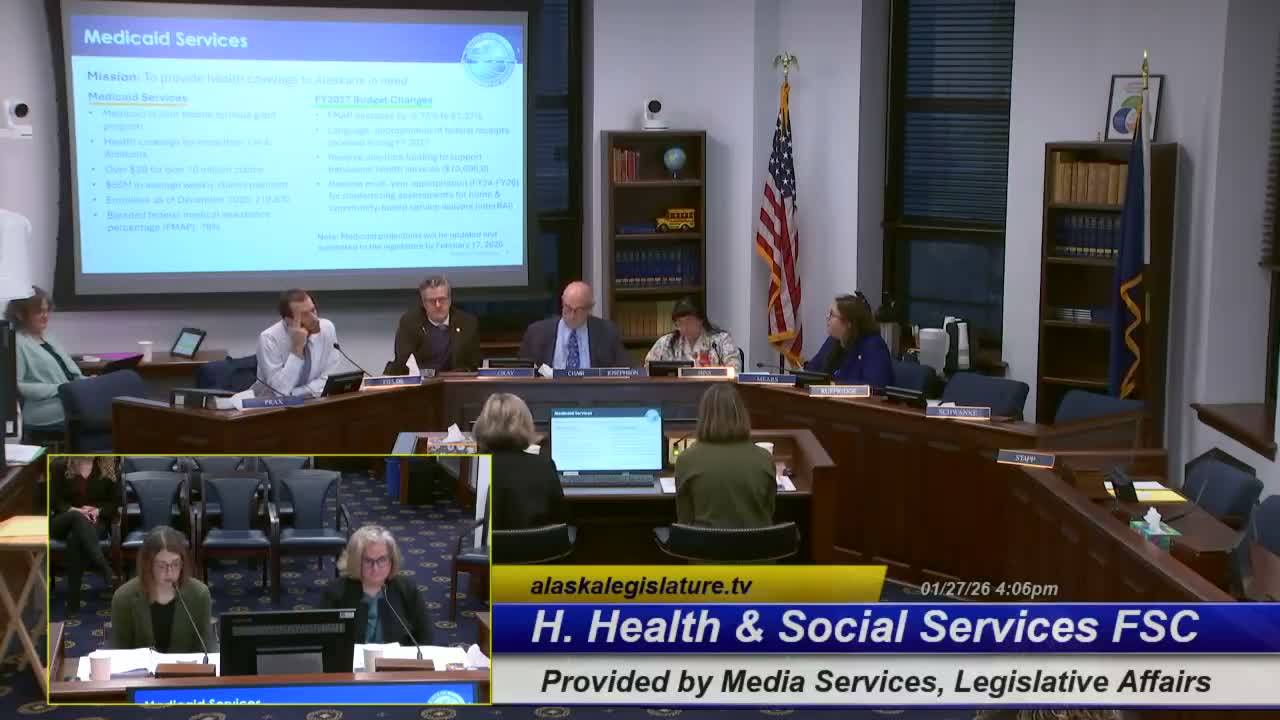
Deputy Commissioner Emily Ricci told the House Finance subcommittee that Alaska’s FY27 budget incorporates a drop in the regular FMAP to about 51.37%, a change Ricci said represents roughly a $13.6 million reduction in federal funds that shifts costs to the state; Medicaid covers about 210,000 Alaskans.
Deputy Commissioner Emily Ricci told the House Finance Committee’s health subcommittee on Jan. 27 that the Medicaid program will see a smaller federal match next federal fiscal year, a change that has been folded into the Department of Health’s FY27 projections.
Ricci, speaking during the department’s budget overview, said Alaska’s regular federal medical assistance percentage (FMAP) for FY27 is about 51.37 percent. “That will take effect at the beginning of federal fiscal year ’27,” Ricci said, and the department estimates the change represents “about a $13,600,000 reduction in federal funding that ends up shifting to the state.”
Why it matters: Medicaid is the largest component of the Department of Health’s budget. Ricci told the committee Medicaid covered roughly 210,000 Alaskans as of December 2025—about one in four—and the division processed about 10 million claims in FY25 with an average weekly payout near $59 million. A lower FMAP increases the state’s share of certain Medicaid costs, creating pressure on the state general fund or on program reductions if offsetting revenue or efficiencies are not found.
Ricci and members of the committee clarified that FMAP is not a single uniform rate for all Medicaid spending. Ricci said the 51.37 percent figure is the department’s regular or base FMAP and that a number of match rates exist depending on the category of coverage or type of activity; some services or populations remain eligible for much higher federal match rates (including tribal reclaiming and certain expansion categories). “There’s a table with about 10 to 12 other kind of federal match rates that the state can draw down,” she said, and noted some activities (for example tribal health services or provider enrollment system work) can qualify for higher federal matches.
Committee members pressed for clarity on the arithmetic and the practical effect on state budgets. Representative Gray asked whether the headline FMAP decline explained why the blended federal share appeared to fall from about 76 percent of total Medicaid costs in FY25 to a much lower base rate; Ricci responded that the 76 percent figure reflected a blend of many match categories and the base FMAP is only one “slice of the pie.”
Department outlook and next steps: Ricci said the FY27 governor’s proposed budget already incorporates the FMAP change and the department will return with more detail when the governor’s amended budget is released (the department will update the committee after Feb. 17). Lawmakers also asked the department to continue identifying opportunities to shift eligible contract costs to federal match or to pursue tribal reclaiming, which Ricci described as an important strategy for maximizing federal dollars.
Provenance: topicintro — excerpt: “As of December 2025, medic Alaska's Medicaid program covered, 210,000 Alaskans…” (SEG 700). topicfinish — excerpt: “that will take effect at the beginning of federal fiscal year '27…and that ends up representing about a, $13,600,000 reduction in federal funding that ends up shifting to the state” (SEG 775–781).
What’s next: The department will refine FY26 supplemental estimates and FY27 projections as more claim-run data and the governor’s amended budget become available. The subcommittee scheduled further budget hearings and follow‑up requests.
Speakers quoted: Emily Ricci, deputy commissioner, Department of Health; Chair Josephson (House Finance subcommittee).