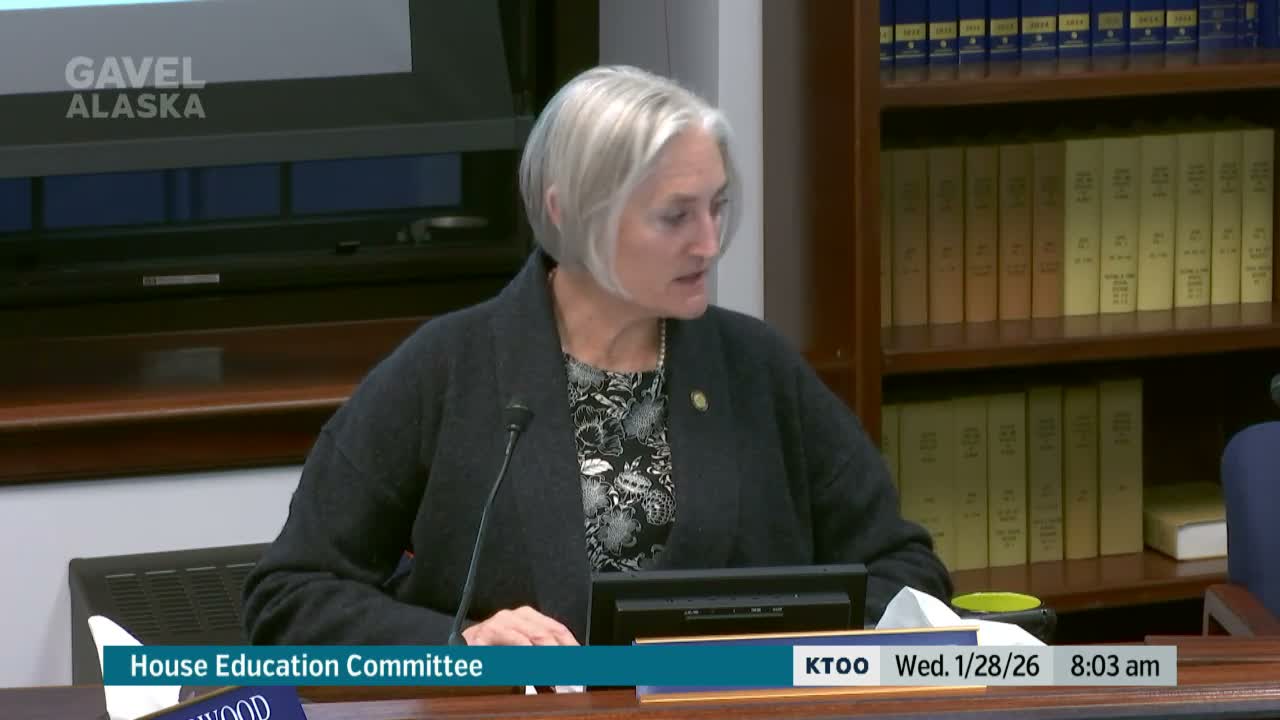
House Education Committee hears tribal compacting pilot update as tribes push for language immersion and local governance

House Education Committee · January 28, 2026

Get AI-powered insights, summaries, and transcripts

Subscribe
AI-Generated Content: All content on this page was generated by AI to highlight key points from the meeting. For complete details and context, we recommend watching the full video. so we can fix them.

Summary

Tribal leaders and education partners briefed the House Education Committee on a proposed pilot (HB 59 / SB 66) to allow five tribally compacted public schools; presenters emphasized language revitalization, local governance equivalent to a school district, teacher certification pathways, and funding/timing questions tied to a June 30, 2028 start date.

Juneau — Representatives from five tribal partners told the Alaska House Education Committee on Jan. 28 that a proposed pilot to establish tribally compacted public schools aims to restore tribal authority over local education and expand language immersion programs.

Misha Jackson, tribal education liaison for the Central Council of the Tlingit and Haida Indian Tribes of Alaska, told committee members the compacting concept is a government-to-government contractual model designed to let tribes operate public schools while meeting statewide standards. Jackson said the pilot (reflected in draft bill language described as HB 59 / SB 66) would be limited in scope, uncodified and intended as a research-style pilot for five tribes selected through the earlier demonstration project. Under current draft language, compacted schools would need to be in operation by June 30, 2028.

"This is not just a bill in front of you — these are our children, these are our future generations," Jackson said, framing compacting as a tool for sovereignty, community-centered operations and education innovation.

Joel Isaac, who described his role as the compacting contractor with the Department of Education and Early Development, said the legislation envisions each tribally compacted public school functioning like a school district. "The tribe would set up its own governing body," Isaac said, describing local tribal education committees or ordinances that operate as a governance structure and would be responsible for finances, evaluations and accountability similar to existing districts.

Presenters said teacher recruitment and retention and a limited tribal certification pathway were central to negotiations. Jackson said tribes insisted on a certification mechanism tied to tribal knowledge and language — a variant of the Type M designation used for language and cultural instruction — so local educators and elders can teach within state accountability systems.

Representatives of the five demonstration partners described practical examples and needs:

- Giminac Maddie Agviak (King Island/ Nome region) said her community has 20 remaining first-language Inupiaq speakers and urged urgency for immersion models and place-based curricula rooted in subsistence activities, which she tied to student well-being and suicide prevention efforts.

- Carl Chamblee (Kinnick/Connect Tribe) described a charter school launched four years ago that was deliberately structured to ease a future transition to a compacted model; he noted enrollment growth to roughly 250 students and the tribe’s creation of an education code and department.

- Mark Roseberry (Inupiaq Community of the Arctic Slope / Kologia Academy) described steps his tribe took to establish a tribal education department and convert a charter to a tribal school. He emphasized apprenticeship-style teacher preparation, culturally rooted pedagogy and aligning tribal certification processes with DEED review.

Presenters cited precedent in Washington state, where several state-tribal compacts operate alongside separate BIE (Bureau of Indian Education) funding and reporting. Isaac said Washington tribes manage dual reporting for federal and state funds and rely on state funding formulas in addition to federal resources; presenters warned that managing separate funding streams adds administrative burden.

Committee members questioned funding and enrollment effects on local districts. Co-chair Story raised the possibility of "hold harmless" mechanisms for districts that lose students to compacted schools; presenters agreed these fiscal transitions must be discussed with superintendents and school boards. Presenters said the bill language appropriates funds similarly to the REAA formula and that the pilot is intended to be limited and evaluative.

No formal committee action was taken. Committee staff said the Department of Education and Early Development could not attend an earlier session due to a miscommunication and that the department will respond to pending questions about a CLSD grant. The committee scheduled a follow-up meeting for Jan. 30 focused on assessment issues.

The tribes’ presenters stressed that compacting is intended to be open to all students, preserve statewide standards and accountability, and create opportunities for language revitalization, community engagement and place-based learning. "It’s the language that revitalizes the people," one presenter said when describing the broader goal of reconnecting students to culture and identity.

The committee adjourned at 10:01 a.m. with follow-up items requested of DEED and presenters.