Legislative finance projects $1.5 billion FY27 shortfall; NPRA treatment, Medicaid and Alaska Care raise risks
Loading...
Summary
The Legislative Finance Division told the Senate Finance Committee that Governor’s FY27 proposal leaves a projected $1.5 billion deficit and would draw heavily on the Constitutional Budget Reserve. Staff highlighted uncertainty from NPRA royalty accounting, rising Medicaid and SNAP costs, and reliance on lapsing Alaska Care funds.
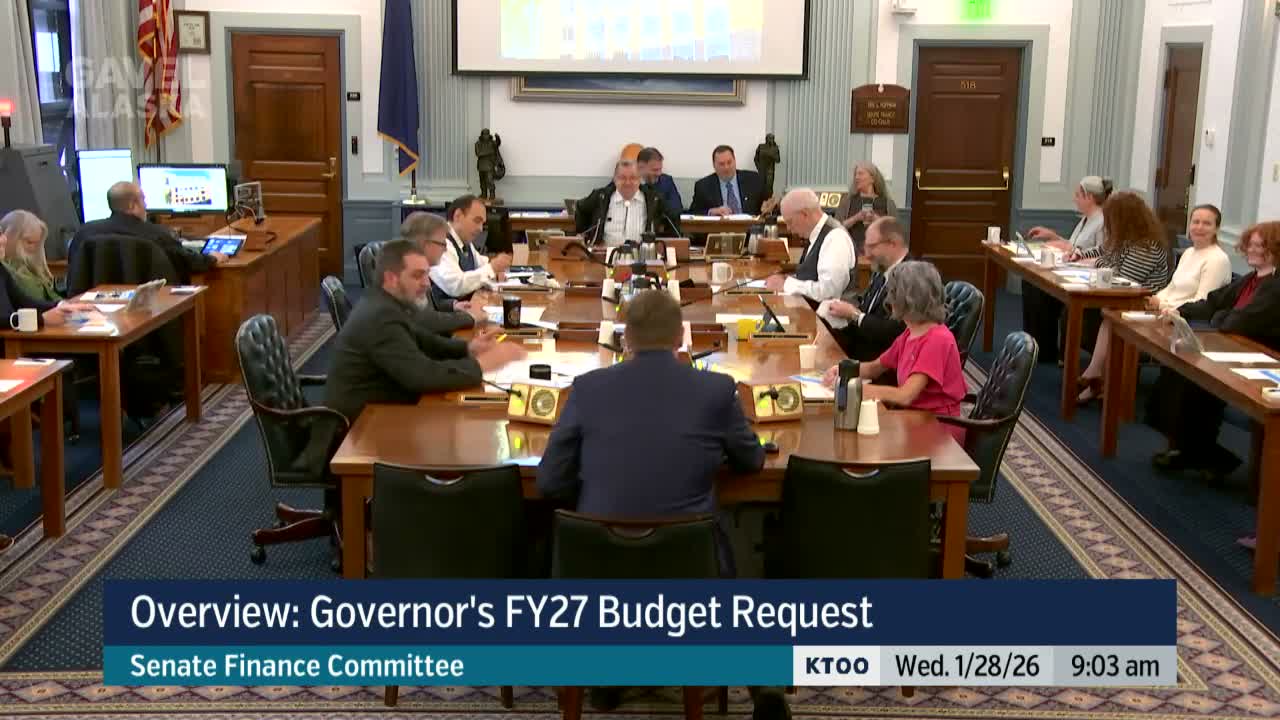
Alexi Painter of the Legislative Finance Division told the Alaska Senate Finance Committee on Jan. 28 that the governor’s FY2027 budget would leave the state with “just over $1,500,000,000” in projected deficit if enacted as proposed. The presentation flagged multiple revenue and cost uncertainties that could widen that gap and urged lawmakers to treat one-time bumps cautiously.
Painter opened with a recap of the prior two fiscal years, noting that spring forecasts and vetoes left FY26 weaker than expected. “That leaves us with a $51,000,000 deficit,” he said, describing how oil-price adjustments, lower corporate tax receipts and increased deductible expenses eroded an earlier surplus projection. He said the governor’s supplemental requests and expected Medicaid adjustments could push the FY26 shortfall higher.
Why it matters: Legislative staff warned that the governor’s approach would draw heavily on state savings. The governor proposes using draws from the Constitutional Budget Reserve to partially cover the shortfall; Painter said combined draws across FY26–27 would use “just over half” of the CBR’s balance, heightening debate about longer-term sustainability.
Major risk areas identified
• NPRA royalties. Painter described a disagreement over how federal royalties from the National Petroleum Reserve–Alaska should be classified. The administration’s revenue book counts most NPRA receipts as Unrestricted General Fund, while Legislative Legal advised treating the monies as federal-restricted revenue for NPRA impact grants. Painter warned the differing treatment changes the fiscal picture as new NPRA production comes online.
• Alaska Care and lapsing appropriations. The division reported that the state relied on lapsing appropriations and transfers in FY25 and that the group health/life fund used about $23.1 million. Painter said that without policy changes the state could be relying on $27–50 million per year of lapsing appropriation to hide costs by FY30 unless the Alaska Care rate is moved to full actuarial funding.
• Medicaid, SNAP and federal grants. Painter said the governor’s supplemental requests so far include about $36.4 million in UGF for Medicaid and anticipated large federal receipts. He also flagged changes from the federal HR 1 package that will raise SNAP administrative cost sharing (from 25% to 50%) and could add an estimated $10.7 million in state costs; longer-term SNAP-match exposure could be materially higher depending on error rates and waiver outcomes.
Overspending and audit follow-up
Committee members seized on repeated overspending in executive agencies. Painter noted the Department of Corrections exceeded appropriations by roughly $8 million in FY24 and preliminary FY25 figures show about $12.6 million of overspending, largely tied to overtime and payroll-reporting issues. He said legislative audit has listed this as a top FY24 issue and that ratification or later adjustments may be required if appropriations are not properly matched to spending.
Long-term outlook and savings
Painter described a temporary boost to the FY27 POMV (Permanent Fund draw) driven by an exceptional market year included in the averaging window, generating roughly $200 million of extra capacity in FY27. He cautioned the committee not to rely on that one-year gain for sustainable spending. Using probabilistic modeling, staff estimated a meaningful chance the earnings reserve account could be insufficient under current policy assumptions and urged the committee to consider a holistic, multi-year fiscal plan.
What the committee asked for
Members requested follow-up materials including updated oil-price sensitivity runs, a ten-year average comparison for disaster and fire-suppression funding, a break-down of the production tax and gross-value-reduction calculations for new barrels, and an updated probabilistic fiscal model. Painter said staff would return with additional analyses and that the governor’s revenue proposals, released the prior Monday, had not yet been fully incorporated into the division’s review.
Next steps
The committee set a next meeting for Feb. 2 to continue budget review and receive supplemental bills. The presentation concluded with committee direction to pursue additional modeling, legal review of NPRA treatment and closer examination of Medicaid and SNAP exposures.