
Santos tells Alaska House panel Pika phase‑1 is nearly complete; first oil expected by March
Get AI-powered insights, summaries, and transcripts
Subscribe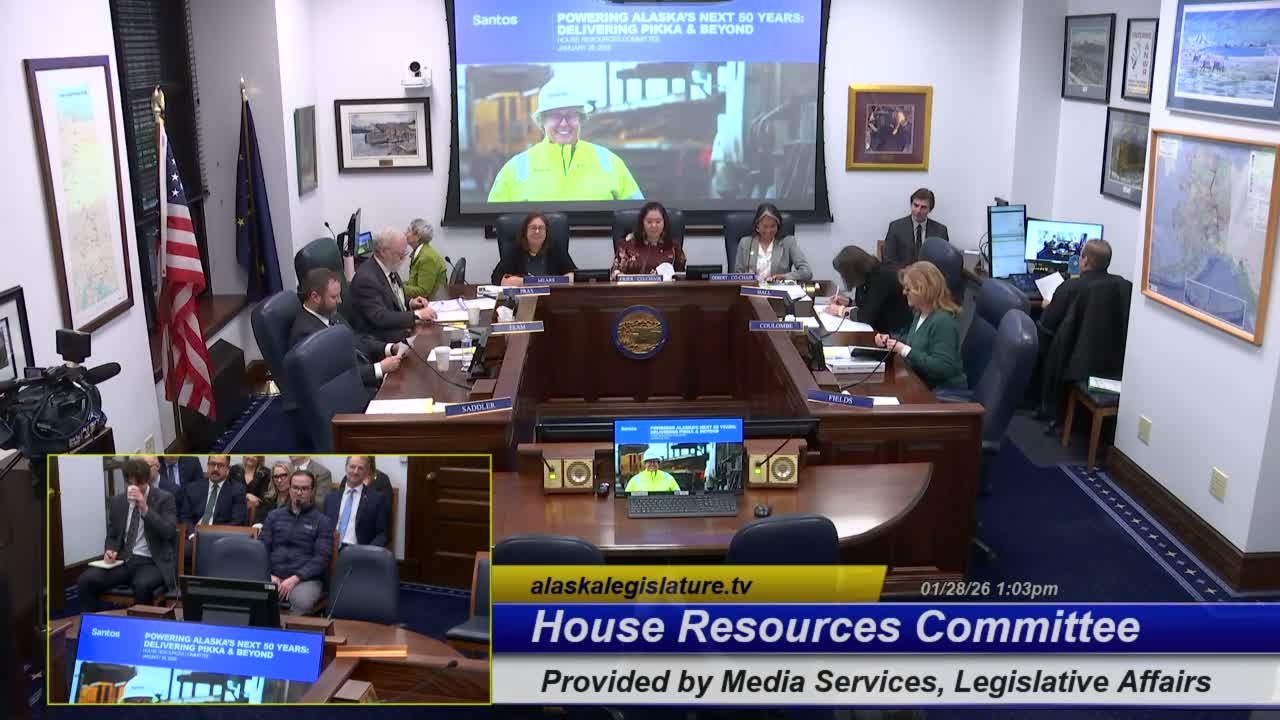
Summary
Santos told the House Resources Committee that its Pika project on state land is in commissioning, about 98% complete, and expected to deliver first oil by the end of the first quarter; company projected phase‑1 production at about 80,000 barrels per day and emphasized Alaska hiring and local contracting.
Santos representatives told the Alaska House Resources Committee on Jan. 28, 2026 that the company’s Pika project is in the final stages of commissioning and is expected to deliver first oil by the end of the first quarter.
“For reference … the Pika project… is a giant oil field,” Santos’ presenters said, and Pete Laliberte, Santos vice president for business development, said, “So right now, we’re at 98% complete on the project.” Santos said phase‑1 nameplate capacity will be about 80,000 barrels per day.
The company said it has invested roughly $3 billion in development to date, built roughly 120 miles of pipeline in two seasons, and had drilled and completed about two dozen wells for phase‑1. Santos said it tied facilities into the Kuparuk (KTC) pipeline and will use the Trans‑Alaska Pipeline System (TAPS) or Valdez and tanker options for crude sales depending on market conditions.
On fiscal impacts, Joe Balash, senior vice president for external affairs, told the committee the company recently filed assessment work with the Department of Revenue and expects to pay more than $60 million in state property tax before production begins. Santos said that—using the state’s price forecast—phase‑1 production could contribute on the order of hundreds of millions of dollars to the Treasury over the coming decade, with a company projection approaching $500 million of cumulative contribution to state coffers by about 2032 under the assumptions shown to the committee.
Santos addressed environmental and safety measures. Balash said the project is designed to be “net 0 in terms of scope 1 and 2 emissions,” and the company said it will offset remaining emissions through nature‑based credits working with Alaska partners. Pete Laliberte highlighted operational safety features on the pads, including laser‑defined exclusion zones around heavy loaders, and described a seawater treatment plant staged at Aliktok Point to treat and re‑inject produced water to maintain reservoir pressure.
The company also emphasized local economic benefits: Santos said about 80% of permanent Alaska hires were sourced in‑state and reported that roughly 81% of the company’s $3 billion project spend has been with Alaska businesses. Committee members asked for clarifications on the revenue figures and whether estimates net out production tax credits; Santos responded that the revenue figures presented were an “all‑in” combination of property tax, corporate income tax, production tax and royalty and noted that carryforward losses will affect near‑term production tax liability.
The committee placed follow‑up questions on the record for staff distribution and thanked the Santos team for the update.