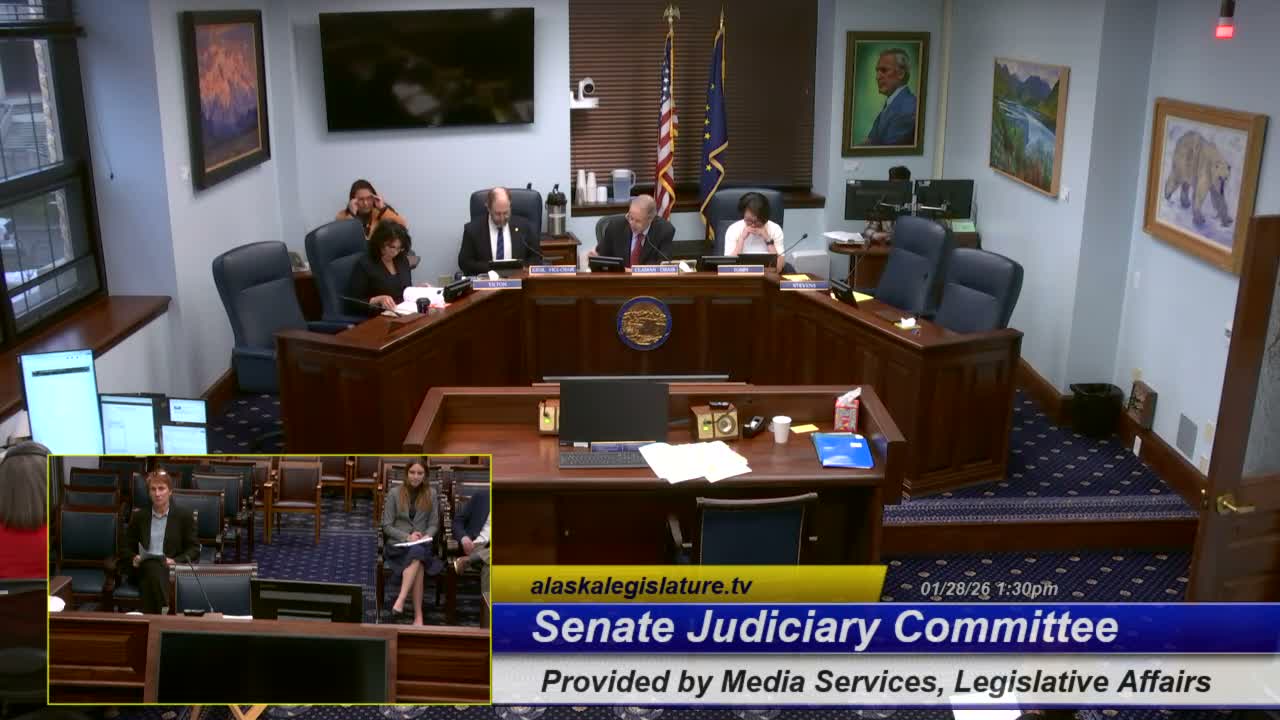
Committee hears request to add Superior Court judge in Palmer amid high caseloads
Loading...
Summary
The Senate Judiciary Committee heard testimony on SB 212, a Supreme Court request to add a 46th Superior Court judgeship seated in Palmer to address above-average caseloads in the Mat Su Valley. Committee members pressed court officials and the public defender on facilities, costs and staffing; the bill was set aside for further review.
JUNEAU — The Alaska Senate Judiciary Committee on Wednesday heard from the Alaska Court System and the Public Defender Agency about Senate Bill 212, a request to increase the number of Superior Court judges statewide from 45 to 46 and add a seat in the 3rd Judicial District to be located at the Palmer Courthouse.
“This bill would add an additional superior court judge in the third judicial district and specifically the judge would be seated in Palmer Alaska,” Nancy Mead, general counsel for the Alaska Court System, said as she opened the court’s presentation to the committee. The request, Mead said, comes at the Supreme Court’s direction after years of reviewing case data and operational needs.
Mead told senators that Palmer’s per-judge caseload is well above the statewide average: “The Palmer Superior Court last year had 683 compared to a statewide average of 458,” she said, and reported a five-year per-judge average of about 707 in Palmer versus 475 statewide. She and court staff said filings in Palmer have ranged roughly 2,650–2,950 per year, about 2,800 on average, and that population growth in the Matanuska-Susitna (Mat Su) Valley has closely tracked the rise in filings.
Mead described several drivers of longer cases that she said increase the time judges must spend on each file, including expanded victims’ rights, more scientific evidence (DNA, phone and computer forensics) and a sharp rise in self-represented litigants in family-law cases. She said the court has tried temporary measures — reassigning Anchorage judges to Palmer, using retired Pro Tem judges paid by per diem, and temporarily assigning district-court judges to superior-court duties under Administrative Rule 23 — but called those approaches intermittent "band aids" that ripple through the system and are not sustainable.
On facilities, Mead said the court sought capital funding to expand the Palmer Courthouse and had planned three new courtrooms with a shelled second floor. She said partial funding for a phase-one project was received and that the court now plans to remodel underused basement space to create a courtroom and related offices for an additional judge, a step she said could avoid asking for new capital funds in the near term.
Terrence Haas, division director for the Public Defender Agency, said his office submitted a fiscal note estimating an additional attorney would be needed if the court adds a permanent courtroom. “It’s clear that an additional judge doesn’t in and of itself increase the number of cases we handle,” Haas said, but he warned that adding courtroom capacity tends to increase the number of hearings and the defender appearances required to manage contested matters, so his agency budgeted for one attorney to cover the added workload.
Committee members pressed both witnesses on fiscal assumptions, staffing and whether additional judgeships would, in practice, speed case resolution. Senator Clayman noted the committee had a fiscal note from the Public Defender Agency but not from prosecutors or the Department of Law and said further agency analysis might be helpful before a vote.
With no public testimony offered, the committee closed the hearing and set SB 212 aside for further review. Senator Clayman told members the committee would accept proposed amendments electronically by Monday, Feb. 2 at noon. The committee adjourned and is scheduled to reconvene Monday, Feb. 2 at 1:30 p.m.