
Actuary warns UI financing has lost flexibility as trust fund surges; economists forecast slower job growth in 2026
Get AI-powered insights, summaries, and transcripts
Sign Up Free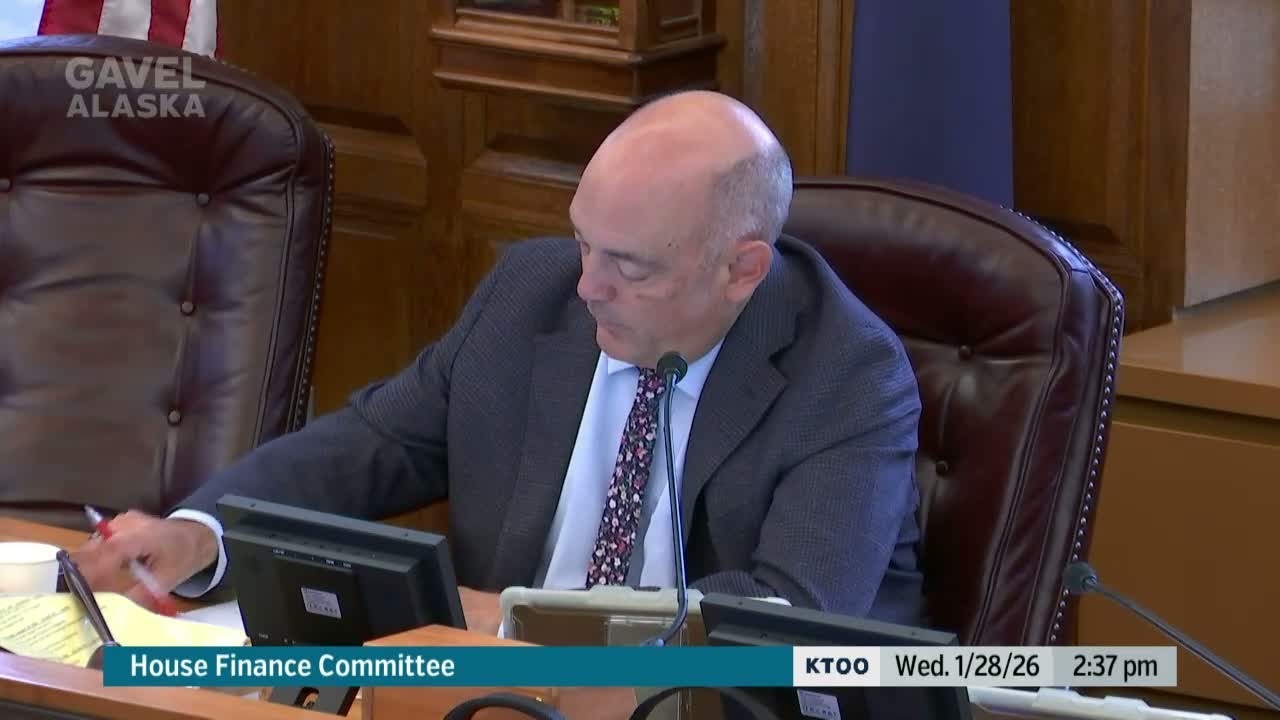
Summary
The Department of Labor actuary told the House Finance Committee that Alaska's unemployment insurance (UI) trust fund has grown substantially since 2021, creating a mismatch with declining benefit costs and statutory tax‑rate floors that limit rate adjustments. Economists also forecast modest job gains in 2026 with sector shifts in oil & gas, construction and health care.
Lennon Weller, the Department of Labor economist and unemployment insurance actuary, told the House Finance Committee on Jan. 28 that Alaska's UI financing structure has limited flexibility because statutory minimum tax rates prevent the system from lowering employer and employee rates when benefit costs fall.
Weller said the trust fund bottomed at just under $300 million in mid‑2021 and has gained substantially since then; he described this growth as a concern because the financing structure is not responding to lower benefit costs. "The financing system has essentially lost its flexibility at these levels of benefit payout," Weller said.
He explained the mechanics: benefit costs (payouts) and net UI contributions (taxes) normally offset each other, with a solvency mechanism that adjusts tax rates according to reserve targets. But Alaska's statutory minimums—1% for employers and 0.5% for employees—now bind the schedule, preventing rates from falling below those floors even though the fund balance is robust. Weller said the department's target pre‑recession reserve is about 3–3.3% of wages; when the fund is above that, solvency credits can lower rates, and when below the threshold surcharges can raise rates.
Weller highlighted program metrics that have declined over time: the benefit‑cost rate (benefits as a percent of wages) and the replacement rate (average weekly benefit relative to average weekly wages), which he put at just over 22% in current calculations. He also noted that Alaska's maximum weekly benefit ($370) has not been updated since 2009 and that the share of unemployed people who claim regular UI benefits is at a historic low (around 22%).
On duration and eligibility, Weller said regular UI claims qualify for a minimum of 16 weeks and a maximum of 26 weeks depending on earnings history; the department can match UI recipients to later wage records to estimate reemployment outcomes but has less visibility for interstate claimants who file from outside Alaska.
Jobs forecast: Economist Corinne Weibold presented the department's 2026 forecast and said Alaska added about 3,900 jobs in 2024 and roughly 3,000 in 2025. The 2026 outlook calls for slower growth (~0.8%) but sectoral gains in oil & gas (+1,000), construction (+700) and health care (+1,100) and anticipated losses in federal civilian employment (about −400 in 2026, with updated data possibly indicating steeper declines). Weibold noted oil & gas average wages are high (roughly $175,000) and that a large share of those jobs are held by nonresident workers (the department estimated about one‑third nonresident). She announced a forthcoming residency analysis report.
What happens next: Weller said the department produces regular projections and that there are policy proposals under consideration to rebalance UI financing; he offered to provide additional tax‑rate series and scenario analyses. Committee members requested more detail on how trust‑fund dynamics would affect tax schedules and benefit levels under alternative assumptions.
Ending note: The presentation linked fiscal mechanics to policy choices, with the actuary urging lawmakers to consider statutory minimums and other levers if they seek to rebalance UI financing.