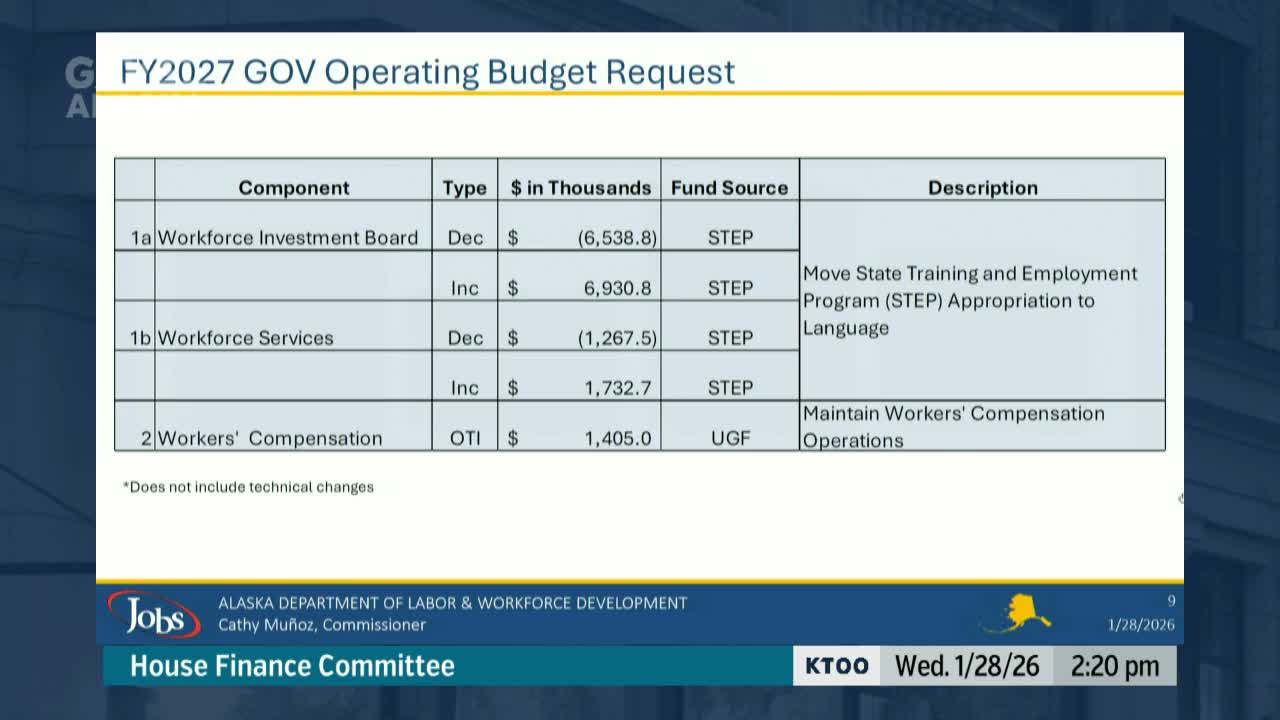
Alaska workers' compensation division seeks $1.4M one‑time UGF to cover WSCA shortfall after fund sweep
Loading...
Summary
Department of Labor officials told the House Finance Committee a reverse sweep in 2021 removed about $2.2 million from the Worker Safety and Compensation Account (WSCA), leaving the division with a 30% vacancy rate and the department requests a $1.4 million one‑time UGF increment for FY27 to maintain operations. Lawmakers asked for a detailed spending breakdown.
Department of Labor officials told the House Finance Committee on Jan. 28 they need a one‑time $1.4 million unrestricted general fund (UGF) increment in FY27 to prevent a 30% vacancy rate in the workers' compensation division.
Administrative Services Director Dan DeBartolo explained the Worker Safety and Compensation Account (WSCA) is normally the primary funding source for workers' compensation operations. "Typically, workers compensation is 99% funded by this fund source," DeBartolo said. He said premiums and the percentage of premium that roll into WSCA have declined as workplace safety improved, while contractual and salary‑related costs have increased.
Committee members pressed for detail about staffing and the historical sweep of the fund. DeBartolo said the division currently has 13 vacant positions — about a 30% vacancy rate — and that at least $2.2 million was reversed out of WSCA in 2021 through the state's reverse‑sweep practice. He said the department had to float operations with internal funds but cannot sustain that in FY27 without the requested increment.
Representative Hannon and others questioned whether WSCA is sweepable and noted the political and legal sensitivities of sweeping funds that originate from employer workers' compensation premiums. DeBartolo said the fund is categorized as a designated general fund (DGF) and that, at the time of the sweep, departments of law and OMB determined sweepability; he confirmed WSCA remains sweepable unless changed by policy or statute.
Why it matters: The request seeks to avert further staff departures and service disruptions for injured workers and businesses that file and adjudicate claims. Committee members asked the department to supply a line‑item breakdown of how the $1.4 million would be used; DeBartolo said it would support basic operations such as payroll for hearings and related staff and that the department can provide a more detailed budget.
What happens next: The department agreed to provide a breakdown for the workers' compensation division showing how the funds would be used. Lawmakers signaled interest in structural fixes to prevent future operational instability, including restoring swept balances or adjusting funding mechanisms.