
DOT tells Senate pipeline will put heavy stress on Alaska roads, seeks state match to leverage federal funds
Get AI-powered insights, summaries, and transcripts
Sign Up Free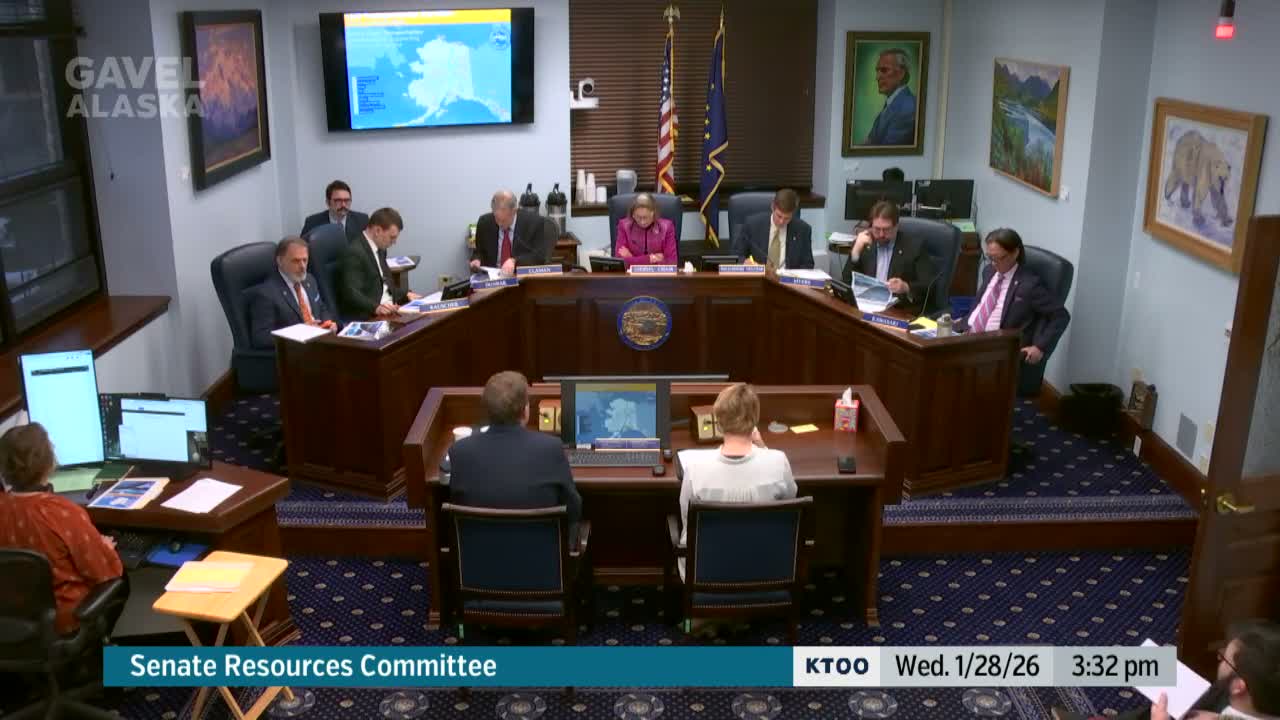
Summary
At a Jan. 28 Senate Resources Committee briefing, DOT Commissioner Ryan Anderson and Deputy Commissioner Catherine Keith described how the proposed Alaska LNG pipeline would increase heavy truck traffic, strain the Dalton Highway and other corridors, and require both capital projects and operating dollars—including a state match for federal advanced construction authority.
Juneau — The Alaska Department of Transportation and Public Facilities told the Senate Resources Committee on Jan. 28 that the proposed Alaska LNG pipeline would generate "thousands of heavy duty trucks" carrying 80‑foot pipe segments and could significantly increase wear on highways, bridges and ports unless the state commits additional maintenance and capital funding.
"We are expecting thousands of heavy duty trucks carrying these 80 foot long pipe segments," DOT Commissioner Ryan Anderson said, describing convoys that could be overweight or oversized and require permitted routing. Anderson and Deputy Commissioner Catherine Keith said DOT is preparing by identifying critical bridges and pavement, stockpiling materials in corridor locations, and programming projects in the Statewide Transportation Improvement Program (STIP).
Why it matters: DOT officials warned the committee that routine maintenance budgets are limited and that many corridor improvements are already programmed across multiple years. Anderson said DOT can use federal tools such as "advanced construction" to front‑fund projects, but those mechanisms require a state match. "We have enough match to get us through July 1 for an undisrupted project flow," Anderson said, adding that timing and certainty of later match dollars matter to contractors and project delivery.
Key details from the briefing:
- Maintenance baseline and needs: DOT described roughly $20 million as the department’s current standard operating baseline for some northern corridor maintenance and said preventative maintenance funding is used where federal rules allow. Senators pressed DOT that the Dalton Highway—414 miles long, with about 250 miles gravel—needs more routine grading and frontline crews, especially in summer months when washouts and potholes accelerate wear.
- Past and planned investment: DOT staff said about $460 million has been invested in Dalton projects since roughly 2015, with roughly $450 million more planned in coming years; DOT also identified a planned $454 million in reconstruction projects between 2026 and 2031 intended to improve corridor resilience.
- Bridges and load limits: Anderson described bridge monitoring, targeted replacement projects (including Parks Highway bridges), and the use of load posting to limit weights when a structure shows stress. He said DOT will monitor and, when needed, post limits or accelerate repairs.
- Ports and rail options: DOT discussed alternatives to moving all material through Anchorage, saying Port McKenzie rail extension work and other port options (Seward, Valdez, Port of Alaska) are being evaluated. Anderson said the state has engaged private firms (cited as Macquarie and Martinus) on financial and rail logistics for Port McKenzie.
- Project sequencing and STIP limits: Many committee members asked whether STIP projects could be accelerated to meet the aggressive timeline industry has described. Anderson said projects are programmed in the STIP and that preliminary design and right‑of‑way work may be budgeted, but that full construction timing will depend on available funding, permitting and the developer’s logistical details (truck types and weights).
- Emergency response, permitting and workforce: DOT discussed a programmatic agreement being negotiated with the developer (referred to in committee as "Glenfarn") to predefine emergency response roles, medevac availability and permitting processes. Anderson and Keith also flagged a workforce risk: pipeline wages could draw workers away from state highway, airport and bridge maintenance; DOT said it is expanding training, CDL scholarships and use of contractors to help scale operations.
Quote on local impacts: Sen. Myers pressed DOT on everyday maintenance, telling the committee that freight rates and vehicle damage have already increased because of road conditions. "If we don't provide DOT the money that we need to maintain it ... we're gonna be missing out on tax dollars," Myers said, arguing that poor maintenance can create wider economic costs.
Funding specifics mentioned in testimony:
- DOT cited $183 million of increased federal obligation authority last year that allowed $1 billion in contract awards and said the department obligated $922 million of federal highway funds in the prior year. - DOT said an estimated $30–$40 million would be needed for a roughly 3.9‑mile highway reroute near the liquefaction facility site referenced in the presentation. - The briefing noted existing appropriations and carryover match that DOT believes will sustain activity through July 1, but DOT emphasized the need to clarify the schedule for additional state match funding thereafter.
What the committee asked next: Senators repeatedly sought clearer, itemized five‑year cost estimates tied to specific haul plans. Anderson said DOT will refine needs once it receives more detailed constructability and vehicle‑weight information from the developer, and that STIP updates to be released publicly in coming weeks will make the department’s capital program and project timing clearer.
The hearing record: No motions or votes were taken. The committee adjourned at 4:58 p.m.; its next meeting is scheduled for Jan. 30, 2026, when the Department of Natural Resources and the Alaska Oil and Gas Conservation Commission are scheduled to present on North Slope gas and resource estimates.