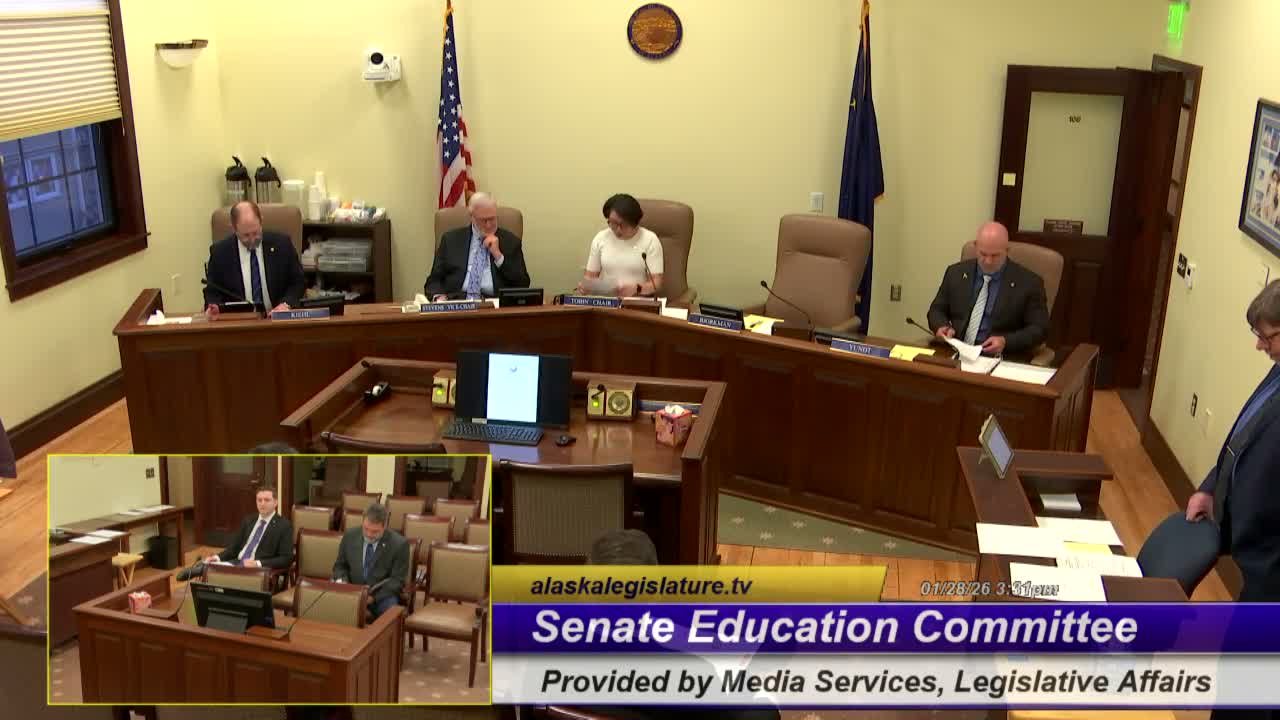
Senate Education Committee hears SB 204 to let board members substitute-teach and bar convicted felons from school boards
Loading...
Summary
On Jan. 28, 2026 the Alaska Senate Education Committee heard Senate Bill 204, sponsored by Sen. Mike Cronk, which would allow regional and municipal school board members to serve as substitute teachers and add felony-based ineligibility for school board service. Student witnesses backed the felony exclusion; committee members raised conflict-of-interest and scope concerns and the bill was held for further work.
Juneau — The Alaska Senate Education Committee on Jan. 28 heard its first public testimony and sectional analysis on Senate Bill 204, sponsored by Sen. Mike Cronk, which would (1) permit regional and municipal school board members to substitute teach in the schools they oversee and (2) add statutory ineligibility for anyone convicted of a felony from serving on a school board.
Cronk told the committee the bill is intended to address teacher shortages in smaller districts and align school board eligibility with the standards that generally bar convicted felons from being hired as teachers. "In Alaska, it is nearly impossible for a convicted felon to be hired as a teacher, and parity should be the minimum standard for a school board member," Cronk said during his sponsor statement.
The bill's staffer provided a sectional analysis noting proposed amendments to AS 14.08.041, AS 14.12.080 and AS 14.14.140 to implement the substitute-teaching permission and felony-based ineligibility. Those statutory citations were identified for committee review during the hearing.
Committee members raised two principal concerns. President Stevens said his experience as a former school board president led him to worry about conflicts of interest if board members became employees of their district: "It is that there is a conflict of interest here," he said, urging caution about allowing board members to be hired by the administration they oversee. Several members discussed mechanisms to reduce that risk, including automatic recusal from financial or contractual matters related to pay for substitute services.
Senator Kiel questioned whether a blanket felony exclusion is appropriate, asking whether narrower disqualifiers (for example, offenses involving children or crimes that bar physical access to schools) might better balance voter choice and student safety. Cronk said he was open to narrowing the language and noted the felony provision was prompted by a resolution passed by the Alaska Association of Student Government.
Two student witnesses called in in support of the bill's felony exclusion. Holly Beeman, a recent high-school graduate from Tok, described a 2022 incident in which a person with a permanent-barrier offense was elected to a local school board, alleging that "their actions while on the board led to legal action and community damage" and saying the lack of statutory protections felt like a failure to prioritize student safety. Jeffrey Alsup, a former student board representative, related a similar local experience and said the bill would also help districts facing substitute-teacher shortages by enabling board members with teaching experience to step in when needed.
No amendments were adopted at the Jan. 28 hearing. Chair Gale Tobin said members could work with the sponsor on language and that the committee would provide the student resolution referenced by the witnesses. The committee held SB 204 to a future meeting for further drafting and discussion.
The committee also announced it will not meet on Friday, Jan. 30; its next scheduled meeting is Monday, Feb. 2, at 3:30 p.m.
Ending note: SB 204 remains under committee consideration; sponsors and members signaled willingness to refine the felony language and to explore safeguards to address conflict-of-interest concerns before returning the bill for further action.