Get Full Government Meeting Transcripts, Videos, & Alerts Forever!
Get email alerts on the Policies And Procedures topic
No spam. Unsubscribe anytime.
Kent County PAB adopts ACC policies; members press for clearer attendance rules and trial-board staffing
Summary
The Kent County Police Accountability Board on Dec. 4 voted to adopt proposed ACC policies and procedures, asked for clearer absence/notification language to avoid punitive interpretations, and discussed trial-board procedures, staffing and legal support ahead of anticipated hearings.
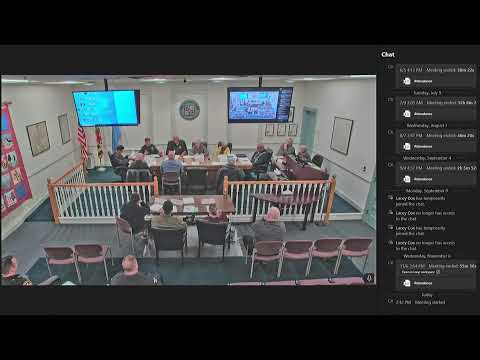
The Kent County Police Accountability Board voted Dec. 4 to adopt proposed Administrative Charging Committee (ACC) policies and procedures and discussed next steps including county attorney review, recruiting more trial board members and clarifying attendance language.
The board’s chair (Speaker 1) opened the meeting by confirming members had received the draft policies and called for a vote. After a brief discussion about wording, members moved, seconded and adopted the policies “as is,” and the chair said the document will be submitted to the county attorney for legal sufficiency.
Several members urged clearer attendance language in Article 3, which currently states ACC members “are expected to attend all meetings.” Member (Speaker 3) said that phrasing reads as mandatory and could cause problems if interpreted strictly in litigation, especially for unforeseeable absences such as accidents or hospitalizations. “If you miss a meeting, you know, that's gonna be a problem,” Speaker 3 said, adding that the language should allow for “reasonable cause” and notification to the chair where advance notice is impossible.
Chair (Speaker 1) and other members agreed the policy’s goal is to address chronic nonattendance that wastes a board position rather than to punish occasional absences. The adopted draft nonetheless retained the current wording; the chair said the board would forward the language to the county attorney for review.
The board also discussed operational needs tied to trial-board adjudications. Chair (Speaker 1) said the ACC currently has one trained trial-board member and needs at least two more so a trial board can be constituted when an officer requests one. The panel discussed logistics for trial boards, including assigning an administrative judge and securing outside officers to serve on boards, and noted that municipalities or the county would cover judges’ and officers’ travel and pay while they serve.
Speaker 7, the accreditation manager, described CALEA — the Commission on Accreditation for Law Enforcement Agencies — and said the sheriff’s office has participated in a multi-year accreditation process to keep policies current and defensible. “For us, as a sheriff's office, we've been accredited with CALEA since 2003,” Speaker 7 said, noting the process requires meeting hundreds of objectives and can be costly to maintain. Members discussed training options (a two-day in-person course and online materials), and the Maryland Police Training Commission’s pool of certified officers that agencies can draw on to staff trial boards.
The chair said Frank and Pete Landon are working to secure a PAB/ACC lawyer to advise on legal questions. Board staff will compile an annual report, using spreadsheets prepared by Ed Ray, to submit to the county commissioners; members discussed how often to document compliments and community feedback.
The board set its next regular meeting for Jan. 15. Before adjourning, Member (Speaker 3) asked that the minutes be corrected to fix the spelling of their name in the boilerplate language.
Votes at a glance: - Approval of prior meeting minutes: motion made and approved by voice vote (SEG 017–023). - Adoption of ACC policies and procedures (as presented): motion made, seconded and approved by voice vote; policies to be sent to county attorney for legal sufficiency (SEG 289–297, SEG 305–307). - Motion to adjourn: made, seconded and carried (SEG 850–852).
What’s next: The board will forward the adopted policies to the county attorney for legal sufficiency, continue recruiting and training trial-board members, and prepare the annual report for the county commissioners.