
Senate education panel advances bill to give private schools wider autonomy after heated debate
Get AI-powered insights, summaries, and transcripts
Sign Up Free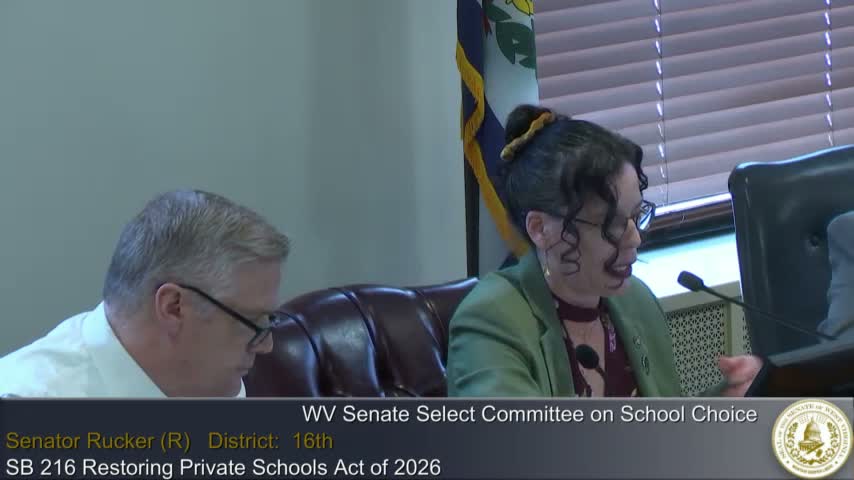
Summary
The Senate Committee on Education voted to report Senate Bill 216 with a do-pass recommendation after testimony from a private-school superintendent and debate over standardized testing and immunization-record requirements; two amendments proposing mandatory benchmark testing and mandatory immunization recordkeeping failed.
The Senate Committee on Education voted to report Senate Bill 216 to the full Senate with a recommendation that it pass after extended testimony and debate.
Counsel told the committee SB216 would remove statutory requirements that currently constrain private, parochial and church schools, including a 900-hour instructional requirement, specific standardized-testing mandates, and provisions that required schools to maintain attendance and disease immunization records and supply lists of enrolled students to county superintendents. Counsel said the bill would allow private schools to set their own measures for instruction and assessment and to report testing results to parents as each school deems appropriate.
Eric Kearns, superintendent of Faith Christian Academy in Martinsburg, testified in support, saying the measure “gives private schools a lot more flexibility in what they would be able to do as far as assessment and ... school days and hours.” He added, “Our accountability is the fact that if people are not satisfied with the education that they’re receiving, then they go to another private school or ... return to the public school or homeschool.”
Senators pressed counsel and the witness on several points. Senator from Wetzel asked whether private schools would still be required to take the state standardized test; counsel confirmed they would not and could instead adopt other authoritative assessments. The senator proposed a conceptual amendment that private schools either take the state standardized test or a nationally recognized test at four benchmark grades (end of grades 3, 5, 8 and 11) and that results be made available to parents. “I think that we should require the test standardized testing from somewhere, whether it be the state or a nationally recognized test,” the senator said, arguing parents need comparable information about student progress.
Opponents of the amendment said it would undermine the bill’s goal of creating greater autonomy and flexibility. Senator from Raleigh noted current practice requires private schools to assess once a year and make results available to parents, but warned that reintroducing state reporting could recreate burdens the bill aims to remove.
After debate, the committee voted on the Wetzel conceptual amendment by voice and then by division; the chair declared the nays had it and the amendment failed. Later, Senator from Cabell offered an amendment to retain a requirement that private schools “make and maintain disease immunization records for each pupil enrolled and regularly attending classes.” Counsel and the chair clarified annual attendance reporting would not be restored; after a division vote the chair again declared the nays had it and the amendment failed.
Following debate and testimony, Vice Chair moved that SB216 be reported to the full Senate with a recommendation that it do pass; the committee approved that motion. The committee then adjourned.
What the bill would change: Counsel said SB216 strikes language in the cited education code sections that (1) require 900 hours of instruction, (2) require private schools to maintain annual attendance and immunization records and to provide student lists to county superintendents on request, and (3) impose standardized-testing requirements for private/parochial/church schools. The bill would allow private schools to implement assessments and instructional programs “as the school deems appropriate” and would require reporting test results to parents, not to the state, unless otherwise specified.
Next steps: SB216 was sent to the full Senate with a committee recommendation that it pass. No enactment date or further committee deadlines were specified in the committee proceeding.