Senate education committee pauses bill to set $50,000 teacher starting salary after fiscal, retention concerns
Loading...
Summary
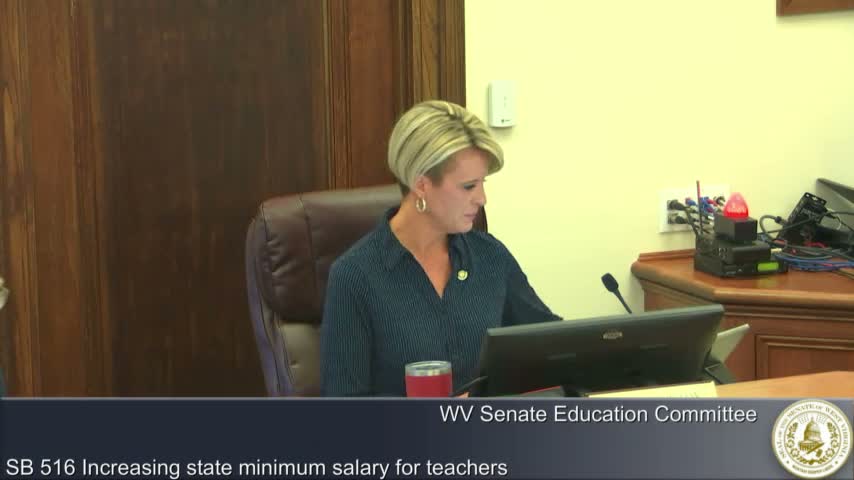
After extended questioning and testimony, the West Virginia Senate Education Committee declined to take action on SB516 — which would set a $50,000 minimum salary for teachers — citing a preliminary fiscal estimate of about $70 million and concerns that a multi‑year flat pay period could undermine retention.
The West Virginia Senate Education Committee on a routine meeting day declined to act on Senate Bill 516, which would establish a $50,000 statewide minimum salary floor for teachers with bachelor’s degrees and guarantee at least a $2,000 annual increase for teachers thereafter.
Counsel to the committee summarized the measure as a rewrite of the teacher salary schedule that would raise beginning bachelor’s‑degree teacher pay to $50,000, add a $1,200 minimum bump for math and certain special‑education teachers, and guarantee a minimum $2,000 annual increase tied to the schedule’s progression. Counsel said the change produces a multi‑year ‘‘flat’’ period for many teachers in which the salary remains at $50,000 before step increases resume under the revised table.
The bill drew detailed questions about how the floor would interact with existing steps and degree differentials. Senators pressed whether the change would merely reindex existing raises or cascade wage gains across the entire scale; counsel explained the new schedule would, for some rank/degree combinations, hold pay flat at $50,000 for several years and then resume increases tied to the prior schedule. Counsel also noted that setting the beginning minimum would alter the step progression and could have complex downstream effects on mid‑ and late‑career salaries.
A preliminary fiscal estimate was cited during the discussion. The chair told the committee that the Department’s chief financial officer, Uriah Cummings, was preparing the fiscal note and that his ‘‘preliminary number is about $70,000,000,’’ while cautioning that the estimate could change as calculations are refined.
Education WV’s Christie Skidmore, sworn to testify before the committee, told senators her organization welcomed debate about teacher pay and agreed the proposal could help recruit beginning teachers. But Skidmore and multiple senators raised a central concern: the bill’s initial flat years could blunt incentives tied to degree attainment and years of service and might worsen retention after the early career period when West Virginia loses many teachers. Skidmore said retention problems are most acute within the first five years and urged further analysis and possible amendments.
Committee members also discussed cross‑border competition with neighboring states and the role of local supplements in retaining staff, and asked for comparisons and case studies (one senator referenced Arkansas’ 2023 LEARNS Act as an example to study). Members asked whether other state pay raises would ‘‘overlay’’ with SB516; counsel said pay raises provided in separate budget actions typically do not stack with the salary‑schedule redesign in the same way and that finance would need to analyze interactions.
After the extended Q&A and testimony, the chair said the committee would not take action on SB516 that day, citing the need for more detailed fiscal information and further discussion about effects on non‑beginning teachers. The chair’s statement concluded the committee would move the bill forward only after those issues are resolved.
Next steps: the chair indicated the bill requires additional discussion and a finalized fiscal note before the committee will consider a vote.