Treasury: Revenue department details budgets, warns of vacancies and large workers’ comp runoff
Loading...
Summary
Secretary Eric Nelson told the Senate Finance Committee the Department of Revenue runs a lean operation, flagged major special‑revenue lines including workers’ compensation runoff and a $34 million transfer to reserve funds, and said staffing vacancies—about 10% in the tax division—are constraining operations.
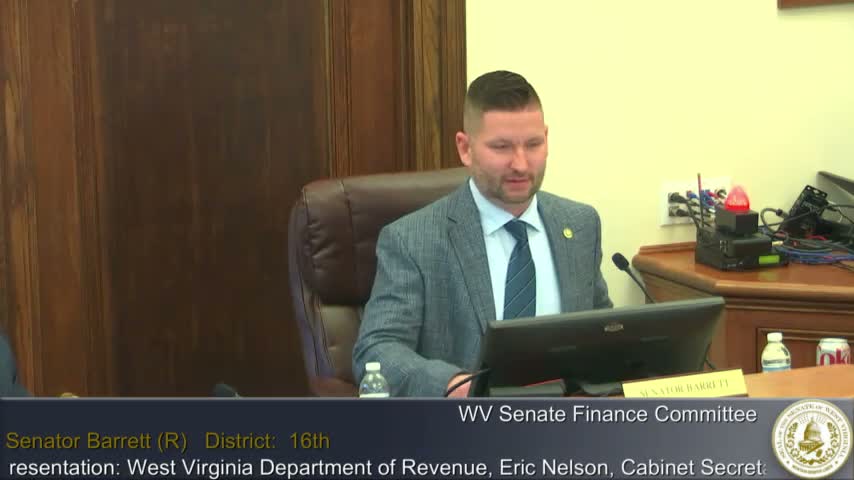
Secretary Eric Nelson presented the Department of Revenue’s five‑year budget overview to the West Virginia Senate Finance Committee, describing steady liquor and insurance revenues and identifying several large special‑revenue items the department manages.
Nelson told senators the department ‘‘runs a lean machine’’ and highlighted a FY2026 transfer of $34,000,000 he said will go to the rainy‑day or PIT fund. He said ABC (liquor) sales generate roughly $140 million a year, with a 32% retail markup that yields over $30 million in a typical reporting period. Nelson also noted large workers’ compensation spending authority lines (he cited $250,000,000 as available authority) and a $20,000,000 line for workers’ comp debt reduction.
Why it matters: the department oversees multiple special‑revenue programs whose timing and reserves affect other budget decisions, and staffing shortages could affect tax administration and collections. Nelson said the tax division processes about 2.1 million returns annually and that roughly 10% of tax division positions are vacant.
On workers’ compensation runoff, Senator from Randolph asked when the workers’ comp debt will be retired. An insurance commissioner responding at the podium said the runoff will extend for years because long‑term claims continue to be paid and that the state may eventually consider reinsurance or a sale, but did not provide a firm retirement date. The commissioner offered to provide monthly reports on claims totals.
Senators asked for clarification on ABC operations. Nelson explained West Virginia is a control state where distributors ship liquor to a state warehouse and the state pays suppliers only when retail sales occur. He said 182 retail outlets operate under the system and that the ABC has administrative spending and enforcement costs tied to new products such as delta‑8 hemp and kratom.
What was requested: senators asked the department to supply comparative taxation data with surrounding states and detailed reports on workers’ compensation claim payments; Nelson agreed to provide further numbers.
Next steps: Nelson concluded by offering to provide follow‑up information requested by the committee. No formal legislative action was taken during this presentation.