
West Virginia Senate passes election-integrity bill tightening rules on provisional and out-of-precinct ballots
Get AI-powered insights, summaries, and transcripts
Sign Up Free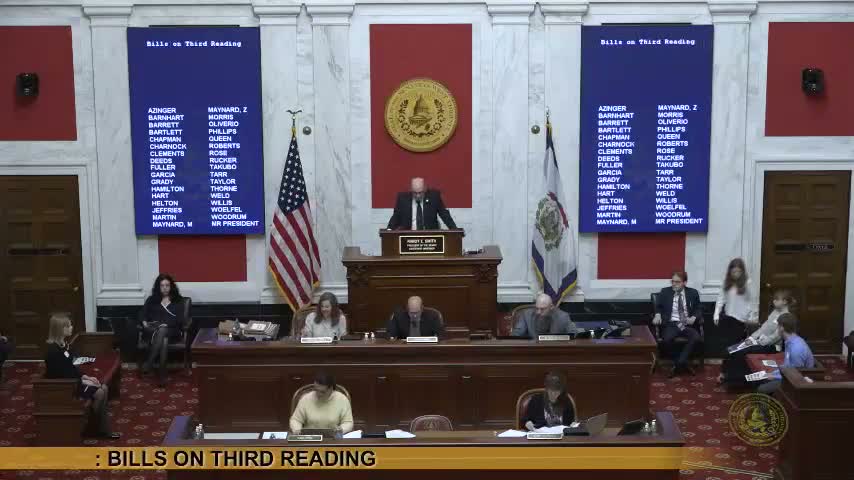
Summary
The West Virginia Senate passed an engrossed committee substitute for Senate Bill 61, which narrows circumstances under which ballots cast outside prescribed procedures or in the wrong precinct may be counted; the measure passed 33–1 on Jan. 30, 2026 after floor debate about potential disenfranchisement.
The West Virginia Senate passed an engrossed committee substitute for Senate Bill 61 on Jan. 30, voting 33–1 to bar counting ballots cast “not in a manner provided for by West Virginia law” or cast in the incorrect precinct except in narrowly defined circumstances.
The bill’s sponsor, identified on the floor as the junior senator from the fifteenth, told colleagues the measure is intended to protect election integrity by clarifying that ballots not complying with state law or cast outside a voter’s district should not be counted and by removing some post-election discretion to count provisional ballots before canvassing. The sponsor said the measure includes criminal penalties for those who “knowingly and intentionally” count illegal ballots, and that an exception exists for voters who must use a different polling place because their regular location lacks disability access.
Not all senators supported the change. The senator from Marion said the bill risks disenfranchising voters who make honest mistakes—especially older residents facing precinct consolidations—and argued that the current provisional-ballot review by county election officials can protect such votes. The senator from the thirteenth urged the chamber to consider that votes cast in the wrong precinct could be for different legislative races and said limiting counting could alter election outcomes.
The sponsor replied that poll workers are required to help voters find their correct polling place when someone shows up at the wrong location and reiterated the bill’s disability-access exception. After brief floor back-and-forth, the Senate voted to pass the bill, and the clerk communicated the action to the House.
Next steps: the clerk will notify the House of the Senate’s action; further House consideration or concurrence would be required before the measure becomes law.
Quote highlights from the floor: "Free elections are the cornerstone of our democracy, and this bill seeks to ensure that the will of the voters is respected and free from tampering," the junior senator from the fifteenth said in urging passage.
"I’m going to take the side to make sure that vote counts," the senator from Marion said in opposition, urging protection for voters who make precinct mistakes.
Outcome and vote: Senate Bill 61 passed on a recorded vote, 33 yays, 1 nay.