
Oversight board and IMB report improved funded ratios and top-quartile investment performance
Get AI-powered insights, summaries, and transcripts
Subscribe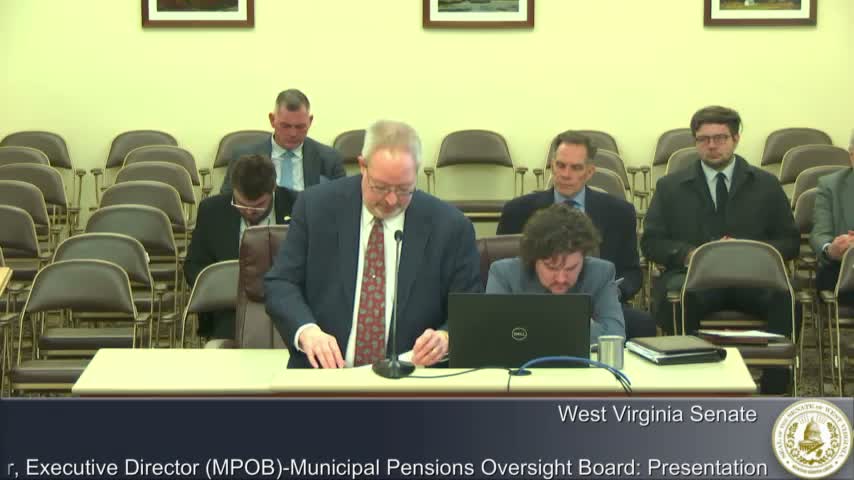
Summary
Municipal Pensions Oversight Board and the Investment Management Board reported that several municipal pension plans have closed into the statewide system, asset values rose in FY25, and IMB’s long-term returns ranked near the top of peers, which the IMB representative said translated into roughly $4.7 billion in added value versus the median fund over 2000–2025.
Blair Taylor, executive director of the Municipal Pensions Oversight Board, and Craig Slaughter from the Investment Management Board gave the Pensions Committee an overview of municipal plan funding, recent municipal plan closures and IMB investment performance.
Taylor said the Oversight Board, created by legislation in 2009, now monitors 53 municipal plans. He outlined funding methodologies (standard, alternative, optional, optional 2) and noted the conservation methodology ended in 2023. Taylor said several municipalities have closed local plans and transferred new hires into the statewide Municipal Police Officers and Firefighters Retirement System, operated by the Consolidated Public Retirement Board. He identified about 10 plans that still use the alternative methodology (naming several municipalities including South Charleston, St. Albans, Princeton, Nitro and Beckley) and said those localities carry persistent unfunded liabilities.
Taylor presented FY24 aggregates across the 53 plans: about $79.2 million in investment income, roughly $154 million total income and about $83 million in expenses. For FY25 he reported an asset value that rose from $726 million to nearly $780 million, FY25 investment income of $73.4 million, total income of $161 million and pension benefits paid of about $86.8 million.
Taylor also described that 12–13 plans have chosen to invest with the Investment Management Board (IMB) and explained IMB participation can lower investment fees by pooling assets.
Craig Slaughter (IMB) reviewed the board’s origin and governance reforms after late-1980s losses and presented long-term performance metrics: he reported a 10-year return of 9.83% and a 20-year return of 7.95%, with percentile rankings placing IMB among the top funds in the peer universe for returns and risk-adjusted returns. Slaughter said IMB’s long-term outperformance relative to the median fund over 2000–2025 “represents about $4,700,000,000 added.” He described the trade-off between return and volatility and noted IMB’s risk-adjusted metrics (Sharpe ratio percentiles) compare favorably in peer cohorts.
Committee members asked clarifying questions about unfunded liabilities and the state contribution mechanism; Taylor explained municipal unfunded liabilities remain on local books and are amortized into each municipality’s normal cost component.
No committee action was taken on investment policy during the meeting.