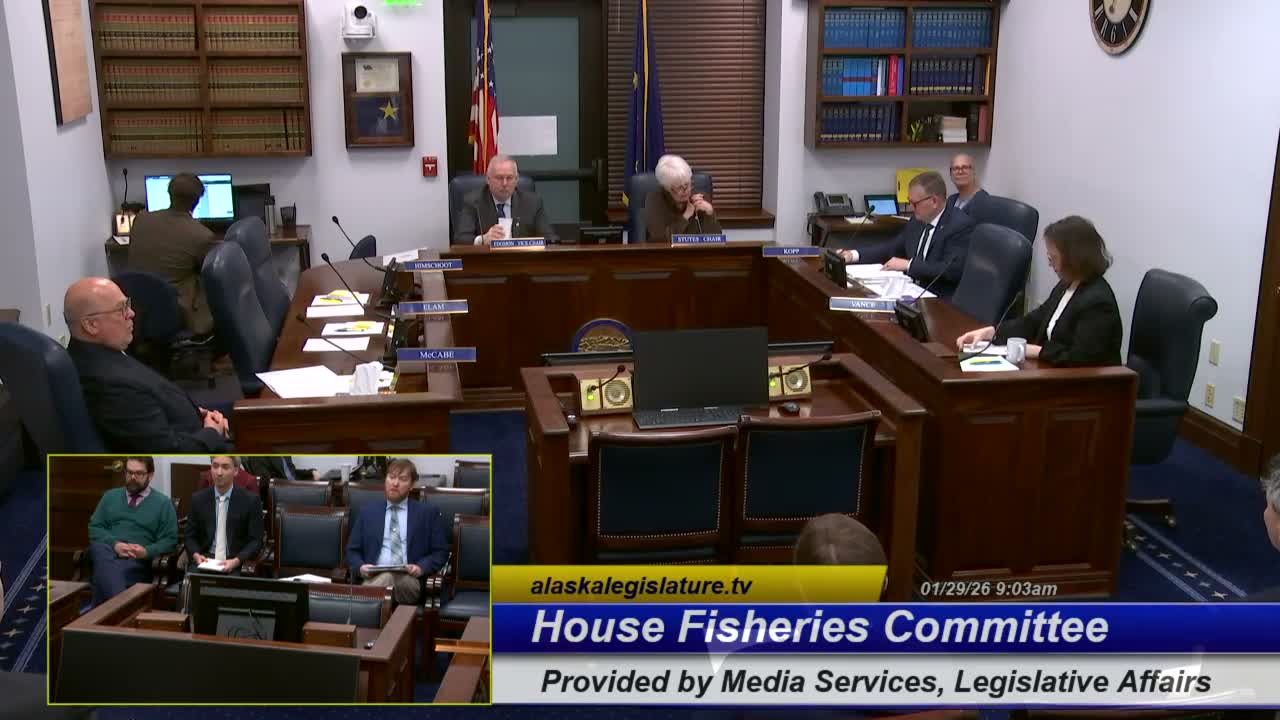
House Fisheries Committee hears industry support for resolution urging extension of U.S. ban on Russian seafood
Loading...
Summary
The House Special Committee on Fisheries heard testimony supporting House Joint Resolution 29, which urges extension and stronger enforcement of U.S. executive orders restricting Russian seafood imports; the committee adopted a committee substitute as a working draft and set an amendment deadline of Feb. 2, 2026.
The Alaska House Special Committee on Fisheries on Jan. 29 heard invited testimony backing House Joint Resolution 29, which urges the President and federal agencies to extend and more vigorously enforce executive orders that restrict Russian seafood imports.
Chair Stutes introduced the committee substitute and, after a motion from Speaker Edgmon to adopt it as a working document, placed HJR 29 before the committee as a working draft. "There being no objection," Stutes said, and later set an amendment deadline of 1 p.m. on Monday, Feb. 2, and scheduled further consideration for Feb. 3, 2026.
Industry witnesses told lawmakers the resolution is needed to protect Alaska fishermen and processors. Julie Decker, president and executive director of the Pacific Seafood Processors Association, said PSPA represents 50 processing facilities in 22 coastal communities and that "the health of the seafood industry ... generates $6,000,000,000 in economic activity in Alaska annually" and supports about 48,000 direct jobs. She said the prohibition on Russian seafood helps level the playing field and urged continued federal enforcement and resources.
Jeremy Woodrow, executive director of the Alaska Seafood Marketing Institute, said the U.S. market is starting to shift in favor of explicitly labeled Alaska product. "We're now buying a 100% Alaska seafood," he told the committee, adding that retailers and food-service operators are changing packaging to call out "Alaska salmon," "Alaska cod," and "Alaska pollock." Woodrow also explained that a regulatory "grace period" and product stockpiles meant Russian-origin product remained in U.S. channels into 2025, so he argued extended enforcement and continued promotional funding will be necessary to sustain price stability.
Staff summarized the federal context for the resolution. Matt Greening, staff to the House Fisheries Committee, referenced Executive Orders 14024, 14068 and 14114 and noted that EO 14024 had been extended on April 10, 2025 for one year and is set to expire in April 2026; the resolution therefore asks the President and Congress to enhance enforcement and funding to protect Alaska's seafood industry.
Committee members asked questions about misbranding and international market dynamics. Representative Vance pressed whether the resolution would address alleged misbranding of Russian pollock sold under U.S. or Alaska names and whether the committee should also examine broader international trade ties (including China and Ukraine). Greening and Woodrow said misbranding protections are appropriate and that international-market issues could be addressed in a separate or expanded resolution.
The committee took the procedural step of adopting the committee substitute as a working draft after Speaker Edgmon moved the motion; no recorded roll-call vote was taken. Chair Stutes set the item aside for further work and established the amendment deadline, and the committee adjourned at 09:28.
What happens next: HJR 29 will be on the committee agenda on Feb. 3, 2026; the committee has invited further amendments by 1 p.m. on Feb. 2, 2026.