
Rasmuson Foundation outlines grant programs and how Alaskans can apply
Get AI-powered insights, summaries, and transcripts
Sign Up Free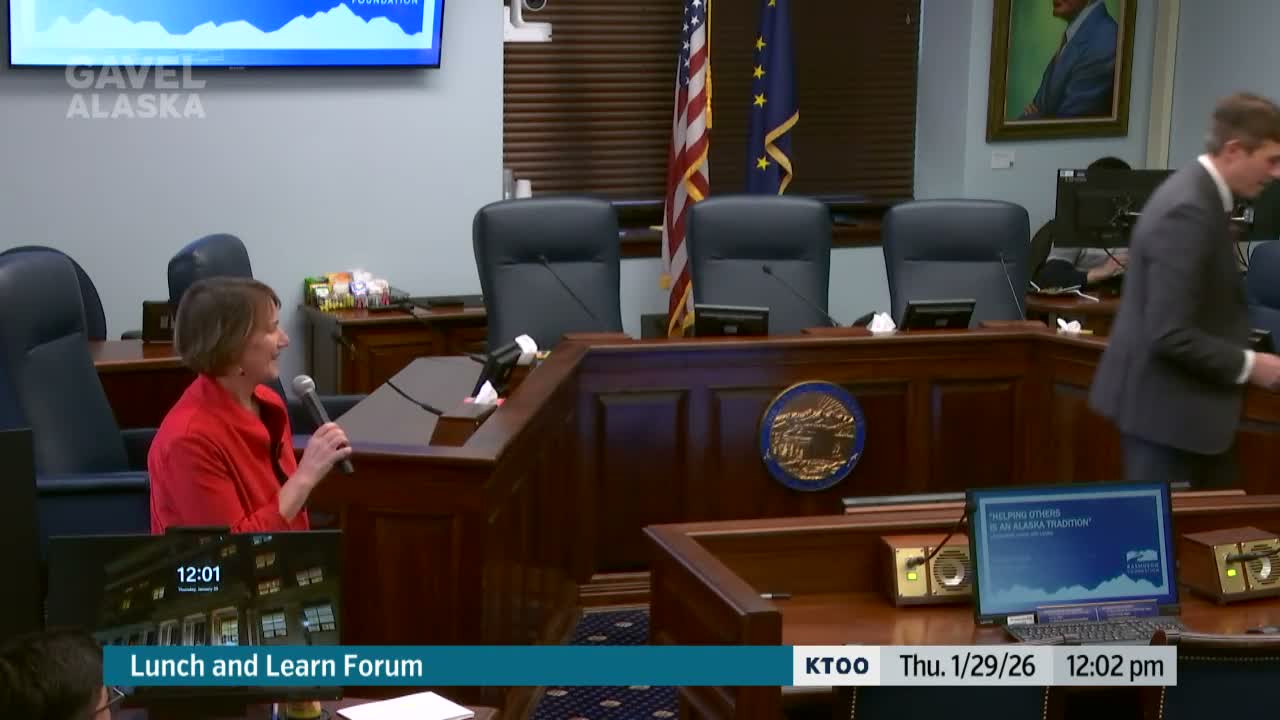
Summary
At a Juneau Lunch & Learn, Rasmuson Foundation CEO Gretchen Gess reviewed the foundation’s Alaska-only mission, its core grant types (small 'buy/build/fix' grants, community support and legacy grants), program-related investments and staff outreach, and described online booking and regional convenings to help applicants.
Gretchen Gess, president and CEO of the Rasmuson Foundation, told a Capitol Lunch & Learn that the foundation focuses exclusively on Alaska and seeks community‑led proposals that “benefit Alaskans.” The foundation’s work includes core grantmaking, strategic initiatives and program‑related investments intended to partner with — not replace — state and federal funding.
Why it matters: The foundation is one of the largest private grantmakers in Alaska and provides both small, rapid-response grants and larger capital or program investments that can be combined with public funding. Gess said the foundation aims to be accessible to communities across the state and to help applicants navigate funding stacks.
Gess described several grant types. Small, monthly-decided “buy, build, fix, and create” grants fund items such as vans, technology upgrades and local trail work; “community support” grants can be up to $250,000 for building projects or programmatic support and are typically part of a larger funding stack; and “legacy” grants start at $250,000 and target transformational projects. The foundation also makes program‑related investments (PRIs) — low‑ or no‑interest loans used to stabilize revenue for organizations that then can pursue commercial financing.
Gess offered examples: the foundation has funded local trail work through small grants and helped a Mat‑Su ski area with snowmaking equipment via a PRI so the operation could open more reliably and show commercial lenders a repayment track record. She also described a recent legacy investment that will support a 4,000‑square‑foot mariculture facility in Kodiak.
On arts and leadership, Gess outlined a long‑running sabbatical program for nonprofit and tribal leaders (roughly 90–120 days with planning and reentry support) and nationally juried artist awards and fellowships. She said program details and application windows are posted on the foundation’s website and that staff members are available for appointments: “You now can book time online with a program officer and just talk about an idea,” she said.
Gess emphasized transparency in decision-making and urged staffers and legislators to direct constituents to the foundation’s website and program officers. She encouraged applicants from underrepresented communities to reach out for guidance and said the foundation tracks how many new organizations receive funding.
The presentation ended with an audience Q&A and an offer from Gess to remain for follow‑up questions; she gave a contact email for further inquiries.