Alaska DOT outlines winter‑operations tech and defends brine use amid local concerns
Loading...
Summary
DOT told the House Transportation Committee it is using new data tools (511, RWIS cameras, AI-assisted alerts, Starlink) to improve winter response, defended targeted brine application with corrosion inhibitors and described local adjustments (Kenai reductions) after community petitions; committee pressed DOT on safety data, environmental impacts and staffing.
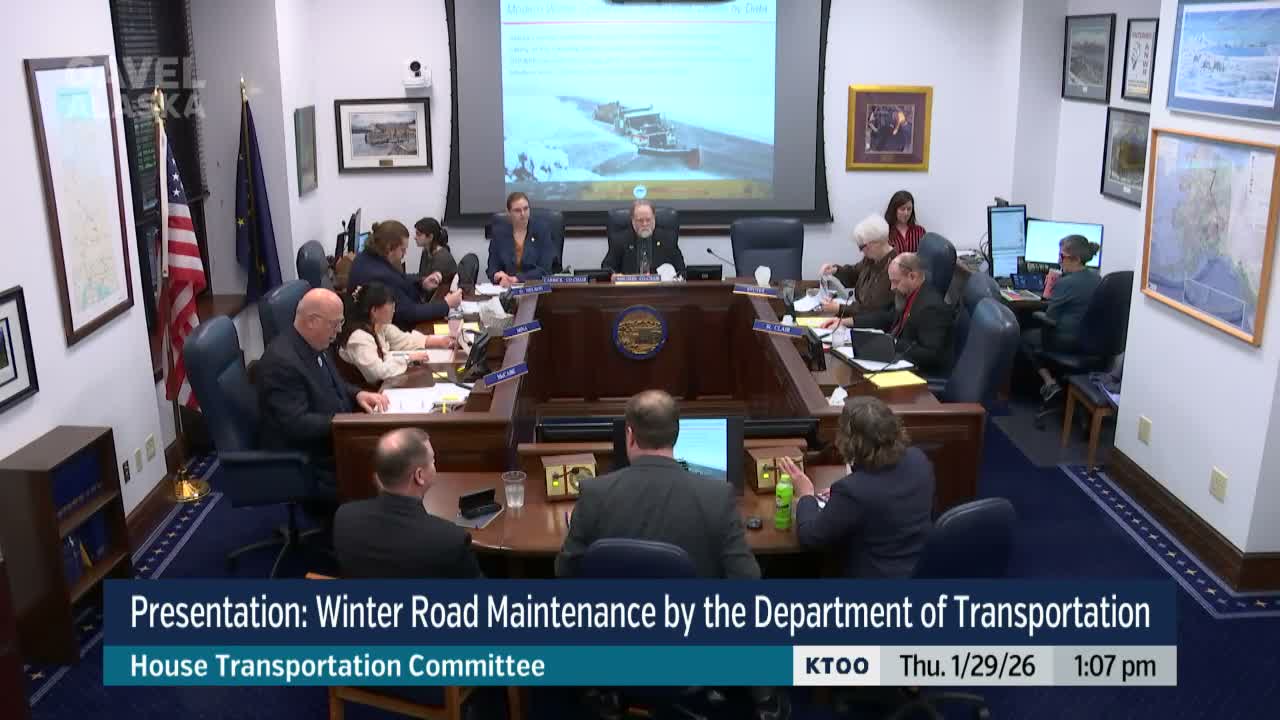
The House Transportation Committee heard a detailed Department of Transportation and Public Facilities briefing on winter maintenance on Feb. 29, where DOT officials described expanded real‑time tools, pilot AI projects and a contested policy shift toward broader use of liquid brine for anti‑icing.
Committee members said the department’s 511 and winter operations dashboard are already changing how Alaskans travel in storms. Christine Langley, data modernization and innovation director for DOT, said, "Over the last year, during 2025, we saw 1,200,000 individuals come to us and come to 5‑1‑1 to look for information," including traffic speeds, bridge heights and plow status.
Members pressed DOT on three recurring concerns: environmental impacts of brine and alternatives, whether reducing brine in some places increased crash risk, and staffing and budget pressures that affect on‑the‑ground clearing.
DOT explained brine and decision rules. Andy Mills, special assistant legislative liaison, described brine as "rendering sea salt… into a liquid form" and said the department targets a 23.3% mixture with added corrosion inhibitors for roadway application. Mills said anti‑icing (treating before an event) and de‑icing (treating after bonding) follow a forecast‑driven decision tree rather than operator discretion.
On alternatives and local pushback, DOT officials noted beet‑juice and urea exist but carry tradeoffs — cost and stickiness for beet juice, vegetation effects and odor for urea. Langley and Mills said the Kenai Peninsula example shows how the department responds to local concerns: the department reduced brine application there and restricted it to higher‑speed routes after a community petition rather than maintaining universal application.
Elected members asked about safety outcomes where brine was reduced. Representative McCabe asked whether discontinuing brine produced more accidents on Mackay Lake Road; Mills responded that "No" spike has been identified to date but that operators shifted resources to keep safety standards, and the department will analyze multi‑year data to be sure.
DOT also described other operational changes: adding Starlink links to vehicles, testing RWIS camera surface classification with machine learning, piloting a pedestrian‑detection crosswalk in Kodiak and rolling out Drivewise alerts for commercial fleets. Langley said the department is cautious about AI accuracy — noting an earlier STIP chatbot pilot was not pushed forward because it proved unreliable.
On staffing and budgets, Central Region maintenance manager Burrell Nicholson described contract use for lower‑priority roads, sidewalk priorities in Anchorage and limitations in snow‑dump capacity. Andy Mills noted a roughly $5 million M&O reduction in the FY‑26 budget and said the FY‑27 proposal seeks to restore those funds to bolster frontline services.
What happens next: the committee set a procedural amendment deadline for the bill later in the meeting and scheduled the next committee meeting. DOT committed to follow up with requested metrics (for example, production figures for priority‑one clearing and the 511 operational start date).
The department’s presentation and committee questioning left several items for follow‑up: DOT agreed to provide accident and priority‑clearance data, a literature review on corrosion mitigation was referenced for committee staff, and DOT promised to return with more Northern Region detail at a later meeting.