
Bill would limit spreading infrastructure costs to other customers and require community benefit agreements for big energy users
Get AI-powered insights, summaries, and transcripts
Subscribe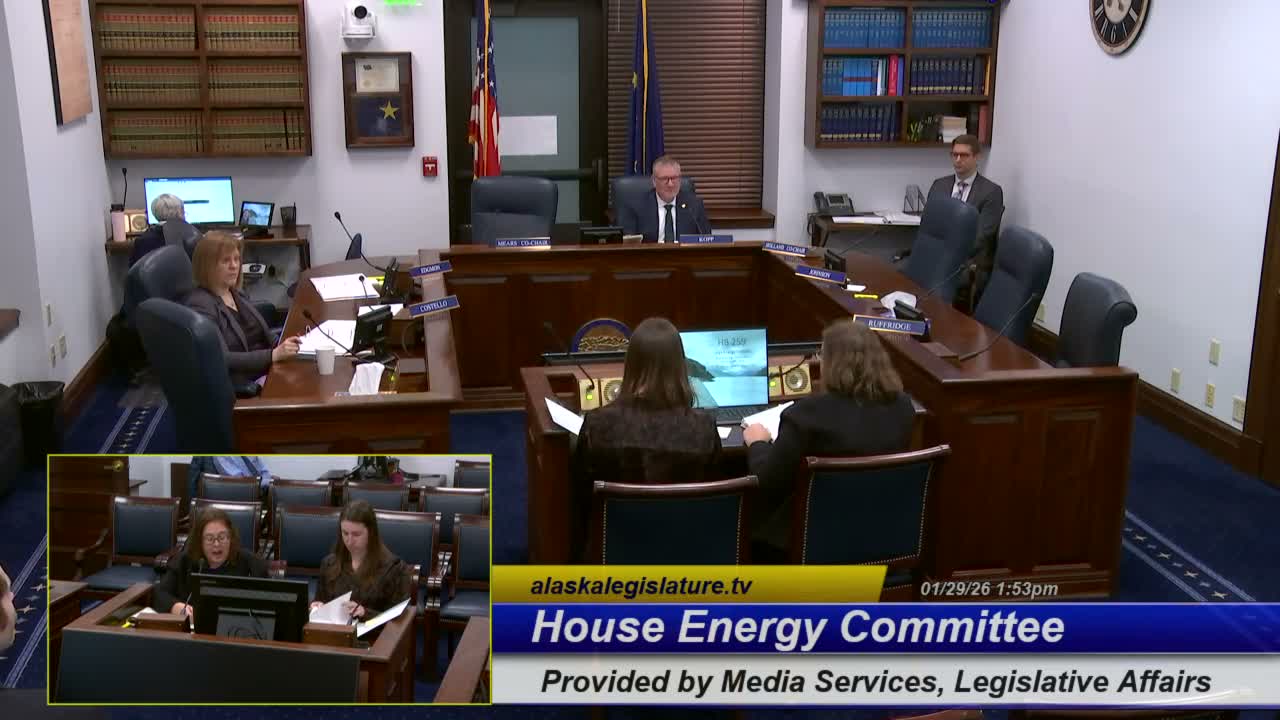
Summary
Rep. Donna Mears introduced HB259 to set contract standards for large energy‑use facilities (20 MW or thresholds tied to 20% of a utility's load), require community benefit agreements (CBAs), and bar utilities from passing project‑specific costs to other customers; the committee set the bill aside for invited and public testimony.
Representative Donna Mears presented House Bill 259 on Jan. 29, 2026, proposing statutory standards for contracts between utilities and large energy‑use facilities and a new requirement for community benefit agreements to secure local buy‑in for large projects.
Mears said the bill aims to attract long‑term anchor tenants — including data centers, mines and manufacturing — while protecting ratepayers and giving communities negotiating power. "By encouraging new energy demand and strengthening our electric grid, HB259 positions Alaska for the future," she said.
Staff read the bill’s sectional summary: the bill would add a subsection to Alaska statute 42.05.381 preventing utilities from assigning generation, transmission or distribution costs caused solely by serving a large energy user to other customers; such costs must be recovered from the facility. A companion new subsection (AS 42.05.435 in the reading) lays out contract parameters: a 12‑year minimum contract (plus optional ramp‑up), purchase quantities, buyout/take‑or‑pay provisions with minimum exit fees to cover utility costs, requirements for new infrastructure costs to be borne by the facility, restrictions so projects do not jeopardize fuel supply, reporting and cost‑identification requirements, an RCA modification process that cannot increase other customers’ rates, and a CBA requirement for large user contracts.
The bill defines a large energy‑use facility as one that consumes 20 megawatts or more of peak electrical demand, or at least 20% of a utility’s annual electric sales, or 2,000,000,000 standard cubic feet of natural gas per year or 20% of a utility’s annual gas sales — whichever is smaller. Municipal signatories to a CBA would be determined by the municipality definition in AS 29.71.800.
Committee members asked whether any existing Alaska facilities meet the definition; staff and committee members noted that some mines (Fort Knox / Golden Valley Electric examples) could meet the threshold if measured against particular utilities. The committee clarified the bill is not retroactive and would apply to new contracts after the bill’s effective date (standard effective date cited as about 90 days after signing).
Members pressed whether community benefit agreements and RCA review could delay projects. Mears said CBAs are flexible and could be negotiated in parallel with other municipal review processes; she also invited more detailed utility input, with the Alaska Power Association scheduled to appear at a subsequent meeting. The RCA will be involved when a project takes service at the meter; behind‑the‑meter projects that produce their own power would still be expected to secure a CBA but would not require RCA contract approval.
The committee set HB259 aside for invited and public testimony on Feb. 3. Members said they will invite the Alaska Power Association and utilities next week to address technical questions, potential project timelines, and whether the bill's provisions strike the right balance between investor certainty and local protections.