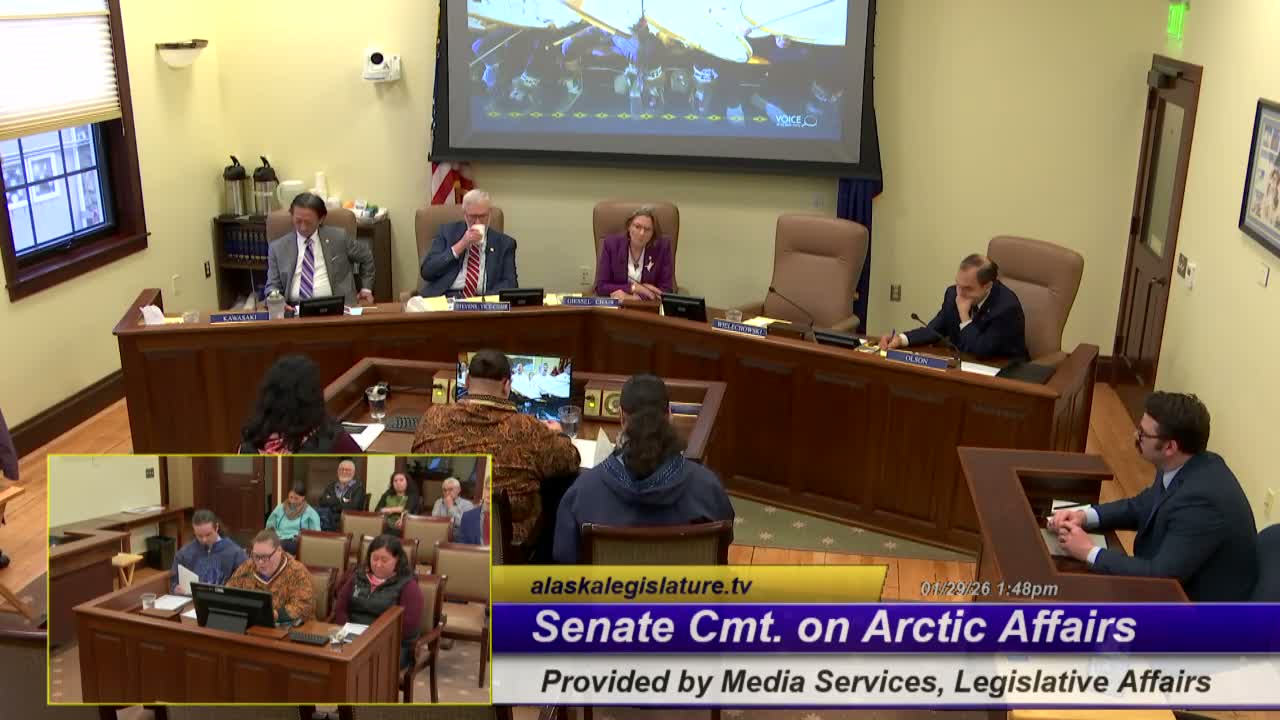
ICAS tells lawmakers tribal emergency management and food programs filled gaps after outages and storms
Loading...
Summary
Megan Edwardson of the Inupiat Community of the Arctic Slope told senators that ICAS established a regional Department of Emergency Management (formally in 2023) and secured IPAWS alerting authority to coordinate alerts, that repeated fiber-optic cuts disrupted 911 service and led ICAS to seek FEMA recognition, and that ICAS runs hunter-gatherer food-security programs and a pilot tribal school (Covingay Academy) seeking sustainable funding.
Megan Edwardson, vice president of the Inupiat Community of the Arctic Slope (ICAS), told the Senate Special Committee on Arctic Affairs that local, tribal-led emergency management filled gaps during recent regional crises and remains essential to protecting life and subsistence ways of life.
Edwardson described ICAS’s Department of Emergency Management, established during the COVID-19 response and formalized in 2023, which now runs a regional emergency operations center, incident-command training across communities, a multijurisdictional hazard mitigation plan, and direct government-to-government communications with federal agencies. ICAS has an integrated public alert and warning system (IPAWS) Arctic-wide alerting authority (wireless emergency alerts and emergency alert systems) obtained in 2022 and used for dozens of storm, sheltering and logistics notices.
She told senators that recurring breaks in a fiber-optic line caused severe communications outages: ICAS submitted a tribal emergency declaration to FEMA in 2023 that was denied, then submitted again after a second cut in 2025 and the event was ultimately recognized as a natural disaster. Edwardson said that when the line went down one year communities could not make 911 calls and "we actually lost a child in 1 of our communities because they couldn't call 911." She described coordinated responses with North Slope Borough and federal partners and cited exercises such as the Arctic Integrated Emergency Management course conducted with FEMA in September 2025.
Edwardson also outlined socially rooted programs that support food security: a hunter-gatherer program that stocks elders and those who cannot hunt and that in one recent October sent about 2,000 pounds of caribou to a community that had poor hunting returns. She described a thermosiphon pilot to protect failing ice-cellars from permafrost melt and a nascent tribal K-12 option, Covingay Academy in Wainwright, which ICAS is working to sustain and to integrate into state funding via compacts and the Alaska Native Tribal Education Consortium (ANTEC).
Why it matters: Edwardson framed these programs as exercises in tribal sovereignty and practical response — asserting that geographically isolated communities need culturally appropriate alerts, local incident coordination and sustainable education funding to maintain subsistence and resilience.
The committee asked follow-up questions about BSA funding for tribal schools and possible state compacts; ICAS said it will follow up with details.