
Legislative finance warns of a $1.5 billion FY27 shortfall and flags Medicaid, ferry grants and SNAP-match risks
Get AI-powered insights, summaries, and transcripts
Subscribe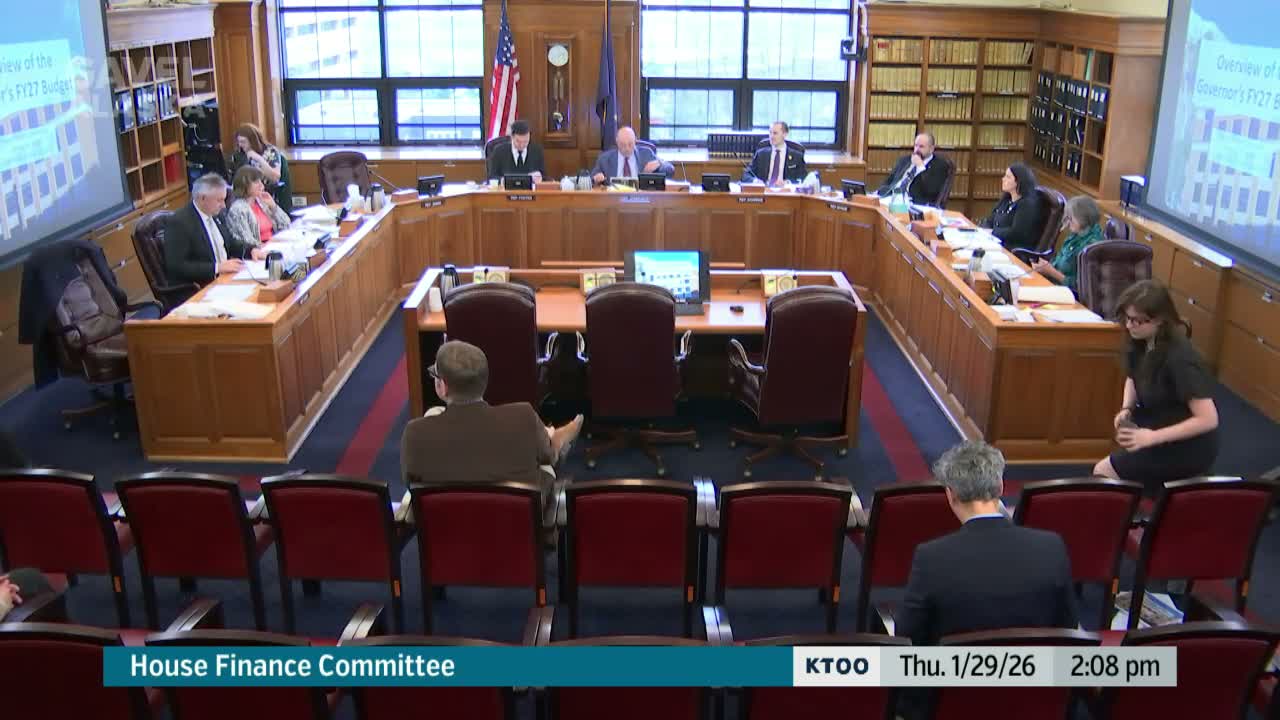
Summary
Legislative Finance Division briefed the House Finance Committee on Jan. 29 on the governor's FY27 budget, reporting an adjusted-base outlook that shows a projected FY27 deficit of just over $1.5 billion and citing risks including Medicaid supplementals, uncertain federal grants for the Alaska Marine Highway System and potential SNAP administrative-match liabilities.
Alexi Painter of the Legislative Finance Division briefed the House Finance Committee on Jan. 29 on the governor's FY27 budget and the division's fiscal analysis.
Painter said agency operations in the governor's proposal are nearly flat against the adjusted base but that the state faces a combined fiscal gap across FY26 and FY27. He described a post-transfer FY26 deficit on the adjusted base and told members that, using the governor's assumptions, the FY27 post-transfer deficit was "just over $1,500,000,000." The governor proposes filling FY26 and FY27 shortfalls partly by drawing from the Constitutional Budget Reserve (CBR) and by using a full statutory Permanent Fund Dividend (PFD) draw under the POMV framework.
Painter highlighted several items likely to come forward as supplementals or adjustments and therefore not reflected in the governor's December budget release. He said the Department of Health projected an additional $47,400,000 of unrestricted general funds needed in FY27 for Medicaid due to updated projections; that sum was not included in the governor's initial proposal. Painter also raised the Alaska Marine Highway System (AMHS) as a material uncertainty: the governor's FY26/27 approach assumed significant federal ferry grant receipts that have not yet been advertised or awarded and therefore create operational risk for the ferry system if the anticipated grants are not obtained.
Painter pointed to SNAP administrative-match changes under recent federal law as another potential liability, estimating the state exposure could be in the millions (the Department of Health estimated an increase of roughly $10,700,000 related to SNAP administrative-match duties, not including downstream program impacts). He also noted a range of known and unknown items that commonly add to the December baseline during the session (for example, guide-house rate-rebalancing studies for behavioral-health and autism rates that may require additional general funds).
On capital budgeting, Painter described the governor's capital program as match-heavy (about 81% general-fund match to federal dollars) with little unrestricted general fund for new state priority projects and no new direct school construction funding in the governor's capital proposal. He said deferred-maintenance funding remained a small fraction of the estimated state facility backlog.
Painter discussed long-term structural issues as well: percent-of-market-value (POMV) draws and ERA (earnings reserve account) balances create variability in the amount available for the general fund in future years. He presented probabilistic modeling showing nontrivial chances that ERA balances could be insufficient to make the full POMV draw in coming years under some assumptions, and noted the governor's fiscal plan reduces statutory PFDs under its proposals while adding some revenue measures but likely leaves a remaining gap without further policy changes.
Committee members asked follow-up questions about university salary requests versus the governor's funding, the treatment of noncovered employees, the PCE/community-assistance waterfall calculation, and the timing of potential AMHS grant notices. Painter answered that some items could be addressed as supplementals and that the division would provide further verifications and figures on request.
Co-chair Josephson closed the presentation, reminded members the committee would receive a Department of Revenue presentation the next day on savings/reserves/investments, and adjourned the meeting at 3:16 p.m.