Get AI Briefings, Transcripts & Alerts on Local & National Government Meetings — Forever.
North Slope leaders tell Senate Arctic Affairs panel they seek durable self-determination
Loading...
Summary
Leaders from Voice of the Arctic Inupiat told the Alaska Senate Arctic Affairs Committee Jan. 29 that decades of organized local institutions — from borough government to tribal organizations and corporations — represent a continuing effort to secure self-determination amid federal and state land decisions, citing historical battles over Project Chariot, ANCSA and ANWR.
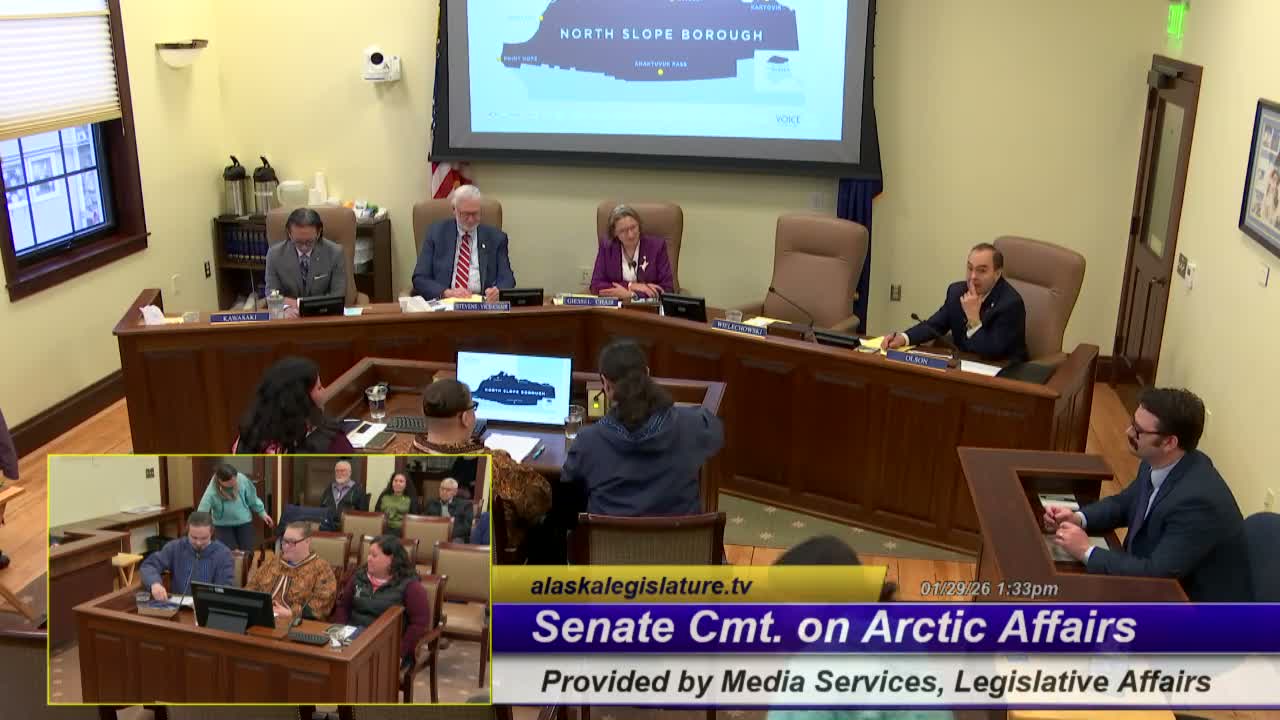
Nogorro Karchark, president and CEO of the Voice of the Arctic Inupiat, told the Senate Special Committee on Arctic Affairs on Jan. 29 that North Slope communities have long organized to defend land rights and local authority and continue to press for meaningful inclusion in decisions affecting the region.
Karchark reviewed a timeline of actions that shaped the North Slope’s political landscape: early federal land designations (including Naval Petroleum Reserve No. 4), the passage of the Alaska Native Claims Settlement Act (ANCSA) in 1971, the later creation of the Arctic National Wildlife Refuge (ANWR) and the formation of regional institutions such as the Arctic Slope Regional Corporation and the North Slope Borough. He said those developments split political and economic functions and that local tribes have worked to preserve sovereignty and subsistence lifeways.
Karchark cited historical community resistance as formative: opposition to Project Chariot in the late 1950s and early 1960s; the founding of Tundra Times and the Alaska Eskimo Whaling Commission in the 1960s and 1970s; and the creation of the Inuit Circumpolar Council and the North Slope Borough Department of Wildlife Management. “When we stand together, blending our voices with evidence, we can redirect the course of history,” he said.
He also described recent federal policy shifts that affected local economic plans and land access, noting that Voice of the Arctic Inupiat and member organizations have pursued litigation and advocacy in response to changes in NPRA and ANWR lease decisions. Karchark said the Voice was formed in 2015 to coordinate legislative priorities across tribes, borough government, Alaska Native corporations and regional organizations and that membership is consensus driven with representation from multiple entities across the North Slope.
Why it matters: Karchark told senators that durable policy must be made with local communities, not only for them. He framed that goal as necessary both for cultural survival and for managing the economic benefits and risks associated with resource development in the Arctic.
The committee did not take formal action on the presentation. Karchark offered follow-up contacts and emphasized the Voice’s willingness to provide testimony or data on issues raised by senators at future hearings.