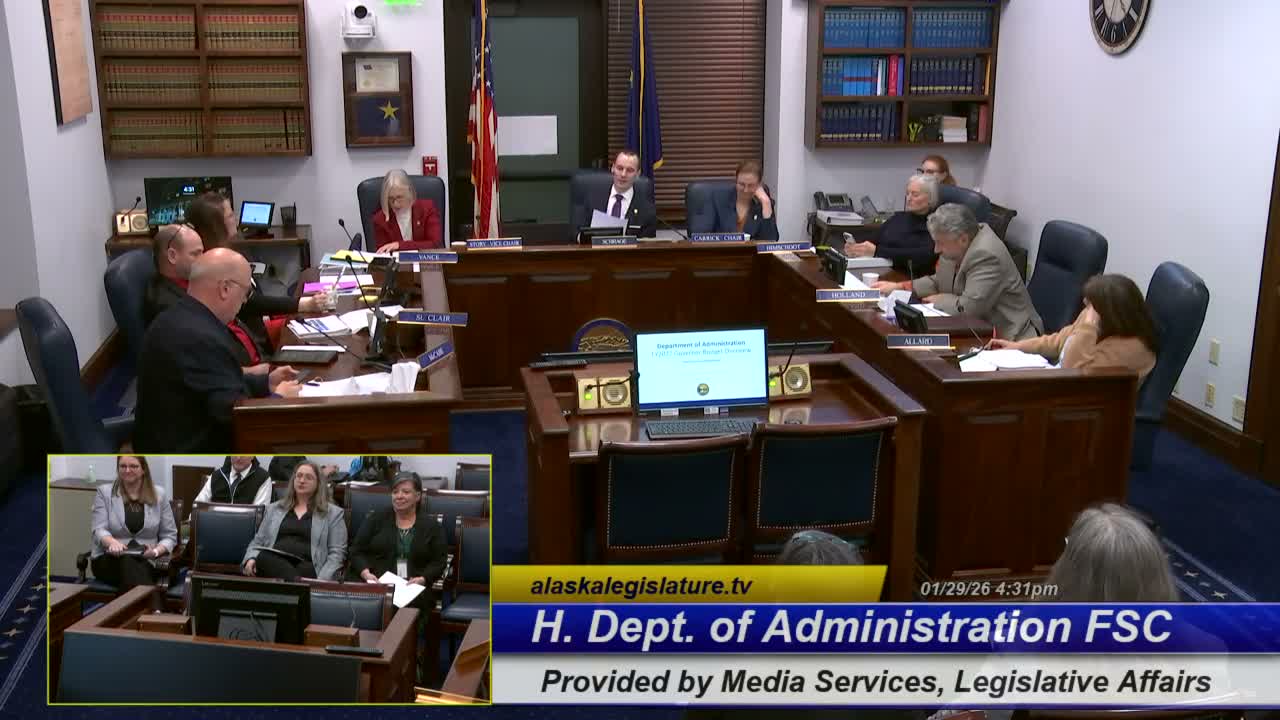
House Finance subcommittee reviews Department of AdministrationFY27 budget, position transfers and IT pilots
Loading...
Summary
State DOA presented a $350 million FY27 budget request, detailed the transfer of dozens of shared-services positions back to agencies, reported an 11.9% vacancy rate across divisions, and discussed limited Microsoft 365 Copilot piloting and IT cost pressures.
The Alaska House Finance Department of Administration Subcommittee on Thursday reviewed the Department of Administration's proposed fiscal year 2027 budget, a plan that Department officials said totals roughly $350 million and shifts dozens of payroll and shared-services positions back to individual agencies.
The presentation and follow-up questioning centered on fund-source changes, the reorganization of shared services, information technology costs and pilots, and service delivery timelines in retirement benefits and public defense.
Director Stephanie Bingham, who the committee introduced as the department's Administrative Services Director, told members she had been in the role about six months and was presenting the governor's FY27 request. "Today, I provide an overview of the governor's fiscal year 27 budget for our department," she said.
Bingham said DOA's FY27 proposed budget totals about $350 million, up from about $340 million in FY26. She said unrestricted general funds in the proposal total roughly $99.8 million (up from $96.6 million), designated general funds about $36.5 million, other funds approximately $212.3 million (largely interagency receipts), and federal funds roughly $1.3 million. The department emphasized that its largest single fund group is "other funds," reflecting interagency billing for enterprise services such as Information Technology and central administrative services.
A large portion of the presentation described organizational changes. Bingham said the Division of Shared Services is being eliminated and many positions are being transferred back to departments. She outlined that 57 shared-services positions will move out of DOA, and the Division of Finance will receive 24 permanent full-time positions and six non-perm positions; 40 payroll positions will move back to agencies with department-level distributions Bingham listed (Corrections 8, Fish & Game 6, Law 1, Military & Veterans Affairs 1, Natural Resources 4, Public Safety 3, and Transportation & Public Facilities 17).
Members pressed for detail on whether the receiving departments have the budget authority and the operational capacity to absorb those positions. Bingham said the departments already have the authority to pay those positions and that the transfers generally shift both the revenues and expenses that previously flowed through DOA. She agreed to provide position counts and additional follow-up where members requested more detail.
Information technology and software costs drew particular attention. Representative Holland asked about a prior-year request for approximately 2,000 Microsoft 365 Copilot licenses that did not proceed. The committee called on Chief Information Officer Bill Smith to explain the current approach. "When that was not included, we did move forward with a small scale pilot that was funded internally for about 200 users," Smith said. He added that agencies have purchased additional licenses on their own and that, to date, "we have about 800 licenses that are in use across the state." Smith said OIT is monitoring adoption and cost-effectiveness rather than pursuing the large-scale purchase originally proposed.
Smith also answered questions about increasing enterprise software and cloud storage costs, saying the state has seen 10'120% service-renewal price increases and rising storage demand for security logging and modern systems. He said OIT is evaluating efficiency measures and retention policies to limit unnecessary storage costs.
Committee members raised operational-service concerns as well. Kathy Lee, director of the Division of Retirement and Benefits, told the committee a reorganization last year reduced processing times from as long as 14'6 weeks back to a typical 4'66 week window, and that "we are still largely meeting our 4 to 6 week processing time with about 80% of our retirements processed during that period." She also said a hiring freeze and some unfilled positions continue to cause occasional delays when additional documentation is required to complete benefits claims.
On legal and advocacy services, Bingham said the FY27 proposal increases the budget for public defense and related services by about $2.9 million and includes one Alaska Mental Health Trust-funded social worker for the Public Defender Agency. Representative Holland pointed to persistent performance shortfalls in key metrics such as client contact within three days of a court appointment and timely predisposition reporting; Director Stinson, who oversees those legal services, said client-centered factors and court-side delays complicate meeting uniform targets and offered to provide follow-up analysis to the committee.
Bingham reported that the department's overall vacancy rate for FY26 was about 11.9%, with higher percentages in risk management and the Alaska Public Offices Commission (APOC). The committee noted an APOC slide was omitted from the packet; Bingham apologized and said the missing slide would be provided to members after the hearing.
The subcommittee did not take formal votes on items at the hearing; members asked for follow-up detail, including position counts for transferred roles, aggregated federal receipt-authority realization, and additional IT cost and pilot data. Chair Schrage adjourned the meeting at 5:17 p.m.
The committee requested written follow-ups on agency ability to realize federal receipts, position-count detail for transfers, additional metrics on the Copilot pilot and OIT licensing costs, and a corrected APOC slide.