
Alaska Department of Health outlines $272 million Rural Health Transformation award, details limits and rollout plan
Get AI-powered insights, summaries, and transcripts
Subscribe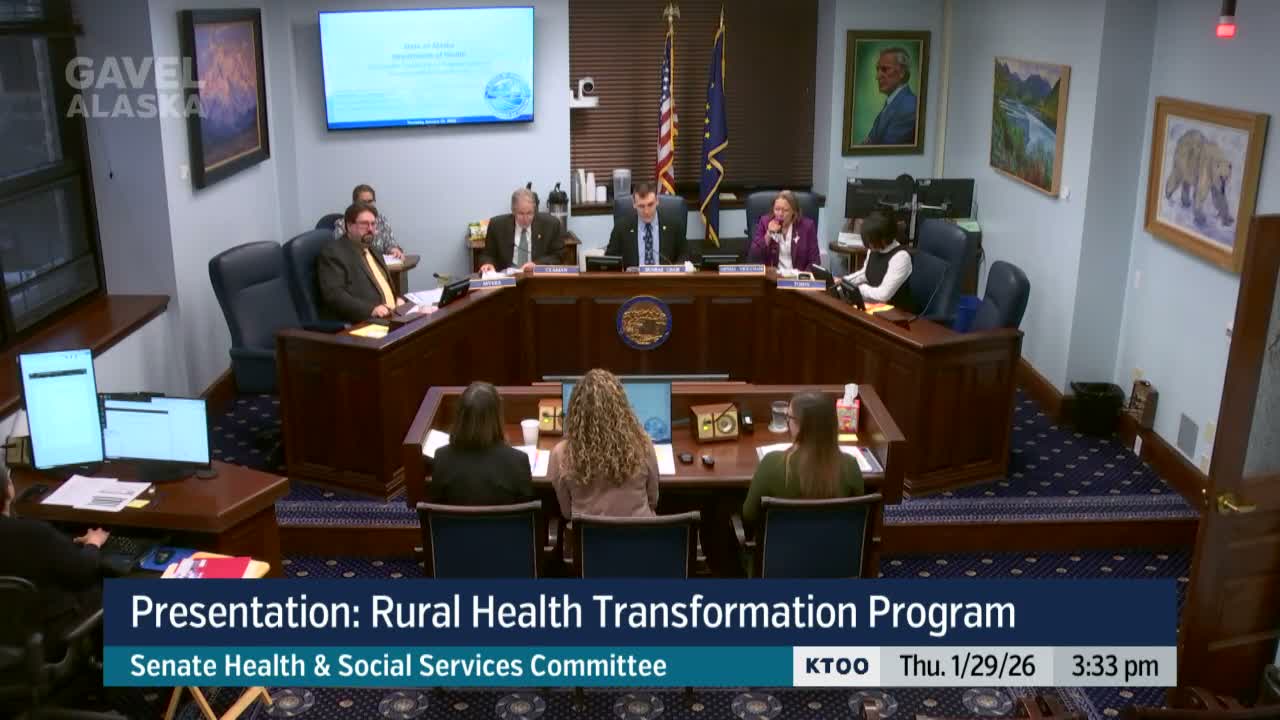
Summary
The Department of Health briefed the Senate Health and Social Services Committee on the federally funded Rural Health Transformation Program, saying Alaska received $272 million in year-one funding and describing program goals, allowable uses, reporting, oversight by CMS, and application pathways. Lawmakers pressed officials on long-term sustainability, oversight, and which policy commitments require legislative action.
The Alaska Department of Health told the Senate Health and Social Services Committee on Jan. 29 that the state received $272,000,000 in year‑one funding through the federal Rural Health Transformation Program, a one‑time, five‑year cooperative agreement intended to expand access and transform health care delivery across Alaska.
Commissioner Heidi Hedberg said the application was developed with broad stakeholder input and intentionally framed to be both competitive and flexible. ‘‘This is a one‑time five‑year investment intentionally designed not to sustain the status quo but to transform health care delivery, expand access and improve outcomes,’’ Hedberg said.
Deputy Commissioner Emily Ricci outlined the program’s three high‑level goals: promoting lifelong health, building sustainable outcome‑driven systems, and driving workforce and technology innovations. The application identifies six funding use categories with examples that include maternal‑health capacity and remote fetal monitoring, expanded behavioral‑health services, upgrades to specialized EMS equipment, home‑and‑community supports, chronic‑disease community programs and support for traditional healing practices identified by tribal partners.
Ricci and Associate Director Betsy Wood said the award is a federal cooperative agreement with the Centers for Medicare & Medicaid Services (CMS), which will review and approve budgets, personnel, and key activities. CMS will also rescore and re‑rank states annually; officials said CMS can reduce future awards or reclaim portions of funds tied to unmet policy commitments. ‘‘There is an annual review where CMS will look at progress and may redistribute or reduce funds if milestones are not met,’’ Wood said.
DOH staff cautioned about prohibited and limited uses. The department said CMS treats the program as a non‑construction grant: new construction and purchasing land are prohibited, but renovations may be allowable within unclear boundaries. Broadband infrastructure purchases (such as buying satellites) are restricted unless CMS provides explicit approval; direct cash payments to individuals and provider loan repayments are prohibited, though retention and relocation incentives may be permitted. Officials said the department is actively seeking CMS clarification on several gray areas.
To administer grants statewide, DOH announced a contract with the Alaska Community Foundation to act as a subrecipient administrator and help distribute funds to community applicants. Wood said DOH will cap administrative spending at 10% of the award and expects to use administrative funds to stand up a web application portal, a letter‑of‑intent process, planning grants, project implementation grants and an administrative readiness pathway for smaller organizations.
Officials said projects must include a sustainability plan as part of the application and that DOH will contract with an independent evaluator to track outcomes and report publicly via a dashboard. ‘‘We want to make it more accessible through a dashboard than what we necessarily have right now,’’ Wood said, describing plans for regular web updates and a listserv for applicants.
Lawmakers repeatedly asked about long‑term sustainability after the five‑year period and about the degree to which promises in Alaska’s application depend on policy changes. Ricci said two of eight policy commitments identified in the NOFO will require legislative action; the remaining items can be addressed by regulations or administrative changes. Officials said exact point weights tied to those policies are set by CMS and are not yet publicly known, so the department cannot translate percentages into certain dollar amounts until CMS provides further guidance.
Committee members raised oversight concerns given past federal audit findings for state grant reporting. Hedberg said DOH will create eight new program positions funded from the Rural Health Transformation Program to support accounting and project implementation and that all grant activity and an independent evaluation will be posted publicly.
What’s next: DOH plans to open a web portal and host applicant webinars soon, accept letters of intent, and provide multiple application windows tied to federal budget periods. Officials urged prospective applicants to align with Alaska‑based providers; DOH said applications that clearly show Alaska partnerships will be more competitive.
Contracting, CMS approvals and annual re‑scoring mean award amounts for future years could change; CMS will post updated award amounts each fall and redistribute unspent funds. The committee scheduled follow‑up hearings; DOH was asked to provide model compact legislation and other documentation where CMS references specific policy commitments.
Ending: The committee recessed after scheduling a return presentation that will include SNAP and Medicaid updates related to HR 1.