Get AI Briefings, Transcripts & Alerts on Local & National Government Meetings — Forever.
House Resources Committee hears bill to create climate change response fund funded by 20¢/barrel surcharge
Loading...
Summary
On Jan. 30, 2026 the Alaska House Resources Committee heard introductory testimony on HB247, which would add a 20¢ per taxable barrel surcharge to create a climate change response fund administered by DEC, projected to raise about $33 million annually; supporters argued it funds mitigation and saves money, while members raised constitutional, fairness and fiscal‑note questions.
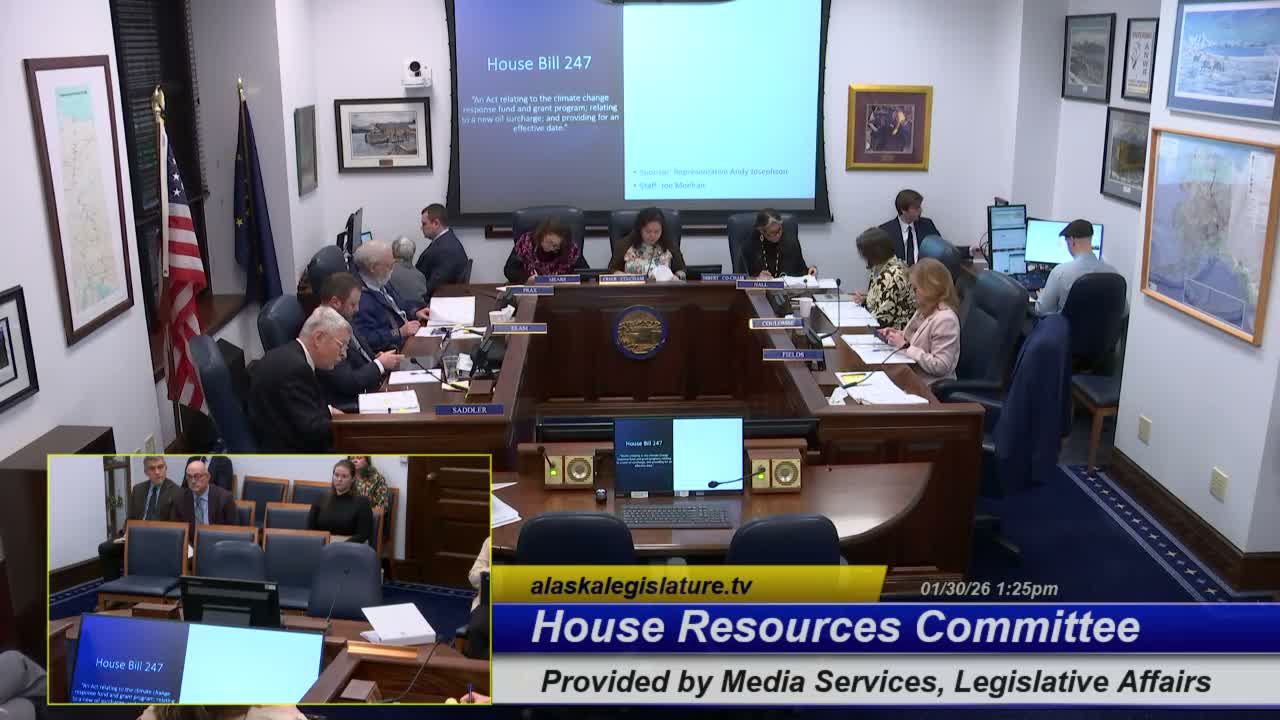
Representative Andy Josephson introduced HB247 at the House Resources Committee hearing on Jan. 30, 2026 in Capitol Room 124, proposing a 20¢ per taxable barrel surcharge to fund a new climate change response program administered by the Department of Environmental Conservation (DEC).
Josephson said the surcharge would be deposited into the general fund and allocated to a climate change response fund to provide grants to nongovernmental organizations, tribal governments and political subdivisions. "This bill, we think, is is vitally important," he told the committee, framing the measure as a structural response to rising disaster costs and fragile fiscal capacity.
Sponsor staff presented the bill's fiscal data and program mechanics. Joe Meehan summarized the proposal, saying it would amend AS 43 to add a surcharge and establish criteria and reporting requirements for a grant program administered by DEC. The committee was told the fiscal note estimates about $33,000,000 in annual revenue from the surcharge and that DEC would use roughly 4% of receipts for program administration.
Witness testimony emphasized the case for mitigation. Rick Steiner of Oasis Earth urged support, arguing climate disasters and costs are increasing and that targeted mitigation produces net savings. "HB 247 starts to fill the pipeline here to provide that sort of money that our communities desperately need," Steiner said, and he reiterated a commonly cited mitigation ratio that "for every $1 spent in proactively, save $6 in response."
Committee members pressed on several practical and legal issues. Multiple members questioned the premise of tying an oil‑throughput surcharge to climate impacts, whether the revenue could be constitutionally dedicated, and the fairness of a broadly applied surcharge to companies that claim emissions reductions or net‑zero commitments. Representative Sadler and others warned the provision could be viewed as "dipping into the revenue stream of the pipeline" and asked how the proposal differed from existing disaster relief accounts.
Theresa Melville, director of DEC’s Division of Spill Prevention and Response, explained the fiscal note and administrative assumptions. She told the committee that startup costs would require general‑fund support in the first year (about $1.2 million) because surcharge revenue was not expected until a later fiscal year; the fiscal note anticipates grant outlays to begin in subsequent years once revenue flows are established.
The presentation and questioning also referenced outside research: Josephson and staff cited a federal/ANH‑affiliated report noting unmet needs in many Alaska Native villages and a legislative research finding that the state spent an estimated $361 million on disaster relief over the last 20 years. Proponents argued that a reliable state revenue stream could leverage federal funds and finance prevention that reduces future response costs.
The committee did not vote on HB247; after invited testimony and questions the bill was set aside for further consideration.
Next steps: HB247 was set aside for later action by the House Resources Committee; no deadline or vote was announced at the Jan. 30 hearing.