Treasury tells Alaska House Finance it manages $58 billion, CBRF near $2.9 billion and 2025 returns were strong
Loading...
Summary
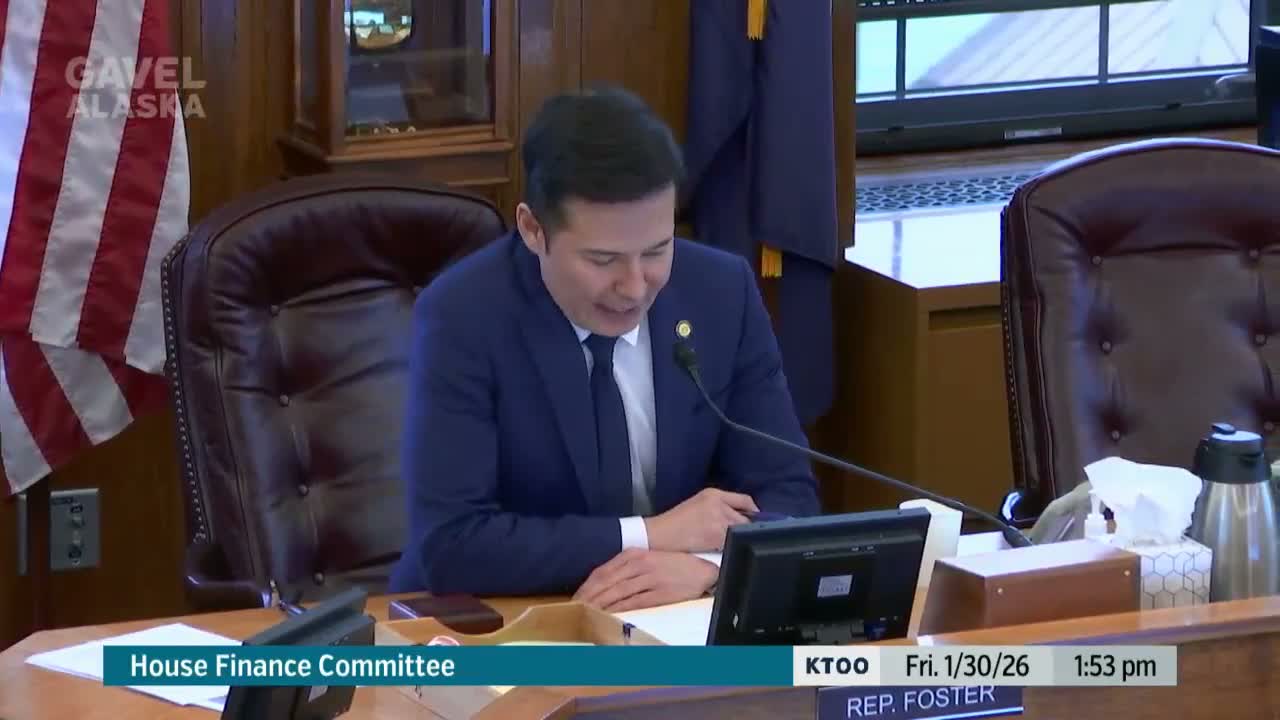
The Department of Revenue's Treasury briefed the House Finance Committee on Jan. 30, 2026 about cash management, the $2.93 billion Constitutional Budget Reserve Fund, pooled investments and investment returns, saying Treasury manages roughly $58 billion and recorded strong 2025 gains.
The Alaska Department of Revenue's Treasury Division told the House Finance Committee on Jan. 30 that it manages roughly $58,000,000,000 in state assets and that the state's primary rainy-day account, the Constitutional Budget Reserve Fund (CBRF), had an invested balance of about $2,930,000,000 as of June 30, 2025.
Acting Commissioner Janelle Earls introduced treasury director Pam Leary and Chief Investment Officer Zach Hanna, who said Treasury's front-, middle- and back-office teams (about 40 staff) execute roughly 120,000 trades a year and oversee investment policy, compliance and daily cash forecasting. "Managing cash flows and investing $58,000,000,000 in numerous investment funds is as complex as it sounds," Leary said.
Hanna described the investment review process Treasury uses to set policy for more than two dozen pooled investment vehicles and said 2025 produced strong market returns. He told the committee Treasury recorded an aggregate return of about 12.9% across the funds it manages in 2025, producing roughly $6,700,000,000 in calendar-year gains. Hanna said much of the year's performance was driven by strong equity returns, including substantial gains in international equities.
On liquidity, Leary told members the CBRF and related statutory reserves are being managed conservatively: at year end the combined CBRF accounts were held primarily in cash equivalents to preserve principal and meet short-term needs. She said the combined CBRF accounts returned about $127,000,000 in net gains in 2025, with one-year performance above benchmark.
Committee members pressed Treasury on how rating agencies view Alaska's reserves and whether best-practice formulas exist for the size of a rainy-day fund. Leary said Pew Research ranks Alaska high in days of coverage and that Alaska's reserves represented about 191 days of operating expense under the Pew methodology; she added that rating agencies evaluate multiple factors, including fiscal restraint and revenue stability.
Hanna also reviewed pooled accounts (described in the presentation as the "Jafonzy" pools), the Public School Trust Fund, retirement systems and the Alaska Higher Education Investment Fund, and offered to provide members more detailed, date-specific return calculations by email. "We review financial markets and performance for each fund quarterly," Hanna said. "The full, quarterly investment review packets are available online."
The committee did not take formal action on Treasury recommendations during the Jan. 30 session. Treasury staff told members they would follow up with written details on returns and the effects of recent fund transfers. The committee adjourned at 2:53 p.m.; its next meeting is scheduled for Feb. 2, 2026, at 1:30 p.m.