DNR tells Senate panel North Slope holds tens of trillions of cubic feet of gas; Prudhoe Bay CO2 content, off-take limits pose technical and revenue questions
Loading...
Summary
DNR told the Senate Resources Committee that known North Slope fields contain roughly 30 trillion cubic feet (TCF) of gas (with another ~200 TCF unexplored), highlighted Prudhoe Bay's 10–15% CO2 content and AOGCC 2015 off-take limits, and recommended further modeling of revenue and reservoir impacts before large-scale sales begin.
The Alaska Department of Natural Resources told the Senate Resources Committee on Jan. 30 that North Slope gas resources are large but technically and commercially complex, with policy consequences for any Alaska LNG export project.
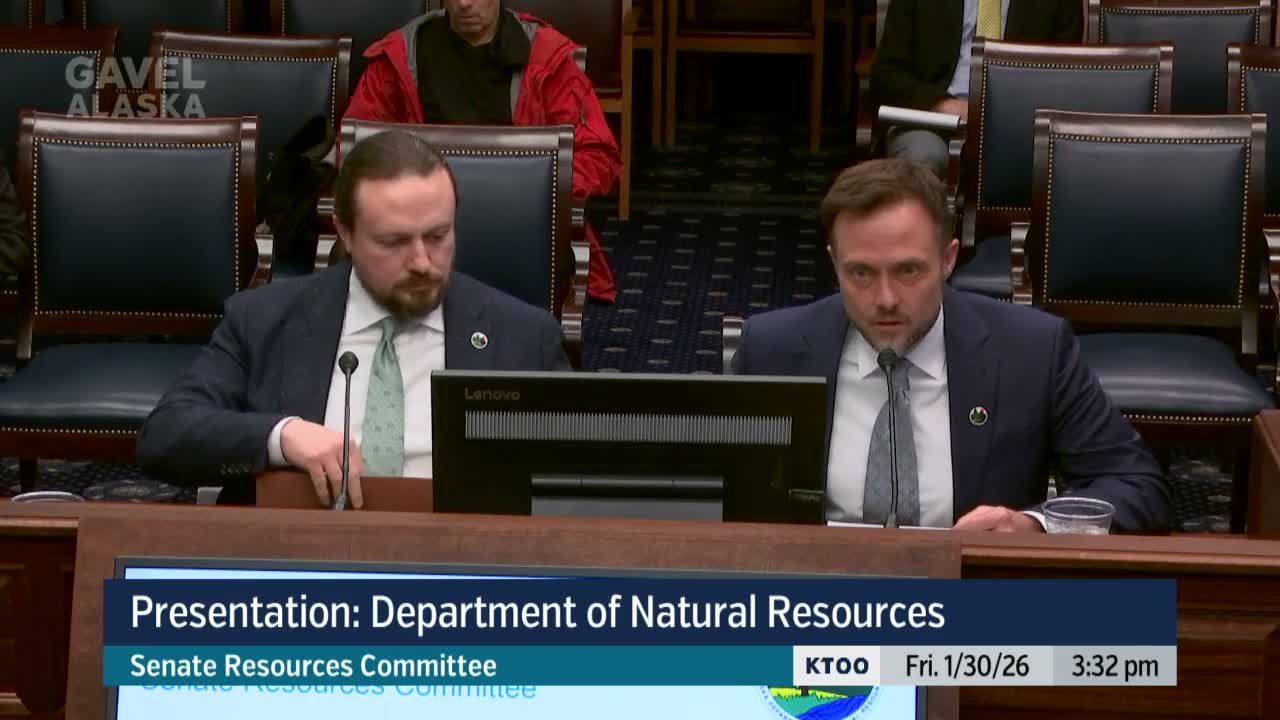
Derek Nottingham, director of the DNR Division of Oil and Gas, said the agency’s evaluation of public data shows roughly 30 trillion cubic feet (TCF) of known gas in major North Slope units — including Prudhoe Bay, Point Thompson, North Star and Endicott — and that unexplored acreage could contain another 200 TCF or more. Nottingham told the committee the southern Alkade, Talitha and Tulip River units could add up to about 7 TCF but are still in appraisal and have not demonstrated commercial rates.
Why it matters: That scale can support multi-phase exports but raises technical hurdles and choices about sequencing. Nottingham said Prudhoe Bay’s gas cap has historically contained an estimated 46 TCF of gas and that DNR’s working estimate of available Prudhoe gas is up to about 22 TCF, subject to constraints including an AOGCC maximum off‑take order and gas quality.
"There are other producing fields that have what we call gas caps or associated gas ... but we're not gonna discuss those today," Nottingham said, summarizing the slide deck the department used for its briefing. He apologized for switching between BCF and TCF nomenclature during the presentation that drew questions from senators.
Technical constraints and facilities: Nottingham emphasized that Prudhoe Bay gas has a relatively high CO2 content ("somewhere in the 10 to 15% range"), which would require a large carbon‑removal facility to meet pipeline‑quality specifications. Point Thompson and North Star were described as lower‑CO2 candidates, while Duck Island (Endicott) has both infrastructure and higher‑CO2 limitations that make it a lower priority for early export phases.
Reservoir and offtake tradeoffs: AOGCC reservoir engineer Dave Roby told the panel that major gas sales would lower reservoir pressure at Prudhoe Bay and consequently reduce recoverable oil; he noted that retained gas has historically supported pressure and enhanced oil recovery. Roby and Nottingham both referenced AOGCC conservation orders issued in 2015 that include maximum off‑take rates (Prudhoe Bay’s order cited at 3.6 BCF/day) that would cap sales unless AOGCC revises or updates those orders.
Revenue and modeling: Senators pressed whether DNR or AOGCC decides how to balance oil production value against gas sales. John Crother, DNR commissioner designee, said AOGCC holds technical authority to set offtake orders but the department can model royalty and revenue outcomes and work with the Department of Revenue to estimate fiscal impacts, including tax and royalty differences between oil and gas sales.
Next steps: DNR told the committee it can provide revenue modeling based on assumptions about gas volume, production impacts and prices; the committee set a follow‑up to solicit more data and to hear North Slope producers at its next meeting on Feb. 2.
The presentation and Q&A left unresolved the sequencing of fields to supply an AK LNG project, the timeline for CO2 treatment facilities and whether existing off‑take orders would be revised as projects advance.