Get Full Government Meeting Transcripts, Videos, & Alerts Forever!
Get email alerts on the Stormwater And Sewer Management topic
No spam. Unsubscribe anytime.
DEP proposes seasonal chlorination/dechlorination at two Flushing Creek outfalls; hearing closes with no public testimony
Summary
The New York City Department of Environmental Protection presented a plan to seasonally disinfect combined sewer overflows to Flushing Creek using injection and dechlorination facilities at TI‑10 and TI‑11, claiming about 91% disinfection during the recreation season; the Queens Borough President hearing closed with no public speakers and the land‑use review continues.
The New York City Department of Environmental Protection on Thursday presented a plan to disinfect combined sewer overflow (CSO) discharges into Flushing Creek by installing seasonal chlorination and dechlorination facilities at two outfalls, TI‑10 and TI‑11, DEP staff told the Queens Borough President’s land use public hearing.
“We have proposed for Flushing Creek a disinfection program,” Deputy Commissioner Angela Licata said in the presentation, describing the proposal as a cost‑effective alternative to very large storage tunnels. DEP officials and consultants said disinfection would target the recreation season (May 1–Oct. 31) and be controlled to meet New York State’s total residual chlorine limit of 0.1 milligram per liter.
DEP and its consultants presented results from hydrologic, hydraulic and computational fluid dynamics modeling that, they said, show the system could disinfect about 91% of CSO flows that reach the creek during the recreation season, exceeding the LTCP target of 88%. “We believe we can achieve about 91% disinfection,” Arcadis engineer Timothy McDonald said while reviewing modeled overflow frequency and dilution assumptions.
Why disinfection? DEP said Flushing Creek receives more than 1 billion gallons of CSO annually, making a storage tunnel of the size needed impractical. “In order to get an equivalent disinfection that we’re proposing, for Flushing Creek, we would need a tunnel of over 200,000,000 gallons,” Deputy Commissioner Licata said, and building an equivalent tunnel would take “decades and multiple billions of dollars.” DEP contrasted that with a 43,000,000‑gallon retention facility already constructed upstream of TI‑10.
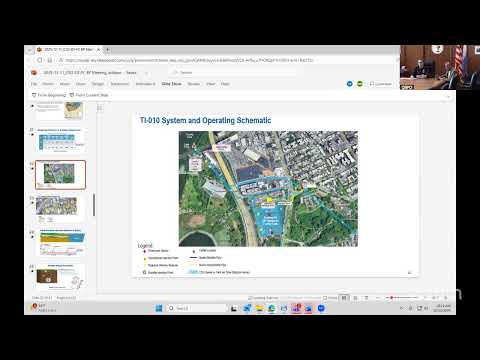
What’s proposed and where: DEP described two treatment locations. For TI‑11, DEP proposes a new facility on 32nd Avenue beneath the Whitestone Expressway traffic triangle; for TI‑10, chlorination would occur within the existing CSO facility with a separate dechlorination building sited on a portion of a Home Depot lot on Avery Avenue that DEP would seek to acquire if approved. The project requires mapping/demapping actions to create buildable lots at TI‑11, DEP said.
Controls, safety and monitoring: Consultants said the system would add sodium hypochlorite at upstream injection points when sensors detect a CSO event, then use total residual chlorine (TRC) analyzers and automated controls to dose sodium bisulfite for dechlorination before the outfall if residuals exceed the state limit. Arcadis described double‑contained piping with continuous leak detection, concrete trench boxes in rights‑of‑way for additional containment, redundant tank and pump systems inside each facility, remote monitoring and operator intervention as a final fail‑safe.
DEP also noted non‑chemical measures. Keith Mahoney of DEP’s CSO team said the agency has built more than 2,000 green infrastructure assets in the drainage area and a 43,000,000‑gallon CSO retention facility; the agency is also pursuing a 19‑acre wetland restoration with the Army Corps of Engineers. Mahoney said DEP has committed to spending $3.5 billion in green infrastructure citywide by 2040 but did not provide a precise estimate of how many gallons of CSO additional GI will remove in this drainage area, saying only that it would likely be “tens of millions of gallons” per year.
Environmental review and schedule: Mitchell Wimbush said DEP released an Environmental Assessment Statement in September, received no comments, and issued a negative declaration on Oct. 1 (no significant adverse impacts identified). DEP said it is proceeding through the EULIP/land‑use approval process, aiming to complete that phase in May, with property acquisition targeted for November 2026 and about a three‑year construction window from late 2026 through 2029.
Questions from the chair focused on debris and safety. The chair asked whether the plan addresses floatable trash; DEP said separate floatables controls are already in construction upstream of both TI‑10 and TI‑11 and are expected to be in place next year. On timing between chlorination and dechlorination, Arcadis said detention times vary by storm, tide and flow; worst‑case modeled contact times are roughly six minutes at TI‑11 and 10–13 minutes at TI‑10, with the bisulfite reaction described as effectively instantaneous and an additional 2.5–3 minutes of pipe travel after bisulfite addition in worst‑case scenarios.
Public testimony and next steps: There were no public speakers in person or on Zoom; the hearing was closed with coordination questions from agency staff about mapping and traffic analysis. The hearing did not include a formal vote; DEP’s land‑use applications (Euler numbers 250323MMQ and 250324PCQ) will continue through the borough president and city land‑use review process.
The hearing was chaired by Vicki Garvey, on behalf of Borough President Donovan Richards; DEP’s applicant team included Alfonso Lopez and staff members Monica Harvey, Angela Licata, Mitchell Wimbush and Keith Mahoney. The department’s consultants on the project included Arcadis (Timothy McDonald) and AKRF (Carrie Cebelli).