
Webinar: NIBIN workflows, ATF MROS and field models from Utah and Phoenix
Get AI-powered insights, summaries, and transcripts
Subscribe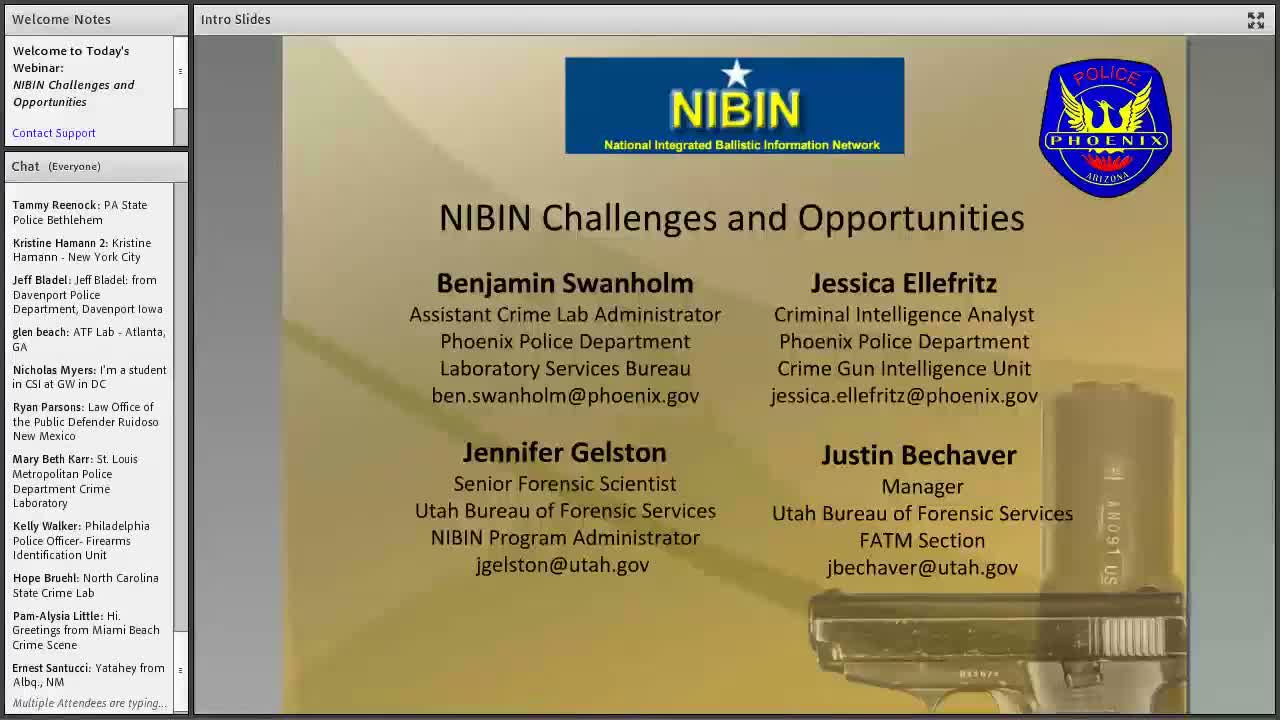
Summary
A training webinar hosted by RTI's Forensic Technology Center of Excellence laid out ATF recommended minimum operating standards for NIBIN timeliness and described how Utah and Phoenix reworked workflows—test‑fire envelopes, triage tiers, and investigator‑embedded teams—to deliver faster ballistic leads and link shootings across jurisdictions.
A webinar from the Forensic Technology Center of Excellence (AskCLAD Train‑the‑Director series) on NIBIN (National Integrated Ballistic Information Network) reviewed ATF’s Minimum Required Operating Standards (MROS) and presented two operational models for getting cartridge cases and firearms into the system quickly.
Benjamin Swanholm, assistant crime lab administrator for the Phoenix Police Department, emphasized the intelligence goal of NIBIN: "So gun crime, intelligence or crime gun intelligence is all about disrupting the shooting cycle." He summarized ATF's timeliness recommendations, noting MROS calls for rapid entry and review (discussed as 24–48 hours for entries and two business days for correlation and secondary review) and that leads should be disseminated within 24 hours.
Justin Beshaffer, Forensic Scientist Manager and technical leader for Utah’s Firearm and Toolmarks Section, described Utah’s earlier manual linkage work that connected roughly two dozen cases over 10 months and helped dismantle a gang case. Utah’s bureau moved to an automated acquisition system and developed procedures to screen multiple cartridge cases and enter representative samples to preserve laboratory capacity.
Jennifer Gelson (Utah Bureau of Forensic Services) and Beshaffer outlined their three‑tier operational approach: a screening lead (automated match), a confirmed hit (microscopic confirmation), and a full exam (court‑ready report). They described agency test‑fire envelopes and a fillable entry notification form to reduce confusion about what was entered, and a crime and intelligence center (CCIC) to coordinate analysts, ATF regional office liaisons and state investigators.
Phoenix Police Department’s investigator‑embedded model was presented by the program lead, who said the city processes approximately 3,100 firearm test fires and about 2,200 cartridge‑case bags annually and reported 411 NIBIN leads in the last year. Phoenix moved many NIBIN functions out of the accredited crime lab and into an investigations detail to meet timeliness goals. The presenter described daily retrievals from a centralized property warehouse, agreements with prosecutors to narrow when fingerprints are required, and a three‑tier prioritization based on violence and case profile. As an example of timeliness benefits, the presenter said a cartridge case submitted the morning after a homicide was compared and, by 9:00 p.m. that night, "we had linked the 2 cases together," enabling investigators to tie multiple homicides across neighboring jurisdictions within 36 hours.
Panelists addressed practical challenges in scaling NIBIN: staffing shortages, training and competency concerns that have led ATF to remove equipment from low‑volume sites, the need for standard intake procedures to avoid evidence loss, and the tension between preserving forensic evidence (prints/DNA) and meeting rapid entry goals. Several presenters recommended retaining test‑fires and selected cartridge cases in‑house where possible to enable rapid microscopic confirmation.
In a short Q&A, attendees asked whether MROS restricts submissions to law enforcement agencies (panelists read the MROS language as forbidding policies that inhibit submissions), whether there is a numeric throughput requirement to maintain NIBIN access (panelists said no firm public number was provided to them), and about error rates for automated matches (panelists cited unpublished local analyses and offered to supply related studies).
The organizers said they will distribute slides, an archived recording and an FAQ to attendees and follow up on questions that require ATF or other agency input. The webinar closed with a reminder about the next session in the AskCLAD series.