Get Full Government Meeting Transcripts, Videos, & Alerts Forever!
Get email alerts on the Substance Use Prevention topic
No spam. Unsubscribe anytime.
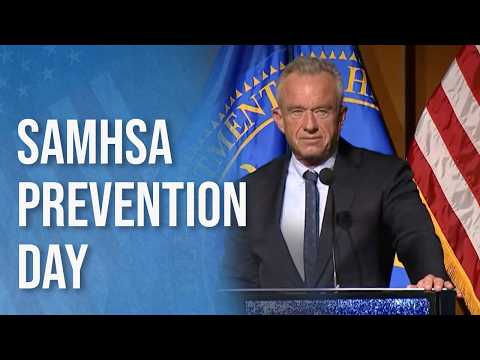
HHS Secretary Robert F. Kennedy Jr. announces $100 million STREETS pilot and major SAMHSA funding allocations
Summary
At SAMHSA's Prevention Day, HHS Secretary Robert F. Kennedy Jr. announced the STREETS pilot—a $100 million initiative to link outreach, treatment, housing and employment—and outlined roughly $1.28 billion in SAMHSA disbursements, assisted outpatient funding, and expanded eligibility for faith-based providers.
HHS Secretary Robert F. Kennedy Jr. used SAMHSA’s Prevention Day to outline a new prevention-and-recovery agenda, announcing a $100 million pilot called STREETS and additional large-scale funding for state mental-health and substance-use programs.
Kennedy framed the plan with his personal recovery history, telling the audience, “I have, now 43 years in recovery,” and stressing that “the secret sauce of recovery is service.” He said the administration will “ground our new policies on the hard learned lessons of experience and of gold standard science.”
Why it matters: Kennedy said the move shifts HHS toward prevention, integrated community care, and expanded access to treatment. He tied the announcements to a recent executive order and called for coordinated local responses that connect first contact on the street to treatment, housing and employment.
What Kennedy announced: He introduced STREETS (Safety Through Recovery Engagement and Evidence-based Treatment), saying, “Streets will invest a $100,000,000 in pilot programs” to help communities address homelessness and opioid addiction by building integrated care systems that move people from crisis into treatment and then to housing and work. He described STREETS as engaging people continuously from first contact through recovery and as involving law enforcement, first responders, courts, housing providers and health-care systems working together.
Kennedy also detailed multiple SAMHSA funding moves: he said SAMHSA will disburse $794,000,000 to states (with $319,000,000 designated to support comprehensive community mental-health services for adults with serious mental illness and children with emotional disadvantages), and will distribute $475,000,000 to the agency’s substance-use prevention and recovery block grant program. He announced $10,000,000 to support court-ordered assisted outpatient treatment for adults who meet clinical criteria, which he described as an alternative to more restrictive levels of care that can reduce hospitalizations and incarceration.
On child welfare and medication-assisted treatment, Kennedy said the Administration for Children and Families will allow states to use federal funding for FDA‑approved medication-assisted treatment when a parent’s substance use places a child at immediate risk of entering foster care, saying, “Early treatment protects children and keeps families together.”
Kennedy emphasized expanding funding access for faith-based organizations that meet evidence-based standards, including eligibility through state opioid response grants and mental-health and substance-use block grants. “Faith based recovery works and we will support what works,” he said.
Context and claims: Kennedy framed the policy shift by citing high economic and social costs of substance use; he said substance-use disorders cost an estimated $93,000,000,000 a year in direct costs and, when broader costs are included, drug abuse drains nearly $2,920,000,000,000 from the economy. Those figures were presented by the secretary as part of his remarks.
What’s next: Kennedy said he will visit recovery houses and prevention leaders nationwide over the coming months to solicit input and monitor implementation. There were no formal votes or regulatory texts presented at the event; the announcements outline agency plans and funding priorities that will require further operational guidance and implementation by SAMHSA and partner agencies.
—Reporting includes direct remarks from Secretary Robert F. Kennedy Jr. and introductory remarks from Christopher Carroll of SAMHSA.