Get Full Government Meeting Transcripts, Videos, & Alerts Forever!
Get email alerts on the District Staffing Attendance topic
No spam. Unsubscribe anytime.
Upper Darby SD review: surging English-learner and special-education populations heighten staffing, attendance pressures
Summary
District administrators told the Education & Pupil Services Committee that rising English learner and autistic-support enrollments, high student turnover and national declines in teacher certification are straining staffing, substitute coverage and classroom continuity; officials outlined recruitment, certification supports and attendance interventions.
Upper Darby School District administrators told the Board's Education and Pupil Services Committee on Nov. 26 that rapid growth in English learner and specialized-education students, combined with high year-to-year student turnover and a shrinking teacher pipeline, is creating persistent staffing and attendance challenges.
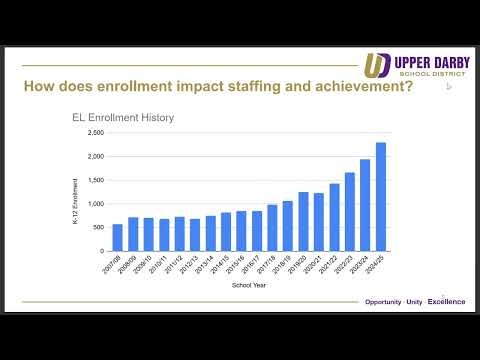
Tim Lambert, the district's manager of data and information, said the district's English learner population has risen sharply in recent years, counting about 2,290 EL students and noting that "we went from 10% to 19% EL population in just 5 years." He told the committee that a growing share of newly enrolled students are identified as English learners, increasing demand for certified EL teachers and space for specialized programs.
Administrators presented enrollment and cohort data showing substantial churn: one first-grade cohort of 991 students fell to 399 by 12th grade, a drop the presentation attributed to transfers, moves and placements in approved private schools. The district reported that roughly 1,400 students withdraw annually while a similar number enroll, leaving school populations steady at an aggregate level but shifting daily.
Presenters described local staffing totals and shortages: the district reported about 981 professional employees under the teacher contract and said it currently employs 55 emergency-certified teachers (staff who hold college degrees but not certification in the subjects they teach). School leaders cautioned that emergency certification is a stopgap and not a long-term solution to fill hard-to-staff positions such as special education, EL, math and foreign languages.
The panel linked staffing pressures to instructional impacts. Principals said underprepared or emergency-certified substitutes can disrupt lesson sequencing and individualized instruction; one presenter noted that, on average at the elementary level, a student sees a daily teacher absent about 14 days per year. District staff also described lower substitute fill rates, increasing burnout for teachers who cover additional classes.
On attendance, presenters explained Pennsylvania's metrics: regular attendance flags students who miss more than 10% of the school year and the state's reported attendance data lags current district figures. The district said average daily attendance dipped after the pandemic (from roughly 93% pre-pandemic to 91%) and regular attendance fell (from about 81% pre-pandemic to the mid-70s post-pandemic in the period reported), and described targeted interventions including weekly building attendance meetings, multilingual outreach, home visits by attendance officers and social workers, and partnerships with community mental-health providers.
To address staffing gaps, administrators described recruitment and retention measures: attending job fairs, inviting career changers with degrees to consider teaching, covering certification costs for staff pursuing EL credentials, offering scheduling and financial incentives where the contract permits, and local grow-your-own efforts with high-school pathways and college partnerships.
Board members asked about pay incentives tied to certification and whether EL teachers are shared across buildings. Administrators said pay differentials would need to be negotiated in a future contract; the district has moved away from sharing EL teachers and now aims to hire full-time EL staff for buildings with identified needs. Presenters also said the district helps cover certification costs for teachers pursuing EL credentials but does not automatically provide extra pay for certification until contract negotiations allow.
The presentation closed with action steps to strengthen instruction and early literacy (coaching, targeted reading specialist time, Scarborough's reading rope strategies) and an acknowledgment that many solutions require state and national action on pipeline and funding issues. The committee then heard public comments urging student attendance incentives and more classroom use of online tools such as IXL.
The committee did not adopt a new policy in this presentation portion; administrators presented data and recommended staffing and attendance actions to guide future board decisions.