Developer presents 200 MW Eagle Energy battery project, highlights safety, timelines and brownfield cleanup
Loading...
Summary
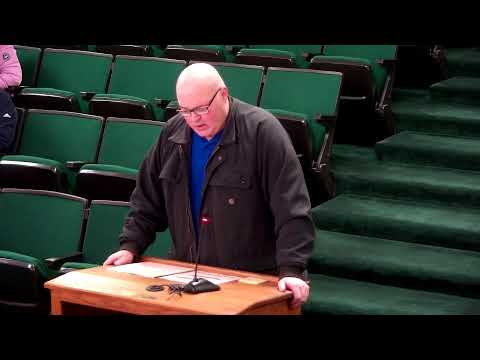
James Hinkston of the Eagle Energy development team told the Flat Rock City Council the proposed 200 MW, battery-only Eagle Energy Storage Project would cost about $300 million, create roughly 100 construction jobs, clean up a brownfield site and target operations in 2028–29.
James Hinkston, a member of the development team for the Eagle Energy Storage Project, told the Flat Rock City Council the proposal is for a 200-megawatt battery-only facility on a brownfield site in Flat Rock and represents about a $300,000,000 investment.
Hinkston said the site would be used to store electricity when demand is low and discharge during peak demand to help utilities manage the grid. “It’s gonna be providing a critical service for utilities to to manage the grid in this region,” he said. He estimated construction would create about 100 jobs and last 12 to 18 months, with commercial operations targeted for 2028 or early 2029.
Why it matters: Hinkston framed the project as both an economic investment and infrastructure addition that can improve local grid reliability. He said Wayne County’s outage-risk ranking contributed to utilities’ interest in storage in the region and noted that utilities are issuing requests for proposals for projects like this.
Project and site details: The team described typical equipment as engineered enclosures (often resembling shipping-container modules), inverters, and HVAC systems; the planned site sits near an ITC 120 kV substation and the Ford assembly plant, with a proposed transmission line crossing a rail yard that will require rail coordination. Hinkston said the property is zoned M-2, the use is permitted by right, and the site plan received unanimous approval from the planning commission.
Safety and standards: Hinkston emphasized safety improvements in battery chemistry and industry standards. He said newer facilities use lithium iron phosphate (LFP) cells rather than older NMC chemistries and that incident rates have fallen as a result. He also cited NFPA standards for utility-scale energy storage (initial guidance in 2020 and updates in 2023 and 2026), noting requirements for testing, layout spacing, and annual on-site training with local fire departments before operations begin.
Noise and mitigation: Council members raised noise concerns near Peters Road where inverter equipment may produce sound. Hinkston said ambient pre-construction noise levels in that area were already near the municipal limit (55 dBA), and that the planning commission conditioned approval on mitigation. He said the project team secured a variance for a 14-foot sound wall and plans landscaping to screen the wall from view.
Technical questions: On voltage and interconnection, Hinkston said the site will include a small substation to step transmission voltages down to levels appropriate for battery systems (the presentation referenced the battery system operating in roughly the 500-volt range, pending final equipment selection and inverter design). He said exact battery voltages and vendor equipment would be finalized during procurement.
Public access to materials and next steps: Council asked for the PowerPoint; Hinkston agreed to provide the presentation for posting on the city website and to send it to council. He said construction would not begin immediately and offered to return with updates as the project advances.
The council did not take formal action on the project at this meeting; Hinkston’s presentation concluded with a question-and-answer session.