FPC audit finds most MPD squad-accident records complete but flags documentation gaps
Loading...
Summary
An FPC audit of Milwaukee Police Department squad accidents from Jan. 1'June 30, 2025 found high overall compliance with documentation but identified gaps in crash reports, photos, video linkage and supervisory recommendations that the FPC says should be corrected as MPD moves to a new records system.
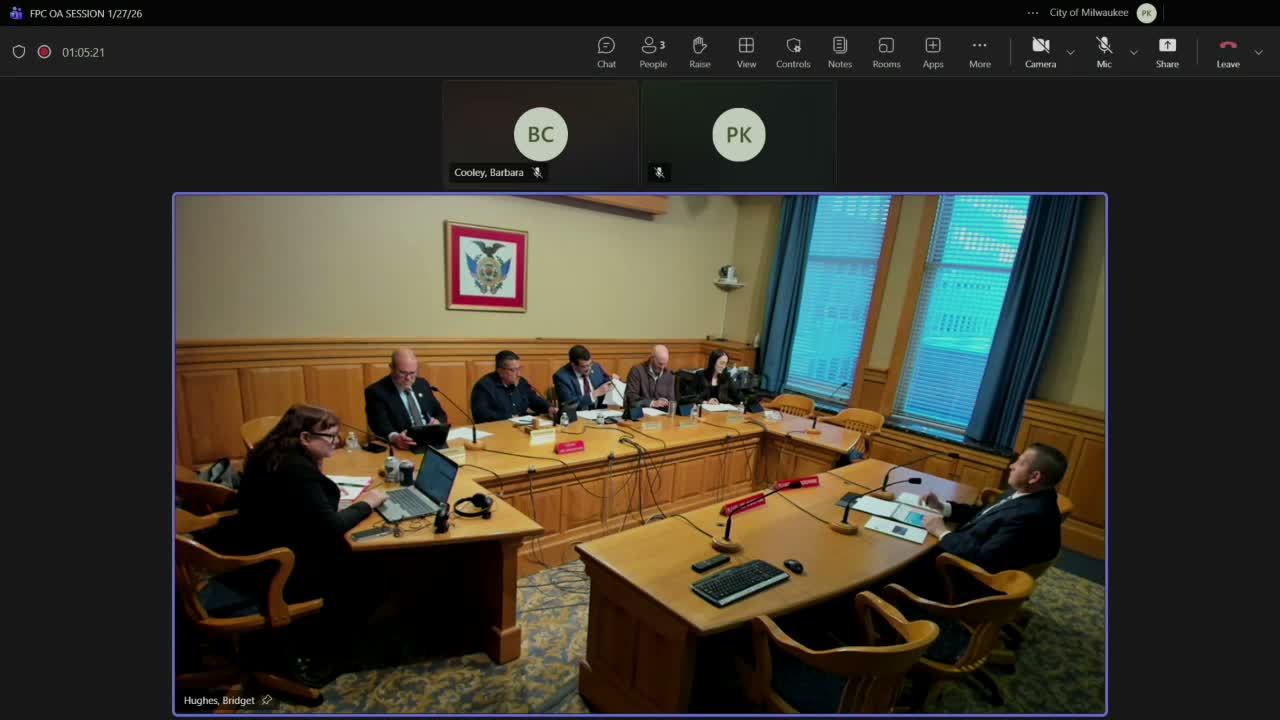
The Fire and Police Commission's audit unit reported that a review of 70 closed Milwaukee Police Department squad-accident records from Jan. 1 to June 30, 2025 found generally strong documentation but several notable deficiencies that merit correction, audit manager Sean Ratclaw told the Oversight and Accountability Committee on Jan. 27.
"This is the first audit of squad accidents for the FPC," Ratclaw said in his presentation. The audit began with 88 records and removed open or voided incidents and those covered by other agencies, leaving a 70-record population for review.
Ratclaw said auditors checked multiple documentation "puzzle pieces" that should be linked: the CAD number in the AIM record, the Wisconsin DT4000 crash report, squad and body-camera video, and photographs. On the CAD linkage, auditors found one failure in the sample (98.57% compliance). For the DT4000 state crash report, auditors reported 67 records passed and 2 failed; one record had not been filed and another showed documentation issues.
Vehicle pursuits were a focal point: Ratclaw said 11 of the audited accidents were pursuit-related and auditors cross-checked pursuit reports against AIM entries. He described the exercise as primarily an audit of documentation rather than a faultfinding exercise.
The audit also reviewed activity and vehicle type breakdowns to inform training and supervision. Ratclaw reported 26 patrol-related accidents, about 10 parking-maneuver incidents, seven responding-to-emergency incidents, and several undercover or specialized-vehicle instances. Vehicle-type tallies showed 44 marked squads, 10 unmarked cars, seven patrol wagons and three motorcycles.
Photographic and video documentation showed room for improvement. Of 70 records, auditors found 59 with satisfactory photo evidence and 11 with documentation problems or missing photos. Video results showed 40 records with applicable squad-camera video that passed, 28 not applicable (vehicles without cameras or undercover units) and 2 failures.
On citizen outcomes, auditors counted eight arrests (some for OWI), 14 citations, four hit-and-run incidents and 44 incidents with no citizen involved (for example, collisions with parked cars). The audit recorded injury fields in AIM as well; Ratclaw told the committee the majority of entries indicated no injury but that auditors did not assess medical outcomes.
Financial detail on repairs was not quantified in the audit scope, Ratclaw said, but auditors noted the state reporting threshold that distinguishes reportable squad damage (at or above $1,000) and nonreportable damage (under $1,000); the sample included 47 reportable and 23 nonreportable entries.
Ratclaw identified supervisory-approval and accountability documentation as recurring issues. "The commanding officer recommendations" were under-documented, he said, and in at least one case a captain had approved his own report. The audit team worked with Internal Affairs Division staff to update records where documentation was missing.
The audit does not adjudicate discipline but recommends improved documentation and continued use of the new benchmark analytics system MPD implemented in November-December 2025 to streamline reporting and capture supervisory action more consistently. Ratclaw said the audit unit will consider looking at disciplinary causation in future audits if directed by the commission.
The committee acknowledged the audit's findings and thanked the audit staff for the work; commissioners asked follow-up questions about pursuit reporting, whether supervisors were repeat offenders on late filings, and the potential for recoverable repair costs. Ratclaw responded that repeat-supervisor issues were not apparent in the sample and that repair-cost accounting was outside the audit's scope.
The committee received the audit presentation for consideration and follow-up.