Advocacy group presents court-watch data on reckless driving; asks judges to limit probation for repeat felons
Loading...
Summary
Enough Is Enough told the committee its court-watch program found frequent dismissals/read‑ins and lenient sentencing in cases involving fleeing and reckless endangering safety, and urged a policy shift away from probation for repeat felons while calling for more prevention and measurement.
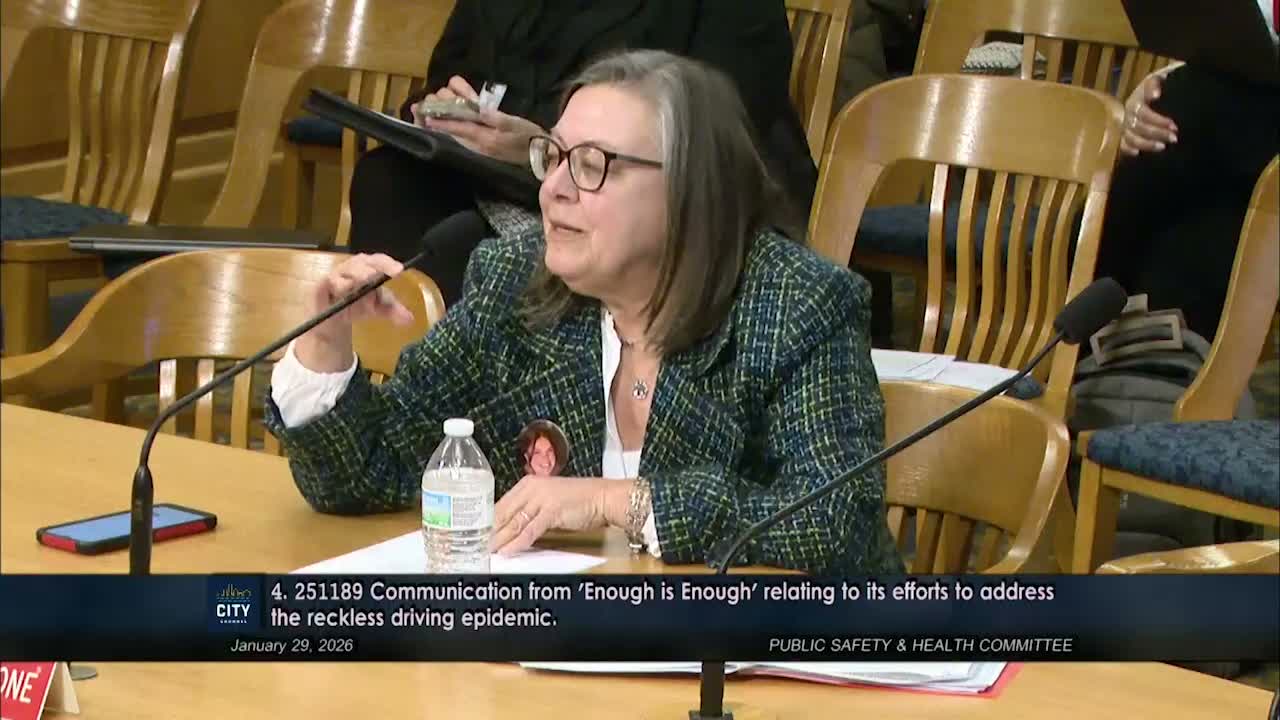
Enough Is Enough, a volunteer nonprofit formed after the 2023 death of Erin Mogensen, presented the Public Safety & Health Committee with findings from a court-watch program and urged local leaders to press for more judicial accountability in reckless-driving cases.
Jeannie Lupo, representing Enough Is Enough, summarized the group’s approach: volunteers identify cases via CCAP, prepare community impact statements and attend plea and sentencing hearings to record judge and prosecutor outcomes. Lupo said the group reviewed several hundred cases and that its most recent report is attached to the committee file.
Lupo presented case examples of fatal incidents — notably the Dunmore sisters and the killing of Lorenzo Martin — where defendants were on probation or had prior convictions when a subsequent reckless-driving incident caused severe injury or death. Lupo said the group sees frequent plea bargains and dismissals/read‑ins that, in her view, undermine accountability. “Safety and accountability is what we’re really looking for,” Lupo said.
On data, the group reported that in a monitored sample period it identified roughly 335 cases, with 64% involving defendants who had previous felony convictions; of the cases reviewed they observed a median sentence figure they reported as 36 months across a range of felony classes. The group said 141 of 335 observed cases (in the sample described) were granted probation in some form and that many probation sentences include short condition time rather than longer incarceration. The organization urged the committee to push prosecutors and judges to avoid probation for repeat felons and to reduce the use of dismissals/read‑ins for guns and drug charges.
Committee members expressed sympathy for victims and interest in prevention. Alderman Moore stressed the need for prevention, youth investment and alternatives to incarceration, and urged partnership with restorative-justice programs. Committee members and the chair also discussed data gaps and offered to connect the group with the Wisconsin Policy Forum and other partners to improve measurement.
The committee voted to hold the communication "to the call of the chair" for follow-up as new reports become available; Enough Is Enough offered to return.
Sources and context: The presentation and case counts are from Enough Is Enough’s court-watch report as presented by Jeannie Lupo before the committee. The committee record reflects questions from multiple alderpersons about methodology and next steps.