Get Full Government Meeting Transcripts, Videos, & Alerts Forever!
Get email alerts on the Street Vending Chapter50 topic
No spam. Unsubscribe anytime.
Dallas staff propose moving free‑food distribution into street‑vending code; councilors press for equity and research
Summary
City staff recommended shifting free food distribution rules into chapter 50, adding a low‑burden administrative permit, time/temperature and training requirements and a grace period; council members raised enforcement, religious‑volunteer and equity concerns and asked staff to provide draft ordinance language and food‑handling research before another committee briefing.
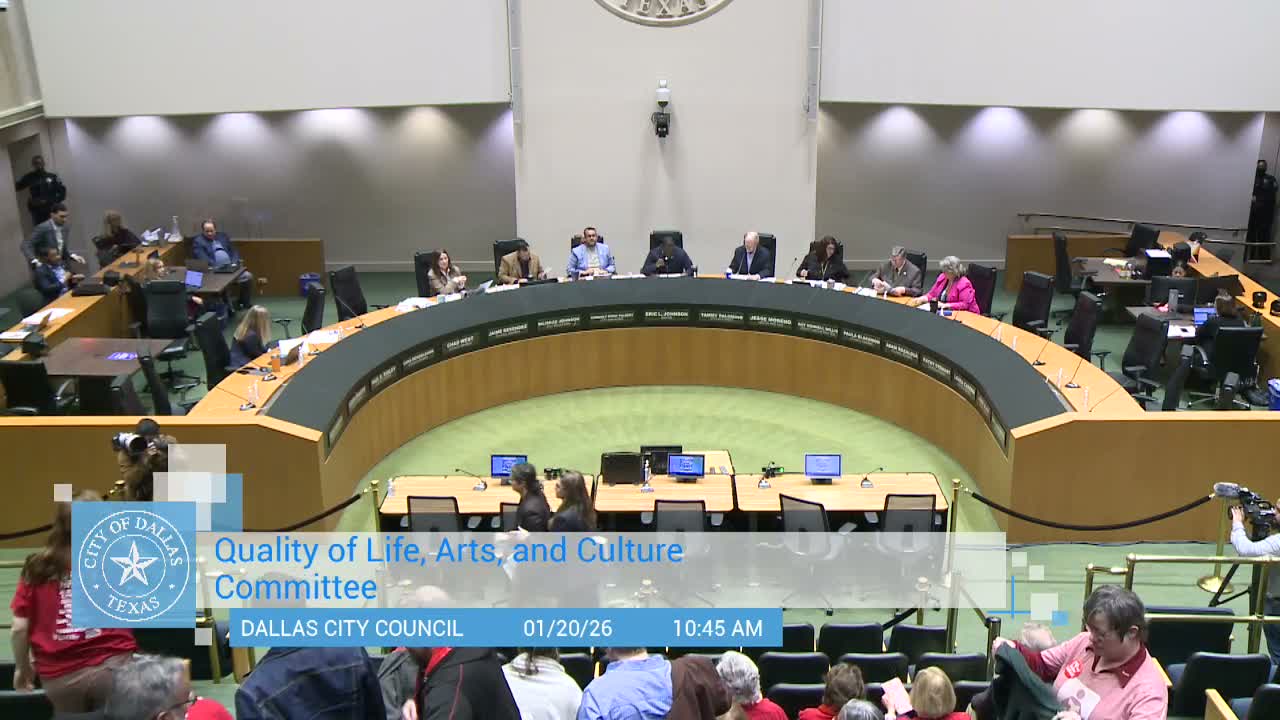
City staff asked the Quality of Life, Arts and Culture Committee on Jan. 20 to update Dallas code so that free food distribution and charitable street feeding are governed in chapter 50 (street vending) rather than chapter 17 (food establishments), following state changes in Senate Bill 1008.
Presenter Christian explained why the change is needed: chapter 17 now implements the statewide Texas food‑establishment rules, which left a regulatory gap for volunteer or charitable free food distribution. Christian proposed expanding the street‑vendor definition to explicitly include food or drink distributed free of charge, requiring a simple administrative permit (automatically approved, low burden), documenting responsible parties, locations and frequency, and attaching basic food‑safety and sanitation conditions moved from chapter 17.
Christian said the permit would not be a commercial food‑service license and that the proposal includes a grace period for education, robust stakeholder engagement, and updated permit software and tracking. Health staff told the committee they have documented 621 free‑food engagements and issued 144 notices of violation during outreach; sanitarians cited time‑and‑temperature control problems and recommended a training requirement for at least one on‑site volunteer.
Council members expressed concern that the proposed changes could be enforced disproportionately against volunteers and organizations serving unhoused people. One council member warned that neighbor cookouts, religious volunteers and ad hoc distributions could be swept up by a permit rule without carefully‑crafted exemptions. Several members urged staff to include nonprofit and faith‑based partners in drafting and to present clear exemption language for small neighborhood distributions.
Action and next steps: after debate, the committee directed staff to finalize proposed ordinance language, gather food‑handling research (time‑temperature safety studies and other evidence), and return to the committee with draft language and the requested research before any full‑council briefing. Staff also proposed a grace period before full enforcement to allow education and adaptation.
What to watch: the committee asked staff to clarify the advance‑notice window (staff proposed two days), the training requirement scope, and how enforcement will avoid disparate impacts on community volunteers and faith‑based providers.