Get Full Government Meeting Transcripts, Videos, & Alerts Forever!
Get email alerts on the Library Regional Model topic
No spam. Unsubscribe anytime.
Dallas library leaders propose regional flagship model, city councilors press for data and neighborhood meetings
Summary
Library staff proposed consolidating neighborhood services into five flagship branches (goal of seven later), closing four neighborhood libraries and identifying $4.5 million in savings over two years; council members demanded raw metrics, neighborhood engagement in affected communities and a March committee follow‑up.
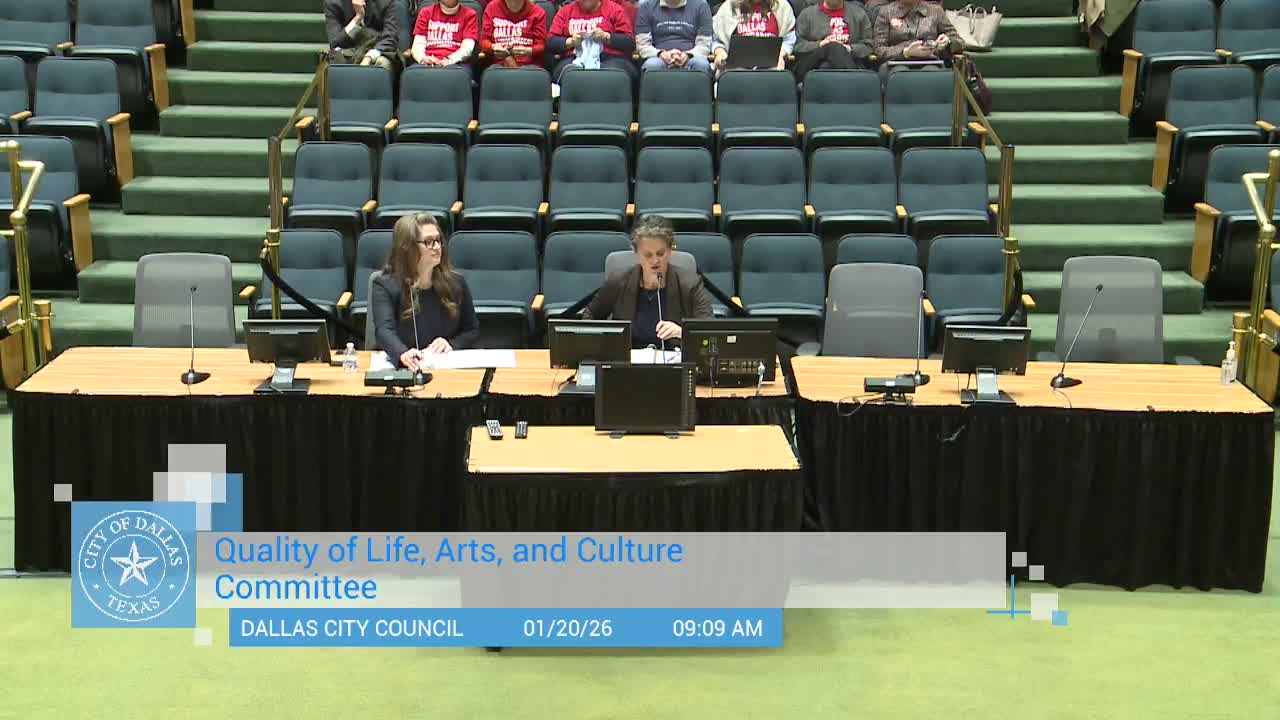
The Quality of Life, Arts and Culture Committee on Jan. 20 heard a staff proposal to move the Dallas Public Library system to a regional model that would concentrate expanded hours and programming at flagship branches and close four neighborhood libraries.
Manya Shore, identified in the briefing as Dallas Public Library director, said the model would create “a creative and innovative way to sustain budget pressures and also give the residents of Dallas more access to library services.” Shore told the committee the library was asked to find $1,900,000 in savings this fiscal year and an additional $2,600,000 next year — a total of $4,500,000 over two years — and that the regional proposal would allow staff to open flagship locations seven days a week with longer weeknight hours.
Shore and the city’s data team described a methodology that weighted community socioeconomic need (50%), library usage (30%) and geographic coverage (20%) to rank branches inside seven administrative regions and recommend five initial flagships. Staff said the proposal would reduce the branch footprint from 28 to 24 and, when fully implemented and expanded to additional flagships, would leave 87% of residents within a 15‑minute drive of a flagship location. The central library is not included in the regional proposal.
Council members acknowledged budget pressures but pushed back on process and community impacts. Council Member Ridley said some residents learned of potential closures from the media and asked how savings would fund expanded services at flagships. He urged staff to explain how neighborhood residents without transportation would access services and noted that Oak Lawn Library houses an important LGBTQ+ circulating collection and serves as a hub for community events. Shore responded the library does not claim Oak Lawn houses the only circulating LGBTQ+ collection in the country and said the collection could be moved to another branch or to the central library if necessary.
Council members also requested raw metrics. Council Member Mendelson said the presentation lacked the underlying data — circulation, visitor counts, computer‑use hours and program attendance — and asked staff to provide those figures. Jack Ireland, the city’s CFO, and representatives from the city manager’s office framed the proposal in broader budgetary context, saying rising costs and public‑safety spending have forced departments to seek efficiencies.
Several council members urged more neighborhood engagement before formal decisions. Vice Chair Cadena and others asked that public meetings be scheduled in the communities affected — not only at the proposed flagships — so residents who would lose a neighborhood branch can speak in their own neighborhoods.
Action: the committee voted to have staff return with additional data and community‑engagement plans and to brief the committee again in March.
What’s next: Staff said the selected neighborhood branch closures would be scheduled near the end of the fiscal year and that flagship openings are targeted for January 2027; the committee asked for detailed operating‑cost breakdowns, the raw metrics used in the model and additional community meetings in impacted neighborhoods.