Get Full Government Meeting Transcripts, Videos, & Alerts Forever!
Get email alerts on the Street Safety topic
No spam. Unsubscribe anytime.
Task force urges tighter enforcement, integrated manuals and design changes to cut pedestrian deaths in Dallas
Summary
A city street‑design task force told the Transportation and Infrastructure Committee Dallas records among the highest pedestrian fatalities in Texas and recommended enforcing existing manuals, standardizing project documents, improving signage, and considering smaller first‑responder vehicles and lower speeds where appropriate.
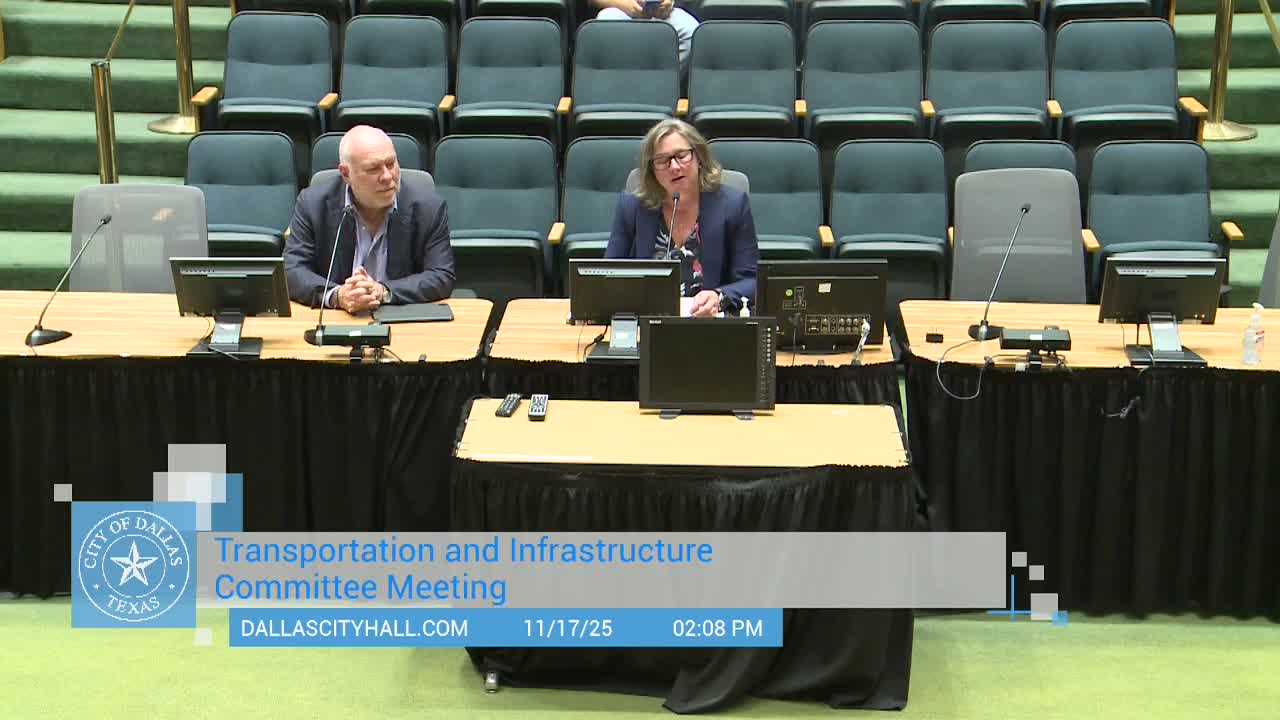
Melissa Kingston, chair of the Street Design Manual task force, told the committee on Nov. 18 that the group spent about a year holding public meetings and reviewing policies to answer why Dallas records high pedestrian and vehicular fatalities. "Dallas has the highest number of pedestrian fatalities, vehicular fatalities, and serious injuries to pedestrians and vehicle operators of any major city in Texas," she said, citing the task force’s findings.
The task force found repeated noncompliance with the city’s own manuals and policies, including cases where contractors or city staff used outdated general notes or did not follow council‑approved geometry standards. Kingston described several specific concerns: improper barrier‑free ramp placement that sometimes deposits pedestrians into intersections rather than crosswalks; excessive sidewalk and curb obstructions; extended sidewalk closures during construction that force pedestrians into travel lanes; and inconsistent use of modern safety design tools such as narrower curb radii, road diets and pedestrian islands.
Major recommendations included enforcing adherence to existing manuals (including conditioning contractor payments on compliance), standardizing general notes and project documents, creating a unified manual that integrates thoroughfare, drainage and street‑design policy, implementing pre‑project zoning reviews to prevent nonconforming work, pursuing staff training, producing quarterly implementation reports to the committee or council, and evaluating whether smaller, "right‑sized" first‑responder vehicles could reduce conflicts without losing response capacity.
Transportation Director Gus Conkley told the committee the department maintains high‑injury network maps and speed studies and that some implementation steps will require legislative change or expense; Assistant Chief Delridge Williams of Dallas Fire Rescue said roundabouts and other designs must be evaluated case‑by‑case to ensure emergency response needs are met. Committee members pressed for geographic data, vendor accountability mechanisms and a practical phasing plan; several members urged creating a procurement or "vendor naughty list" for contractors that repeatedly fail to meet standards.
The task force recommended beginning with enforcement, engineering changes and public and staff education, and asked the transportation director to return with more detailed resource and implementation information.