Get Full Government Meeting Transcripts, Videos, & Alerts Forever!
Get email alerts on the Drivers Of Opportunity topic
No spam. Unsubscribe anytime.
Dallas staff previews 'Drivers of Opportunity' framework tied to federal compliance; committee asks for metrics and legal review
Summary
City staff presented a five‑driver 'Drivers of Opportunity' policy framework designed to align investments and federal‑grant compliance. Committee members pressed for measurable goals, a redline of affected policies and fuller details of an omnibus resolution due to full council in December.
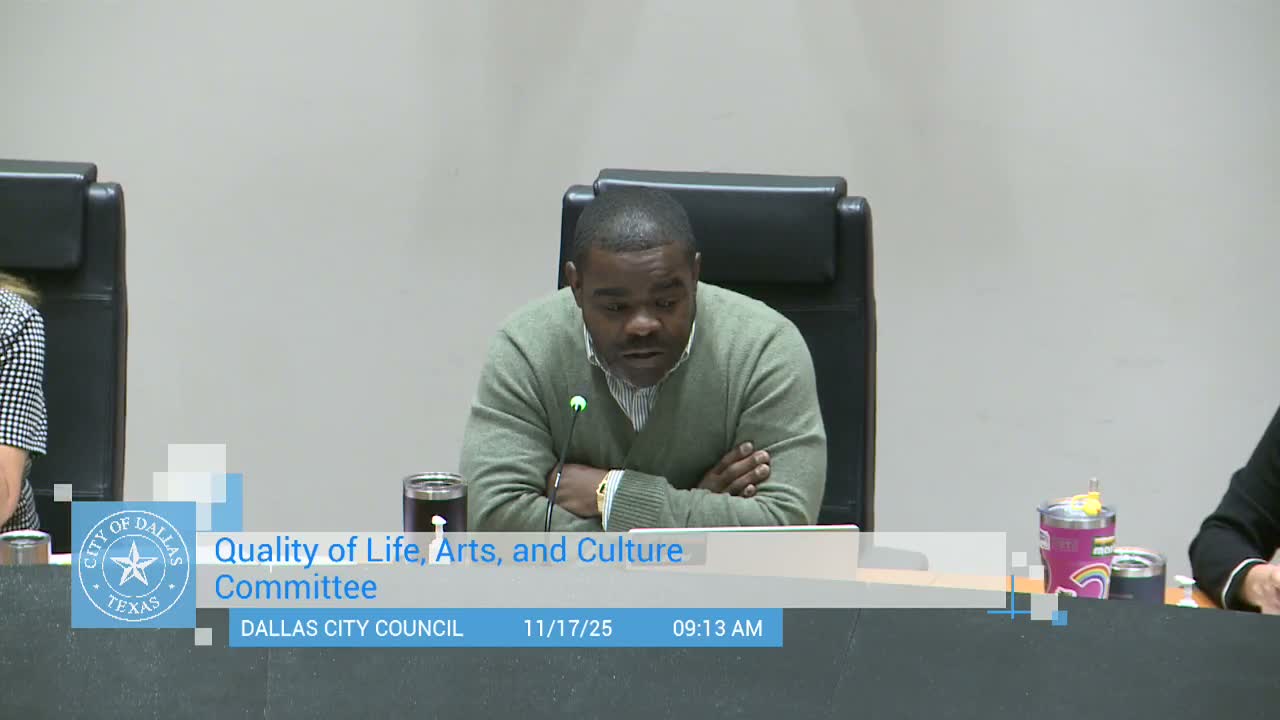
City of Dallas staff on Wednesday briefed the Quality of Life, Arts & Culture Committee on a new policy framework called the Drivers of Opportunity, a place‑based approach intended to focus city resources and partnerships where economic hardship is concentrated.
Deputy Director Jessica Galashaw and Thor Erickson, director of Housing and Community Empowerment, said the framework groups municipal priorities under five drivers — employment, education, opportunity‑rich neighborhoods, environment and health/public safety — and maps 27 domains that staff plan to track through a community opportunity assessment and dashboards. Galashaw said the work grew from national models and resident input and was informed by a citywide federal grant compliance review begun after executive orders issued in January 2025.
Why it matters: staff said the framework is intended to make city investments more targeted and legally resilient as departments adjust programs to meet federal requirements. Staff also told the committee that changes identified in department self‑assessments are being consolidated into an omnibus resolution that will be briefed to full council on Dec. 3 and come to council for adoption on Dec. 10.
Committee members repeatedly asked for concrete performance measures. Councilmember Ridley and others said the slides presented broad goals but lacked numerically specified targets; staff replied that establishing metrics is the next step tied to development of the community opportunity assessment. Galashaw said the framework had strong resident support in surveys and engagement and that “we envision that [developing metrics] will require significant engagement with community‑based partners and our data team.”
Several members also asked how the city reached multilingual and hard‑to‑reach residents. Assistant Director Christina da Silva said the outreach included community forums, on‑the‑ground outreach at events, translated surveys and partnerships with anchor institutions and that about 10% of survey responses were in Spanish.
Concerns about the omnibus resolution surfaced repeatedly. Councilmember Bezaldua said she wanted a comprehensive list of actions staff will take to remain compliant with state and federal requirements, and warned against piecemeal rescissions of past equity policies. Assistant City Manager Lyssa Dio Pereira said the omnibus package, which staff are still finalizing, will indicate where language in existing plans or policies may be revised and that the committee’s feedback would inform the full‑council briefing.
Next steps: staff requested committee feedback to refine the framework and said they will deliver the community opportunity assessment and proposed metrics in the coming weeks ahead of the Dec. 3 briefing to full council. The committee did not take a final vote on the framework at the meeting.