Get Full Government Meeting Transcripts, Videos, & Alerts Forever!
Get email alerts on the Fair Park Revitalization topic
No spam. Unsubscribe anytime.
Staff proposes hybrid operations model for Fair Park, council presses for community-park timeline
Summary
City staff told the Parks Committee they favor a hybrid operating model—city oversight with targeted private contracts and nonprofit partnerships—backed by a five-pillar revitalization strategy. Council members pressed for timelines, deferred-maintenance figures and delivery of a promised community park.
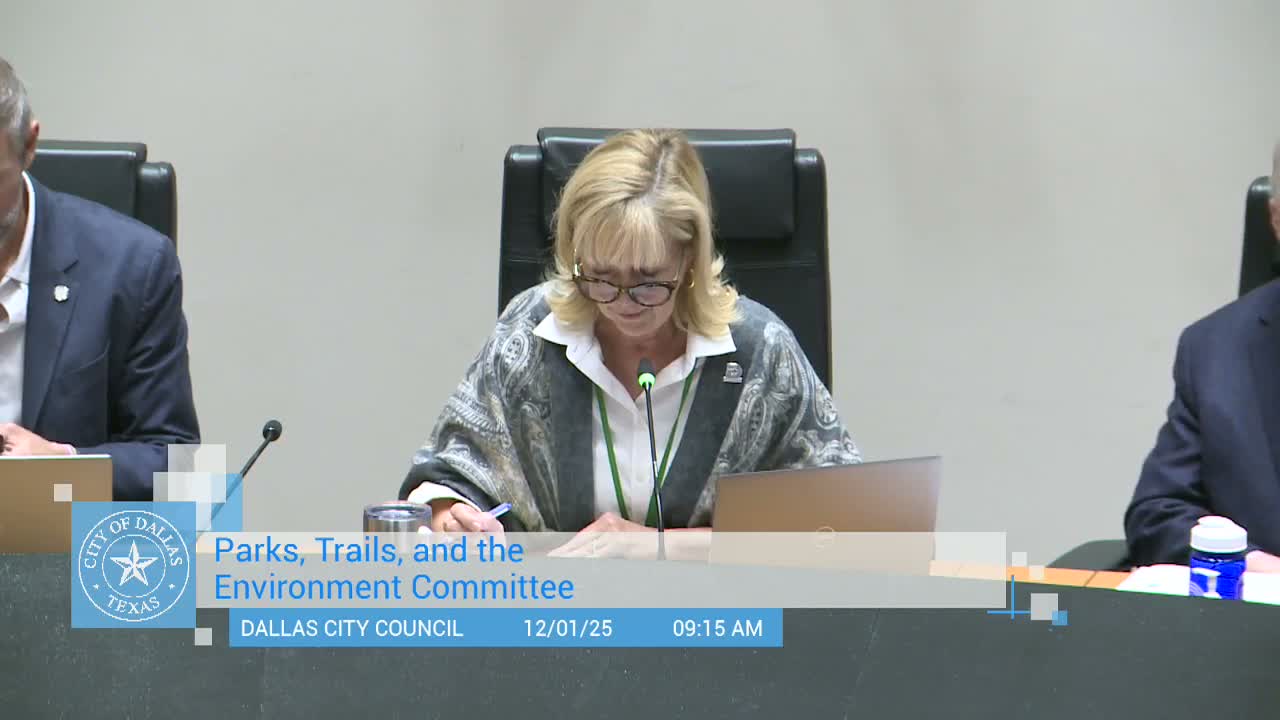
City staff presented a vision-setting briefing Dec. 1 recommending a hybrid operating model for Fair Park that would keep overall campus control with the city while contracting private firms for specialized services and partnering with nonprofits to leverage philanthropy.
The presentation, led by Deputy Director Ryan O'Connor with General Manager Brett Wilkie and Director Jenkins, framed the strategy around five pillars: maximize campus partners; create recurring community programs and events; pursue large-scale campus activations; pursue complementary economic development (retail, restaurants, hotels); and cultivate nonprofits to support capital campaigns and operations. "We are recommending for the operations model using a hybrid approach," O'Connor said during the briefing.
Why it matters: Fair Park attracts large annual attendance—staff cited roughly 4,000,000 visitors in a typical year—yet operating and capital needs have outpaced available city funding. Staff argued the hybrid model and new revenue contracts, including sponsorships and an event-related revenue stream, are necessary to stabilize operations without repeated reliance on future bond programs.
Key details and next steps - Revenue tools: Staff described short-term (1–2 year) contracts to stabilize services (security, parking, janitorial, food and beverage) and said they will pursue longer 3–5 year agreements for sponsorship, advertising and event revenue. O'Connor said the city intends to secure measurable objectives in vendor contracts to ensure performance. - Event surcharge: Staff proposed an attendance-based contribution roughly equivalent to a $2-per-attendee surcharge as a mechanism for campus partners to contribute to park operations; staff said the mechanism could be applied through ticket surcharges, parking fees or other partner agreements. - Foundation and study timelines: Staff proposed a Cotton Bowl Foundation modeled on the Rose Bowl Foundation to raise private capital. Director Jenkins told the committee the goal is to launch the foundation "no later than probably April, May of next year." Staff also said an economic-development study led by the Dallas EDC will begin early next year, with a full business plan and prioritized action list to follow.
Council concerns and community commitments Council members pressed staff to put the community park promise to South Dallas at the center of revitalization planning. "We have 30,000,000 already raised and efforts towards a community park," one council member said, urging a stronger emphasis on delivering that element. Another said she was "tired of the way that things are being put on an agenda that gags us," referring to limits on what could be discussed at the briefing.
Several council members asked for more precise deferred-maintenance figures and for clearer timelines showing which actions could be delivered quickly versus those that will take years. Staff responded that the forthcoming economic-development study will include detailed revenue projections and a 10–15 year business plan showing how operations and capital needs intersect.
Operational context and partners Staff said they are finalizing arrangements with key campus partners, including Live Nation and Broadway Dallas, and that many tenant contracts on the campus are expired or decades old and will be revisited. General Manager Brett Wilkie described early community engagement efforts—attending neighborhood meetings and listening sessions—and said the park team is prioritizing service contracts to start regular, daily activations rather than isolated weekend events.
Outstanding issues and oversight Council members repeatedly raised governance, access and infrastructure questions—parking, ingress/egress, traffic management and the need for the city manager's office to be more involved in cross-departmental planning. Several asked for a clearer accountability structure to govern long-term private partnerships and to ensure community benefits. Staff committed to returning with a detailed timeline and a prioritized list of actions in early 2026.
The committee did not take formal action on the revitalization strategy at the briefing; staff said specific contracts and implementation items will be brought to the council for consideration in the months ahead.