Get Full Government Meeting Transcripts, Videos, & Alerts Forever!
Get email alerts on the Gunshot Detection topic
No spam. Unsubscribe anytime.
Committee approves recommendation to pursue Firefly gunshot-detection pilot and technology integration
Summary
Dallas Police briefed the committee on Firefly sensors, which DPD said have had ~150 activations; staff described a pilot to integrate sensors, drones and cameras and an initial 24-sensor deployment (about $330,000) with $1,800 per sensor annual subscription (about $43,200/year for 24 sensors). The committee voted to recommend the item to council for further action.
The Public Safety Committee on Dec. 8 recommended that the City Council consider the continued testing and possible pilot expansion of Firefly gunshot-detection sensors and a technology integration pilot that could link sensors with drones, cameras and license-plate readers.
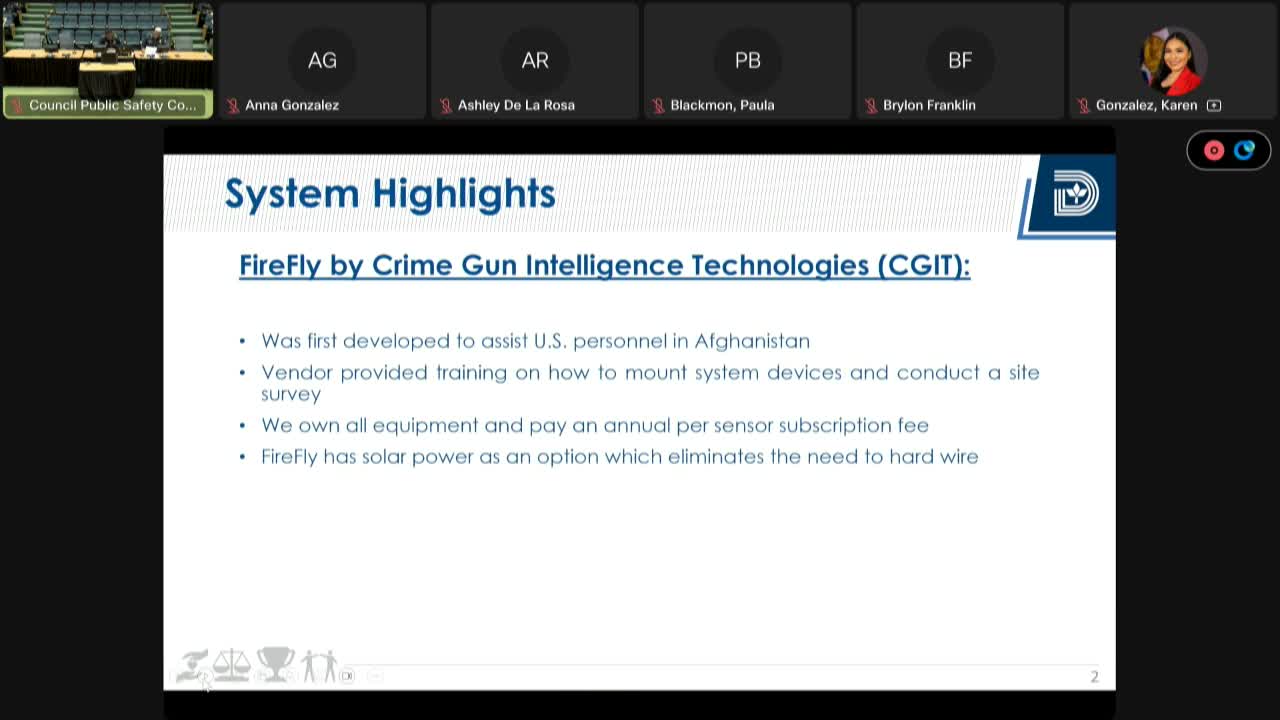
Major Nelson of Dallas Police outlined the sensor system and how DPD has deployed it to date. "These are basically recording devices, and microphones," Major Nelson said, describing a solar-powered sensor that AI classifies as a potential gunshot and produces an audio clip for human review. He said DPD currently owns equipment and pays an annual subscription for each sensor.
Staff described the initial package on the record: an initial 24-sensor deployment that covers roughly one square mile cost about $330,000, and the subscription cost is approximately $1,800 per sensor per year—about $43,200 annually for 24 sensors. Martin Riojas, assistant director (DPD financial), confirmed the subscription arithmetic and said the department has a three-year contract for the current deployment.
Nelson and others said the system has produced about 150 activations in Dallas; some activations led to quick drone responses and successful evidence collection and arrests. Staff emphasized the limits of a standalone sensor network and described a proposed pivot to an integrated model where sensors, drones and cameras would work together to improve response times and evidence collection. Nelson said drones could reach many activations in "30 seconds to 2 minutes" when integrated and that the department is seeking pilots to test that capability.
Council members raised concerns about coverage area, cost and prioritization of neighborhoods with recurring random gunfire. Several members asked for lifespan and maintenance details for sensors and for data demonstrating arrest-rate improvements in other cities; staff said they would provide additional metrics and noted vendors and other cities had demonstrated positive results, usually when a significantly larger footprint is deployed.
The committee moved to recommend the item to full council; the motion passed unanimously. Staff said the next steps are a targeted pilot and additional community and operational metrics before broader procurement or citywide expansion.
End note: Staff said they will develop a business case and report back with cost estimates by footprint and suggested a six-month pilot could be used to test integrated drone/camera responses.