Get Full Government Meeting Transcripts, Videos, & Alerts Forever!
Get email alerts on the Home Rule topic
No spam. Unsubscribe anytime.
City attorney briefs Dallas committee on home rule limits and 2023 Regulatory Consistency Act
Summary
The city attorney's office explained home-rule authority for Texas cities, the charter review timeline and implications of the 2023 Texas Regulatory Consistency Act (referred to in the briefing as HB 2,127); staff said Dallas is among cities challenging aspects of the law and will supply litigation status to the committee.
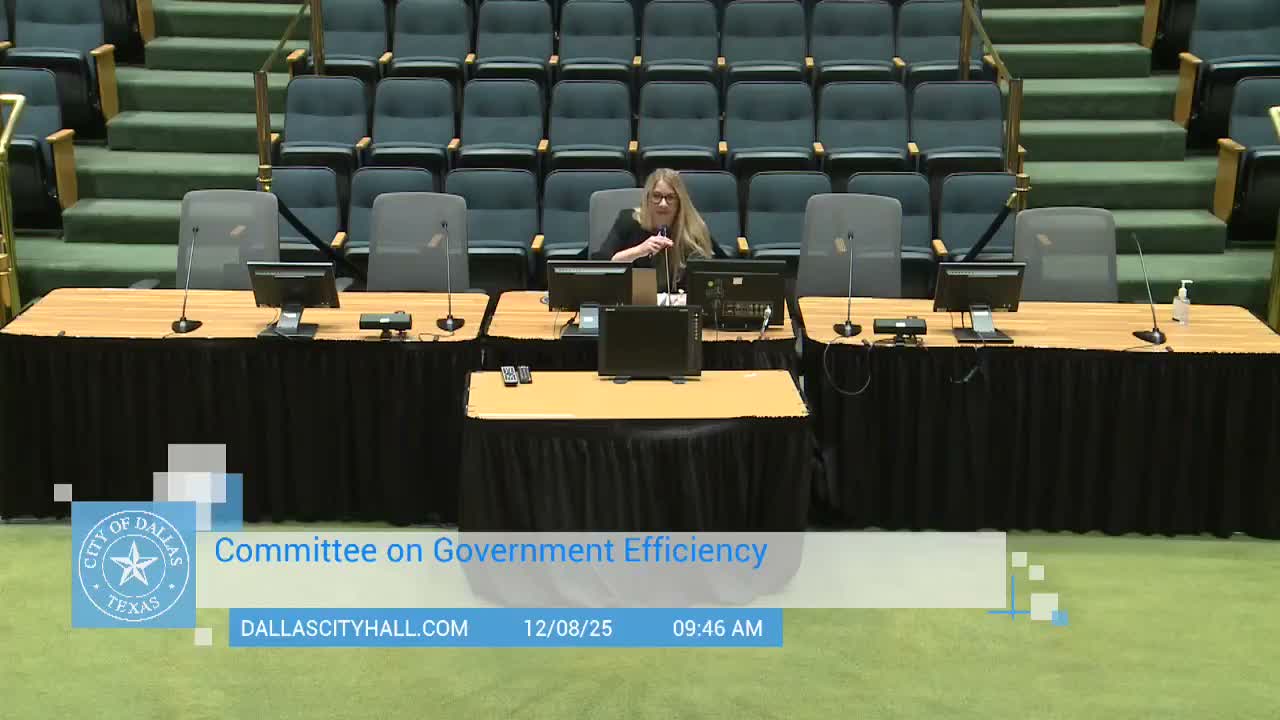
The City of Dallas’ city attorney briefing to the Committee on Government Efficiency on Dec. 8 outlined the scope of home-rule authority and recent state-level changes that restrict local regulation in specified fields.
Laura Morrison, deputy chief of the municipal regulatory section in the city attorney’s office, said home-rule cities exercise broad local powers under the Texas Constitution and the Texas Local Government Code but remain subject to preemption where state law applies. She told the committee that a city must have at least 5,000 residents to adopt a home-rule charter and noted Dallas’ most recent charter review process took place in 2023–24; the next window to amend the charter is expected around May 2027.
Morrison described the 2023 Texas Regulatory Consistency Act (referred to in the briefing as HB 2,127) and said the measure lists specific state statutes that preempt local regulations in identified fields, shifting to cities the burden of proving consistency with state law. “Any city or county ordinance, order, rule, or policy that violates the act is void and unenforceable,” Morrison told the committee.
Councilmembers pressed staff on the constitutionality of the statute. Councilmember Ridley said the act appears to invert prior legal standards and questioned whether Dallas or other cities are challenging it. Morrison replied that many cities across Texas are challenging the law and that Dallas is among them; she said she would coordinate with staff (Miss Palomino) to provide the committee a briefing memo on the litigation status.
The presentation covered differences between general-law and home-rule municipalities, statutory limits on local authority, and practical implications for areas such as zoning, permitting and occupational regulation. Committee members requested follow-up briefings that detail which statutes are covered by the act and the current litigation posture.
No formal action was taken. The city attorney’s office committed to returning a litigation-status update and to providing the committee a list of the specific state statutes implicated by the act.