Get Full Government Meeting Transcripts, Videos, & Alerts Forever!
Get email alerts on the Homelessness topic
No spam. Unsubscribe anytime.
SMU data analysis links Dallas 311 encampment reports with concentrations of unexplained deaths and some violent crimes; briefing ends early
Summary
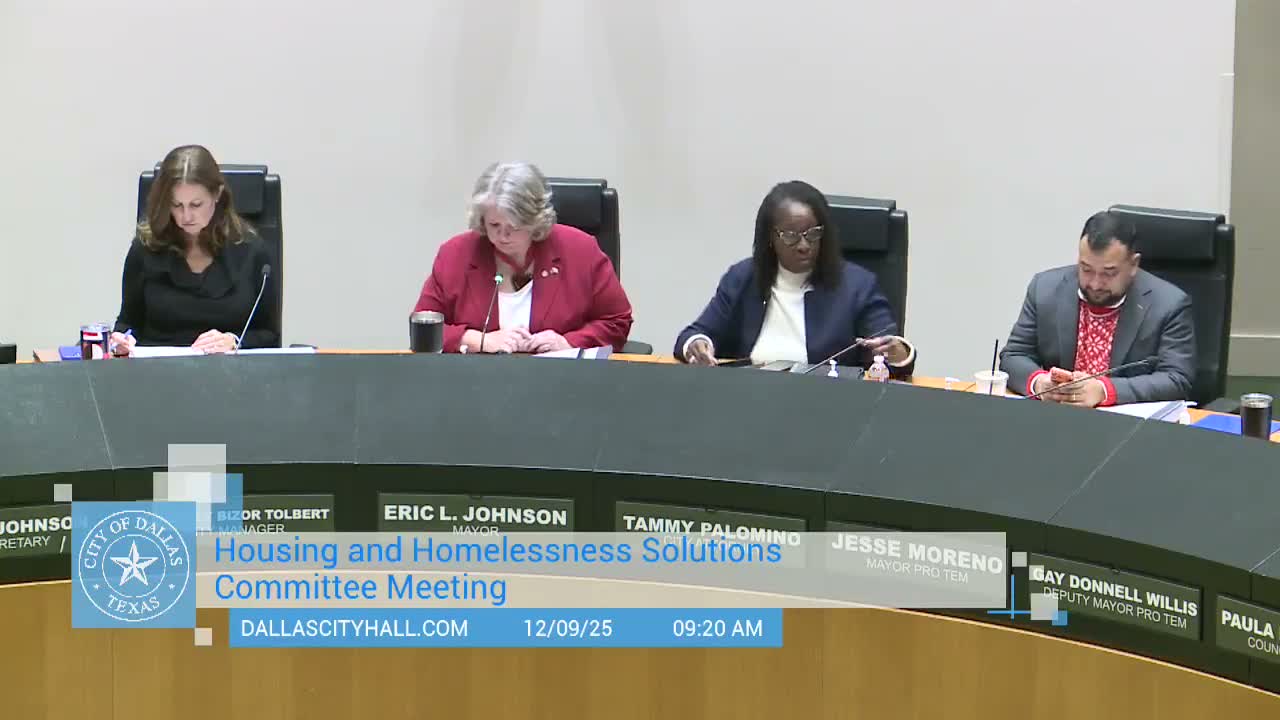
SMU clinical professor Alan Guinn told the Housing and Homeless Solutions Committee Dec. 9 that 44,545 Dallas 311 reports of homeless encampments (10/01/2020–09/30/2025) and police incident data show geographic overlaps with unexplained/non-residential deaths and some felony assaults; the briefing was cut short after a procedural dispute and the committee adjourned.
Alan Guinn, a clinical professor of information technology and data analytics at Southern Methodist University, told the Housing and Homeless Solutions Committee on Dec. 9 that an analysis of Dallas open-data sets shows geographic concentrations of 311 reports of homeless encampments that overlap with police-recorded unexplained or non-residential deaths and with certain felony assaults.
Guinn said he pulled two primary public datasets — Dallas Police Department incident data and Dallas 311 service-request records — and used latitude/longitude coordinates to map and aggregate reports. “Data always has a story to tell,” he said during the presentation, and described a rollup method that aggregated reports within 250 meters and excluded pins with fewer than 25 reports to emphasize major concentrations.
The presentation included a cited total of 44,545 311 calls related to homeless encampments in a five-year span Guinn gave as 10/01/2020–09/30/2025 and a separate filter that produced “over 1,200” police-recorded incidents classified in non-residential settings (vacant structures, fields, parking lots, service stations). Guinn cautioned that police and 311 records have known reporting biases and misclassifications and that published data exclude some categories, which limits causal conclusions: “Crime data itself makes it impossible to conclude that crime is declining when it may just be crime reporting that’s declining,” he said.
Using the maps, Guinn showed that encampment report clusters frequently occur near public-transit corridors and nodes. He noted the Dallas Area Rapid Transit (DART) route and station maps are available and overlaid those locations with encampment rollups, saying the proximity of some hotspots to transit stops was “not unexpected.” He also mapped penal-code-level categories (for example, felony assaults) onto the encampment concentrations and said the maps show areas where those offenses and encampment reports coincide while acknowledging the maps do not explain cause-and-effect.
Guinn illustrated service gaps with a personal case he described as “Diana,” saying that after outreach and multiple attempts by family and service providers they were finally able to hospitalize and stabilize the individual. He used the example to underscore limits in pathways to involuntary or emergency treatment and to argue for clearer mechanisms to get people into care: “If there’s somebody that cares about someone, there ought to be a path to get these guys into treatment,” Guinn said.
Councilman Bazaldulla questioned whether Guinn had consulted local homelessness providers — naming Housing Forward and the regional Continuum of Care — or DART before drawing conclusions and said the presentation used “subjective language” that warranted additional stakeholder input. The committee’s assistant city attorney, Hannah Peacock, suggested a brief recess to clarify procedural questions during a later, heated exchange about yielding time and a point of order.
Chair responded to the presentation by emphasizing the public-safety implications of the maps and the connection between encampments and deaths in the dataset: she said she is “a big advocate of removing encampments against people’s will because it’s not safe for them.” Before the presentation began the committee had approved its Nov. 4 minutes by voice vote; later, after the procedural dispute, the chair ended the briefing and called a recess, the meeting lost quorum and was adjourned at 10:06.
Guinn said he has ideas for follow-up research and indicated he could return to present further analyses to this committee or to public-safety stakeholders. He also emphasized the limitations of publicly published records and urged cautious interpretation of correlations in the mapped data.
What the presentation did not establish: Guinn repeatedly cautioned that the mapped overlaps are correlations observed in public records and that the underlying data suffer from reporting bias, departmental filtering of categories and occasional location misclassification, so the analysis does not prove that encampments cause deaths or increases in crime. The committee did not take formal policy action during this meeting and asked no final vote on any new directive before adjourning.