Get Full Government Meeting Transcripts, Videos, & Alerts Forever!
Get email alerts on the County Budget topic
No spam. Unsubscribe anytime.
Anderson County adopts 2026 budget and a 0.493907 tax rate to close deficit
Summary
Anderson County Commissioners Court approved the 2026 budget and adopted a property tax rate of 0.493907 per $100 of taxable value to help close projected deficits, add a $755,000 road-and-bridge contingency and cover a $500,000 retirement contribution; commissioners debated alternatives and voted by record to adopt the proposed rate.
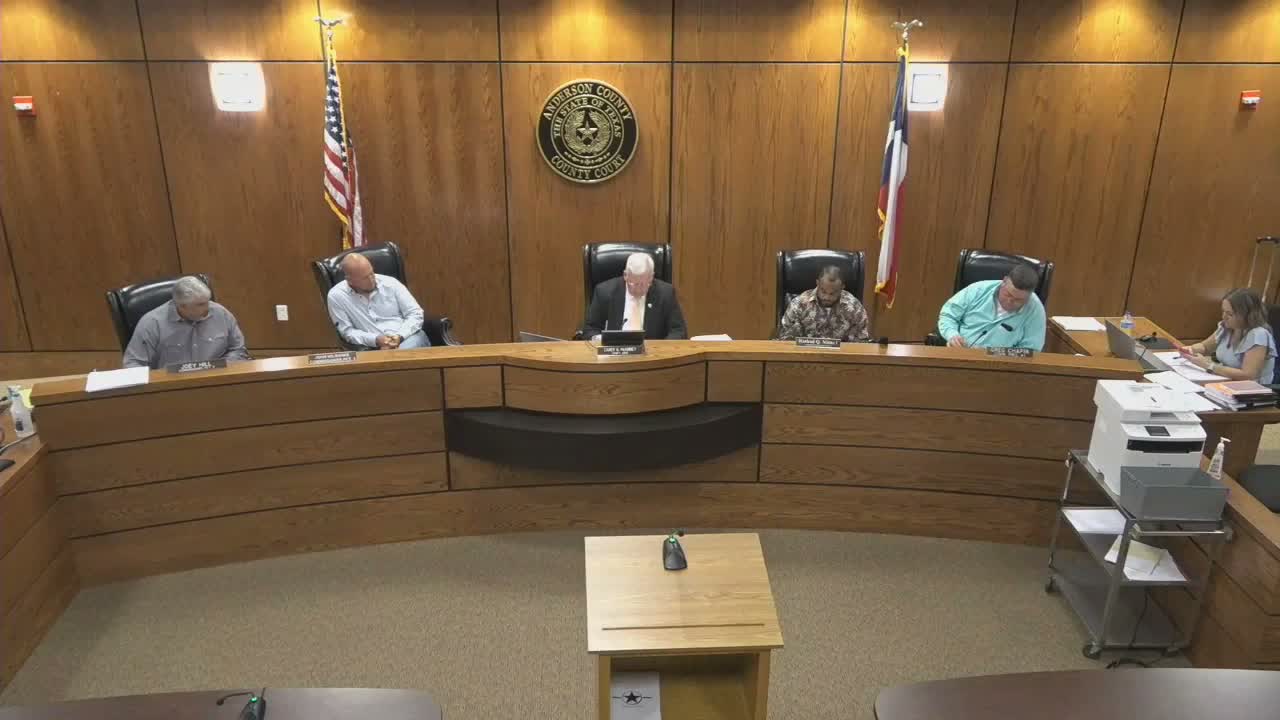
Anderson County’s Commissioners Court on Sept. 8 adopted the county’s 2026 budget and set the property tax rate at 0.493907 per $100 of assessed value, a move the presiding judge said is intended to reduce an operating deficit and preserve services.
Judge (presiding) led the court through a detailed budget presentation and said the combination of the proposed rate and two one-time payments into the retirement system would materially reduce the county’s projected shortfall. “I’m trying to make sure we’ve got the revenue so we don’t have to cut services,” the judge said during discussion on the floor.
Why it matters: County staff presented three modeled revenue scenarios — the proposed rate, a voter-approval rate and a no-new-revenue rate — and showed how each would change the general-fund shortfall. The proposed rate was calculated to produce the revenue needed to support a $31.43 million expenditure plan for 2026 after accounting for a roughly $500,000 lump-sum retirement payment and other one-time items described to the court.
What the court approved: In addition to adopting the budget, commissioners approved a $755,000 road-and-bridge contingency line the court said will be allocated by precinct; approved a budget amendment to adjust jail staffing/pay tied to a public-safety grant; and approved an insurance renewal for county employee coverage through the Texas Association of Counties. Staff also documented for the record that elected and appointed officials completed required cybersecurity training.
Staff (Megan) told the court employee health-insurance costs increased 7.7 percent for the coming plan year and outlined employee-payroll deduction changes on different plan tiers; the county agreed to absorb the majority of that increase, she said. “The health insurance rates went up 7.7%,” Megan said as she walked the court through payroll impacts.
Contested choices and votes: Commissioners debated alternatives that would have kept the current rate or used a different flat rate (several members asked staff to show revenue and fund-balance impacts for a flat 49¢ rate and for the no-new-revenue option). The court held multiple motions on different proposed rates. After discussion and a record vote the court approved the motion to adopt a combined tax rate of 0.493907 per $100 to fund the adopted 2026 budget; the court announced the motion passed.
What happens next: County staff will finalize the budget documents and proceed with the administrative steps required to implement the adopted rate and budget. The court also ordered the statutorily required verification/notice of the property-tax increase related to the adopted budget.
Budget and revenue details noted in court (selected): the county’s proposed total expenditures were presented at about $31,432,005; staff cited an estimated ending 2026 general-fund balance near $7.0 million and a reserve percentage within the county policy band after the proposals; commissioners were shown modeled revenue differences of several hundred thousand to more than $1 million depending on tax-rate choices.
The court voted unanimously to adopt the budget as changed through workshops and to adopt the tax rate by record vote; the motion carried and the meeting moved to subsequent agenda items.