Get Full Government Meeting Transcripts, Videos, & Alerts Forever!
Get email alerts on the Health Workforce And Ome topic
No spam. Unsubscribe anytime.
Physicians and medical examiners warn cuts to residency grants, behavioral‑health pass‑throughs and OME operations would erode capacity
Summary
Physicians urged lawmakers to preserve Medical Education Council and residency grant funding, warning cuts would eliminate residency slots and worsen Utah’s primary‑care shortage; the Office of Medical Examiner requested one‑time support to stabilize statewide death‑investigation operations.
Physician leaders and the Office of Medical Examiner (OME) told the Social Services Appropriation Subcommittee that a set of staff‑proposed cuts to medical education, residency grants and OME operations would have outsized long‑term consequences for health care and public safety.
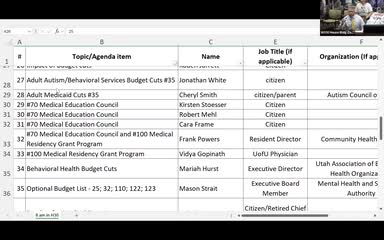
Multiple residency program directors and physician educators told the committee that eliminating the Medical Education Council funding (line 70) and the medical residency grant program (line 100) would remove dozens of funded residency slots. Dr. Kara Frame, a family medicine residency director, said cutting those lines would “immediately eliminate 28 family physicians in this fiscal year” and worsen an existing shortage: “Utah ranks number 49 out of 50 for primary‑care physicians.”
State staff warned those proposals were on a secondary tier of potential reductions and described the immediate operational risk of mid‑cycle residency terminations. Janae Duncan, division director for population health, said cutting mid‑cycle would create operational voids and effectively export trained physicians to other states.
The Office of Medical Examiner presented a one‑time building block request of $677,100 to stabilize investigative support and transport reimbursements, re‑engage local funeral homes and fund basic supplies. Dr. Deirdre O’Maro described 2025 activity levels (approximately 5,000 investigations, 3,000 postmortems and 2,600 scene responses) and cited rural gaps in on‑scene investigator coverage. “Without an investigator on scene, the chances of having an undetermined manner of death increase,” she said, and warned that stagnant transport reimbursements were causing vendor refusals and higher contracted transportation costs.
Behavioral‑health providers cautioned that proposed reductions to population‑based mental health passes (line 110) would forfeit federal Medicaid match and amplify budget impacts. Nathan Strait and Mariah Hurst explained the pass‑through pulls down considerable federal dollars and that a $23.6 million state cut could result in a substantially larger net funding loss when county matches and federal matches are considered.
Committee staff and agency leaders repeatedly asked the committee to consider downstream effects — workforce pipeline loss, rural forensic service gaps and provider closures — before finalizing reductions. No final votes were taken; the chairs plan to schedule formal votes and invited stakeholders to submit requests for appropriations or intent language prior to the next meeting.