Get Full Government Meeting Transcripts, Videos, & Alerts Forever!
Get email alerts on the Colorado River topic
No spam. Unsubscribe anytime.
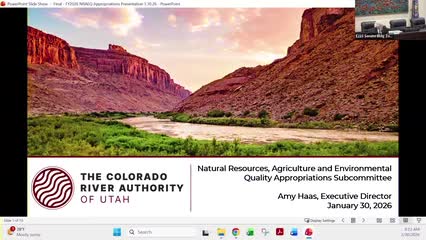
Utah official warns Colorado River states face tight deadlines; failure to agree could hand decisions to federal agency
Summary
A presenter to the committee said operating rules for Lake Powell and Lake Mead expire Sept. 30 and that immediate deadlines—Feb. 14 for a seven‑state agreement and March 2 for comments on a draft EIS—create pressure. Failure to reach consensus could prompt federal selection of operations and prolonged interstate litigation.
A presenter to the legislative committee told members that current operating protocols for Lake Powell and Lake Mead expire Sept. 30 and that a series of near‑term deadlines make agreement among the seven Colorado River basin states urgent.
“The Bureau of Reclamation’s deadline for a definitive seven‑state agreement is Feb. 14,” the presenter said, adding that states must also submit formal comments on the draft environmental impact statement by March 2 and have new operating criteria in place by Oct. 1 or face federal selection of a plan.
The presenter outlined the main sticking points: Utah’s demand for a litigation‑waiver to bar compact claims and damages during a deal’s term; the level and timing of releases from Lake Powell so as not to further deplete the reservoir; additional Lower Basin reductions beyond the roughly 1,500,000 acre‑feet under current discussion; and disagreements over using upstream initial units such as Flaming Gorge and Blue Mesa to prop up Powell.
He warned that failure to reach a consensus could leave Reclamation to choose among proposed alternatives in the draft EIS and likely trigger “unprecedented litigation” involving multiple states and the federal government. The presenter said Utah’s internal estimates point to 20–30 years of litigation and “hundreds of millions” in legal costs, plus forced curtailments for junior users (which could affect the Central Utah Water Conservancy District) and an estimated $500,000,000 in annual agricultural losses in eastern Utah if curtailments occur.
On the hydrology, the presenter said 100% of the Upper Colorado River Basin is experiencing drought, Lake Powell was at about 27% capacity, and projected inflows were roughly 60% of average. He added that critical elevations at Powell could be reached as early as this summer, threatening infrastructure and hydropower generation, and that Reclamation is considering supplemental releases from Flaming Gorge and Blue Mesa to preserve Powell elevations.
What happens next: the Bureau of Reclamation is moving through a NEPA process that includes a long draft EIS with several alternatives; if the states do not coalesce around a shared plan, the federal agency could select an operational regime. The presenter said the Feb. 14 and March 2 deadlines will be central to whether states secure a negotiated outcome.