Get Full Government Meeting Transcripts, Videos, & Alerts Forever!
Get email alerts on the Local Government topic
No spam. Unsubscribe anytime.
Portland council approves multiple appointments and infrastructure agreements; approves ticket-fee to fund arts after debate over Live Nation venue
Summary
The council approved minutes, several board appointments, licensing and MDOT repaving agreements and passed an amendment to Portland City Code creating a venue ticket-fee for large venues to support a local arts fund. The amusement-code amendment prompted public comment from opponents and proponents, including Live Nation representatives.
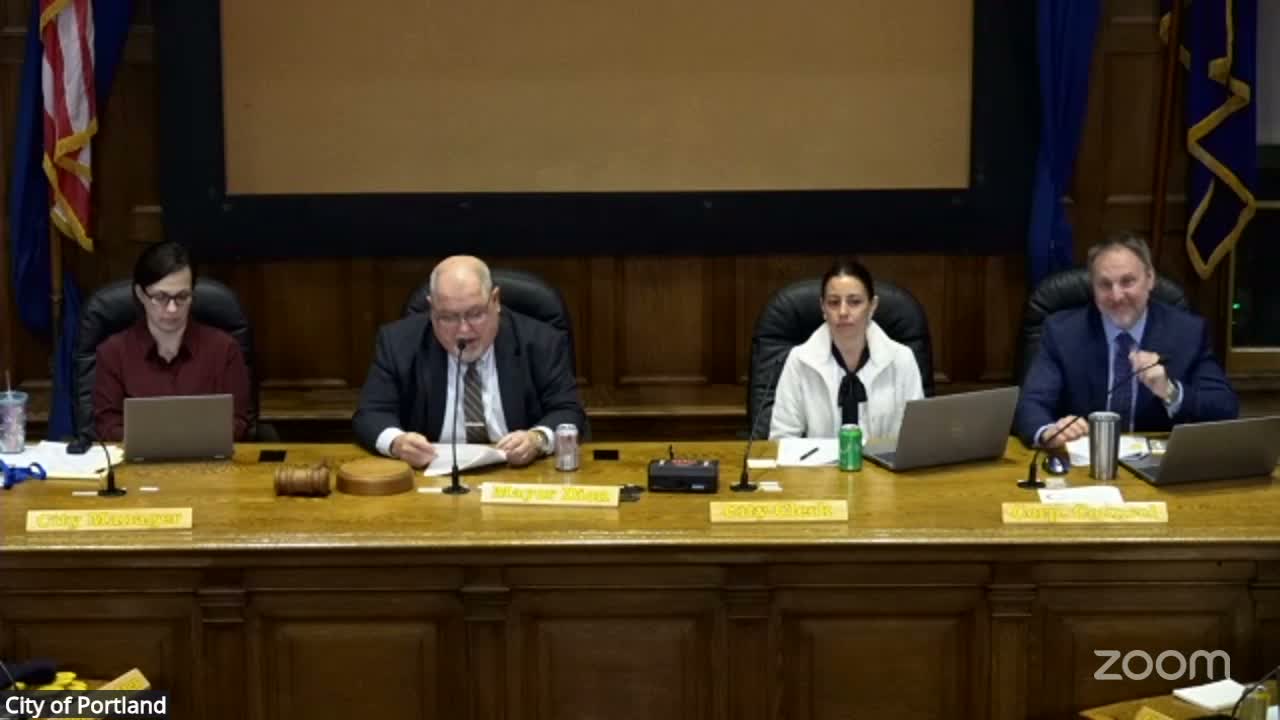
The Portland City Council on Tuesday moved through a multi-item agenda, approving minutes and multiple appointments, authorizing Maine Department of Transportation roadway agreements and passing a contested amendment to chapter 4 of the city code that creates a ticket-fee to fund arts and small-venue support.
The council approved the minutes of the Dec. 15 meeting by roll call after a motion from Councilor Sykes and a second by Councilor Phillips.
A series of appointments carried by roll call as the council briefly recessed to act as corporator: David Page was appointed as a director of Creative Portland Corporation (Order 1082526), Tuck O’Brien was appointed to the Portland Development Corporation (Order 1092526), and Joe Masawa was appointed a class B director of the Fish Pier Authority (Order 1102526). The council also certified a slate of other board and committee nominees.
On business licensing, the council approved a municipal officers' decision granting Playmakers Pizza & Pub a class 1f application for 512 Warren Ave; councilors offered public thanks and support for the neighborhood business.
The council considered and passed amendments to the city’s golf-cart ordinance (Portland City Code chapter 30). Councilor McNevich described the changes as a realignment that removes a numerical cap while keeping business-zone restrictions; the amended ordinance passed on roll call with Councilor Phillips recorded as the lone "No."
Multiple MDOT partnership agreements for repaving and ADA upgrades on several corridors were approved after Department of Public Works staff explained shared-state contributions and additions such as crossings and curb-tip improvements. Director Michael Murray described about $6 million in paving work with roughly $1 million in city-added upgrades.
Councilors debated and approved an amendment to Chapter 4 (amusements) to create a ticket-fee applied to venues above a 2,000-seat threshold, with proceeds directed to a fund (likely administered through the development corporation) to support local arts and small venues. The proposal had been advanced from committee after concerns about pressure on existing local venues and the unknown impact of large operators.
Residents spoke against immediate passage and urged delay and clarification (resident Martin Lodish asked councilors to specify how third-party ticketing fees would be treated and warned the fee could burden local venues). Todd Goldenfarb, a co-developer working with Live Nation, and Ryan Vangel, president of Live Nation New England, spoke in favor of the project and the community-benefit approach; Goldenfarb cited an Oxford Economics report estimating the Portland Music Hall would bring $44 million a year in economic impact.
Council members said the ordinance sets a framework and that committee follow-up will write implementing rules. The amusement-code amendment passed on roll call; councilors also voted to accept a $12,000 donation from the Maine Community Foundation to fund recertification as a "welcoming" community (passed under an emergency waiver so payment could be made this week) and accepted a $2,500 donation for a "Shop with a Cop" program.
Clerk read several first-reads for code amendments (Civilian Police Review Board and Landcare Management Advisory Committee) before the council adjourned.
Key votes and outcomes recorded at the meeting are reflected in council roll-call records and are summarized in the article's action list.