Get Full Government Meeting Transcripts, Videos, & Alerts Forever!
Get email alerts on the Climate And Transportation topic
No spam. Unsubscribe anytime.
Residents urge Portland council to prioritize rooftop solar for schools and renewed pedestrian safety measures
Summary
Public comment period focused on rooftop solar for schools and calls to improve pedestrian safety after recent fatalities. Speakers representing the Portland Climate Action Team and grieving community members pressed the council to make solar an immediate priority and to consider lower speed limits and enforcement tools.
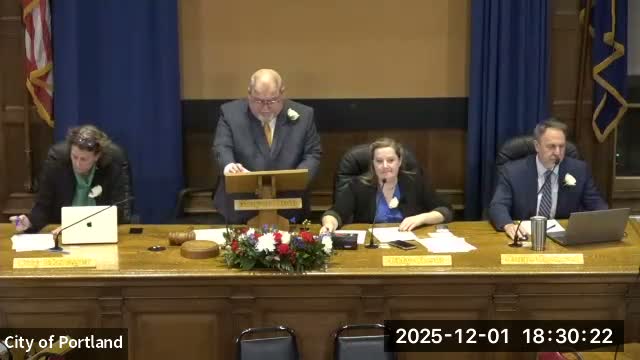
Portland, Maine — During an extended public‑comment period at a City Council meeting, several residents urged the council to prioritize rooftop solar installations on public school and municipal buildings and to renew attention to pedestrian safety following recent local fatalities.
Joey Brunel, of Pine Street and a member of the Portland Climate Action Team steering committee, urged the council to place large‑scale rooftop solar on schools and public buildings among its top priorities for 2026. Brunel said other Maine towns, including Dover and Westbrook, had already installed school rooftop systems and that such projects can be implemented without upfront cost to taxpayers and deliver rapid savings. "There is literally money falling onto the roofs of our buildings," he said.
Other speakers backed that view. Dave Gulick cited examples including Mount Ararat High School and Westbrook schools, describing energy‑savings contracts and guaranteed savings that, according to Gulick, can pay for both efficiency upgrades and solar installations. Linda Stimson, a retired ELL teacher and Portland Climate Action Team member, and Sarah Southard asked the council to direct staff to collect school electric bills and study potential savings; Stimson noted the council had endorsed a related initiative in 2019.
Several speakers tied the calls for solar to costs for families and to the city’s greenhouse‑gas goals. "Solar energy is being widely used," one speaker said, urging the council to act because rising electricity costs will otherwise strain municipal budgets.
Separately, Eric Hager entered the name of Diane Bell — who was killed at the intersection of Marginal Way and Franklin Arterial — into the record and urged a recommitment to pedestrian and bicycle safety. Ed Soslovic described two recent pedestrian fatalities and asked the council to pursue measures including lowering the citywide speed limit to 25 mph, photo enforcement for red‑light running and illegal passing of stopped school buses, and creation of separated off‑road paths for walkers and cyclists.
Speakers asked for concrete follow-up: collection of school electric bills to analyze potential savings, and transportation‑committee action or staff reports to address lighting, crossings and enforcement where pedestrians are at risk.
What happens next: Several commenters explicitly asked the council to place rooftop solar on its 2026 goals and to task the sustainability office with evaluating school electric usage. Councilors did not announce specific follow‑up at the meeting; those requests will be for future committee or staff action.