
Subcommittee advances environmental literacy measure amid split public testimony
Get AI-powered insights, summaries, and transcripts
Subscribe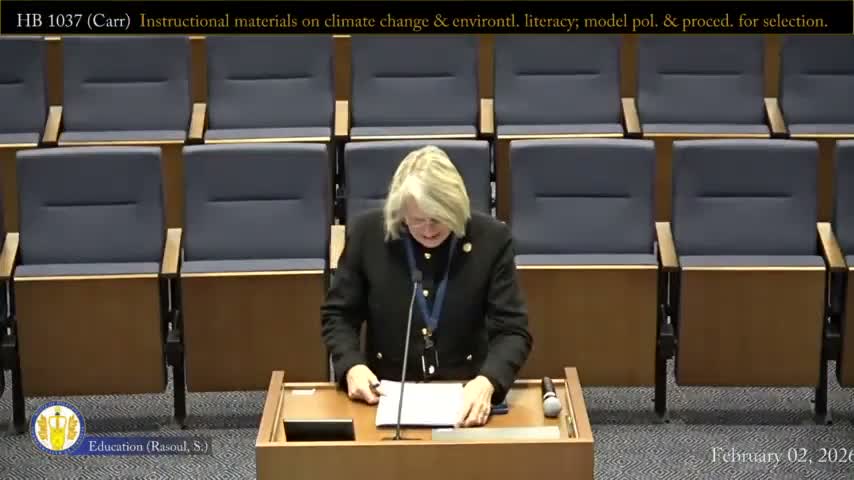
Summary
The House K‑12 subcommittee reported House Bill 1037, which would direct the Department of Education to produce materials on environmental education and literacy for local school boards; supporters cited benefits for critical and systems thinking while some public commenters raised unsubstantiated claims about geoengineering and opposed the framing of 'environmental literacy.'
The House K‑12 subcommittee on Feb. 3 reported House Bill 1037, which would direct the Department of Education to create materials for local school boards on environmental education and literacy. Delegate Carr, the bill’s patron, told the committee the measure would “promote environmental literacy” to prepare students for a changing climate and to strengthen STEM and workforce readiness.
The committee heard several witnesses. Jay Ford of the Chesapeake Bay Foundation urged support, saying environmental education “increases critical thinking, [and] systems thinking” and helps raise the next generation of leaders across sectors. An online speaker, Dot Walton of the Virginia Education Association, said HB 1037 would allow a nationally awarded climate-change curriculum to be shared across the Commonwealth.
Opposition testimony included Dr. Sheila Fury, who said the bill was “dishonest” and raised claims about geoengineering, alleged dispersal of aluminum and boron into the atmosphere, HAARP, and other government actions that she said affect weather and insect populations. The assertions were offered as the speaker’s concerns and were not substantiated during the hearing.
Student testimony in favor came from Netra Parashottaman, an 11th grader at Thomas Jefferson High School for Science and Technology, who described creating a mini climate curriculum and urged the committee to equip teachers with resources so climate material could be taught constructively rather than only producing fear.
The committee voted 11–6 to report the bill out of committee. The measure will proceed through the House process and any fiscal or implementation questions will be addressed in subsequent committee work.