Get Full Government Meeting Transcripts, Videos, & Alerts Forever!
Get email alerts on the Data Center Siting topic
No spam. Unsubscribe anytime.
Committee requires tougher local review, assessments for large data centers in SB 552
Summary
SB 552 would require site assessments and public hearings before rezoning or permitting large data centers and ask utilities to disclose transmission/substation needs; the committee adopted amendments raising the threshold to 25 MW and recorded the bill for further consideration.
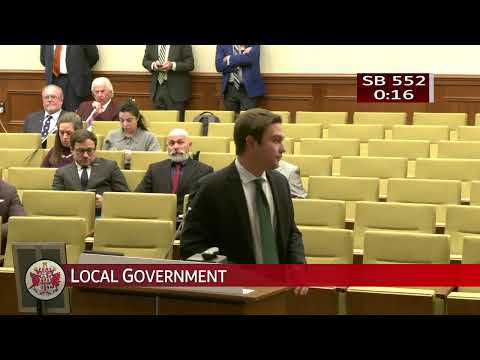
Richmond — The Senate Committee on Local Government advanced SB 552 after hearing testimony about the local and statewide impacts of large, high‑energy data centers and adopting amendments to increase the project threshold and require applicant‑paid site assessments.
Sponsor presentation and purpose: The sponsor (identified in the hearing transcript as speaker 61) described a bill that would require an initial public hearing and a comprehensive site assessment before a locality approves rezoning, a special exception or a special use permit for a covered data center. The site assessment would be filed with the Department of Environmental Quality and evaluate noise impacts on nearby residences and schools, surface and groundwater effects, light pollution, traffic, agricultural and forest impacts, and anticipated electric grid infrastructure needs (substation/transmission upgrades). The sponsor argued the scale of modern data centers and their aggregated electricity use justify the disclosures: the record cites a JLARC estimate that existing data centers used roughly 5,000 megawatts, comparable to the electricity use of about two million Virginia households.
Amendments: Committee members adopted amendments to raise the covered‑project threshold (from 1 MW in earlier drafts to 25 MW), and to require that costs for site assessments be borne by the applicant rather than ratepayers. The sponsor emphasized the bill is designed to give localities and citizens clearer information about water, power and other impacts before approvals.
Support and opposition: Support came from conservation and farmland advocates, who said more information and public hearings are appropriate. Opponents included the data‑center industry and some labor and commerce groups, who called the bill duplicative of existing local authority and warned it could impose new layers of state process on one industry.
Committee action: The committee recorded a roll and reported SB 552 with the adopted amendments. The transcript documents both the amended motion and the recorded roll entry; further administrative and agency coordination (DEQ, utilities) was discussed as follow up.
What this leaves open: The bill requires more detailed site assessments and utility disclosures, but it delegates mitigation and final determinations to local approvals and possible follow‑on DEQ review; sponsors and industry representatives differed on whether the bill creates new state‑level bureaucracy or provides useful information for local decisions.
Provenance: Discussion of SB 552 is anchored beginning at SEG 4369 through the committee report recorded around SEG 4591 in the transcript.