Bill would let courts order parents into services at shelter‑care hearings; supporters say it keeps children safe, opponents warn of service gaps
Loading...
Summary
Senate Bill 6,308 would permit courts to order parents of young children released at shelter‑care hearings to participate in services or evaluations necessary to maintain safety in the home, and prevent those conditions being used as admissions of abuse at fact‑finding; proponents say it preserves children safely at home, opponents and in‑home providers say services and access are insufficient.
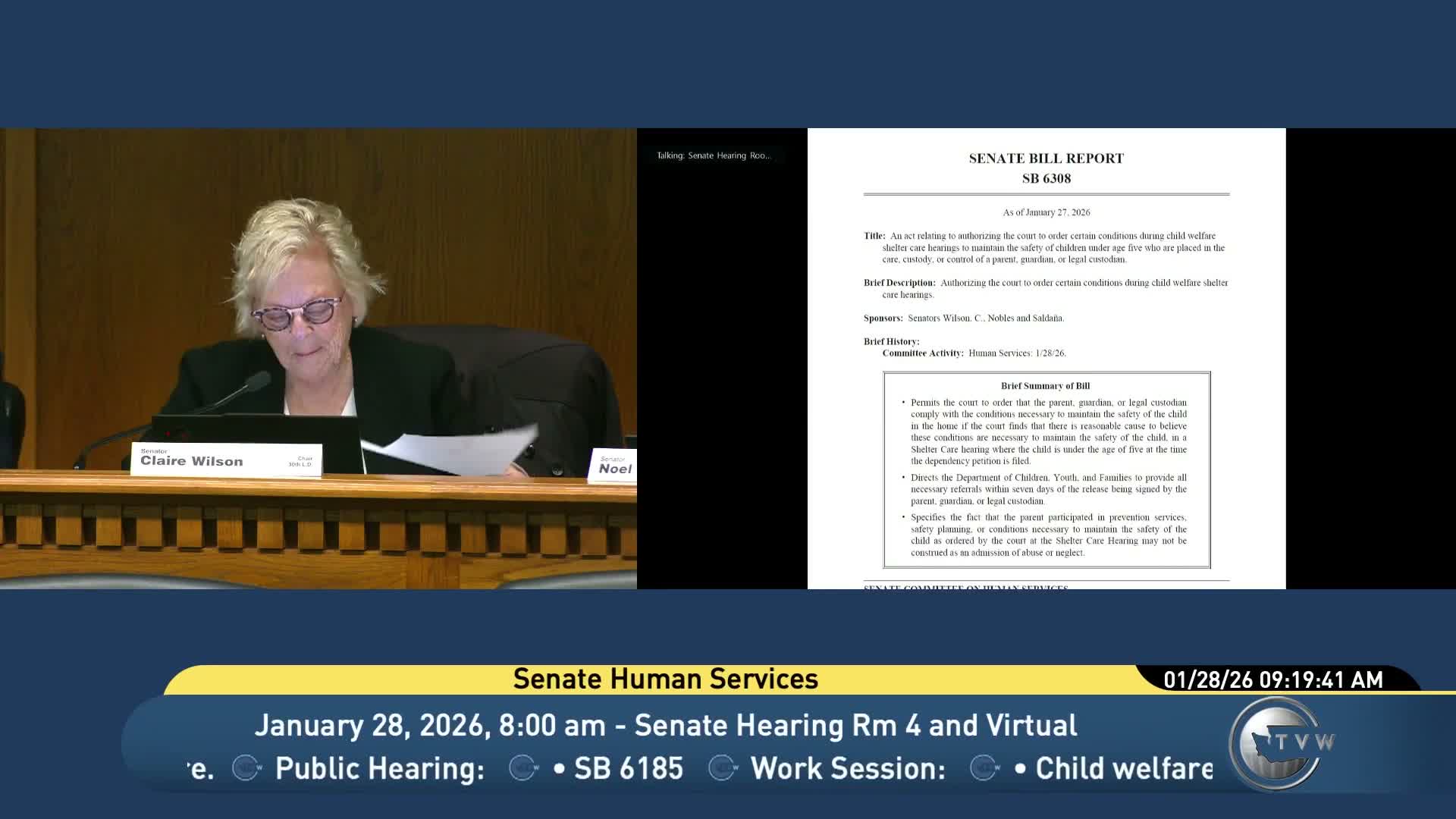
Senate Bill 6,308, briefed and discussed during the committee’s morning session, would authorize courts at shelter‑care hearings to order certain conditions — including participation in services or evaluations — when the court finds reasonable cause that such conditions are necessary to maintain the child’s safety in the home. The bill would also prohibit courts from treating participation in services ordered at shelter care as an admission of abuse or neglect at a later fact‑finding hearing and instructs DCYF to provide referrals within seven days.
Julie Watts, representing DCYF, told the committee the agency supports this bill as a tool to prioritize child safety while allowing children to remain at home when appropriate, provided referrals are timely and services are culturally appropriate and accessible. “The goal of this bill is to ensure that if a court is considering placing a child back in the home at a shelter care hearing, the court can order the parent to engage in evaluations and services if those are necessary to maintain the safety of the child in the home,” Watts said.
Supporters — including Partners for Our Children and Family Impact Network — argued that providing swift, court‑ordered referrals to therapeutic services can reduce trauma associated with removal and increase participation. Clinicians and researchers recommended pairing statutory changes with funding for substance‑use treatment, medications for opioid use disorder, family‑style residential options and peer supports.
Opponents and some in‑home providers cautioned the bill as written risks leaving children without protection if services are unavailable, inconsistently delivered, or if parents do not engage. Christina Johnson, an in‑home provider, said many families do not consistently engage in weekly in‑home services, and that leaving an unsafe child in place can compound harm. Amy Parks said the bill, as limited to very young children in some versions, could leave older children at risk.
Witnesses repeatedly urged that any expansion of court authority be matched by clear timelines for referrals, inclusion of in‑home providers in stakeholder workgroups, access to legal counsel and funding to expand available services. The committee did not take a vote during this session.